
Contributed by Laura Fischer | Principal team lead for climate resilience analysis at EPRI
Edited by Paul Gerke
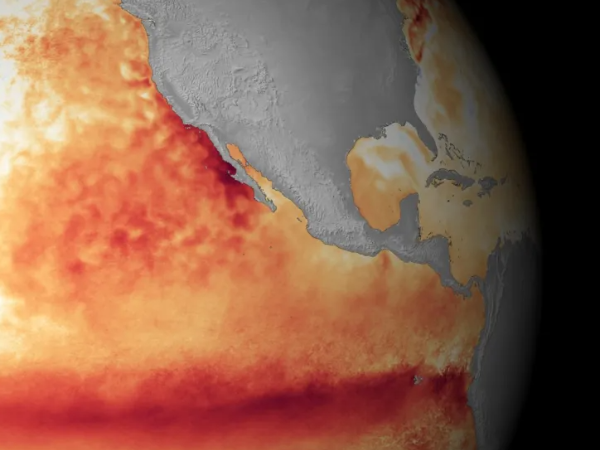
As climate scientists continue to track a strengthening El Niño into late 2026, familiar headlines are surfacing in the United States: wetter winters in some regions, fewer Atlantic hurricanes, and renewed drought concerns in parts of the West. Internationally, as Europe endures record-breaking summer heatwaves, the United Kingdom’s national meteorological service predicts this El Niño could be the strongest in living memory.
For the power sector, the question is not whether El Niño will produce a single, predictable outcome. It will not. A strong El Niño does not guarantee extreme weather, nor does it affect every region in the same way. Instead, it shifts the odds of certain weather patterns, providing a seasonal climate signal that utilities can incorporate into planning alongside other risks.
El Niño’s value lies not in predicting specific storms, droughts, or grid events, but in helping energy planners ask better questions earlier, :
- Where could water availability tighten?
- Where could reservoir management become more complex?
- Where might flood risk rise?
- How should load forecasters adjust expectations?
- How should operators prepare for a range of outcomes, not just the most ly one?
A Climate Signal with Operational Relevance
The El Niño-Southern Oscillation, or ENSO, is the planet’s dominant driver of year-to-year climate variability. In its warm phase, El Niño influences the Pacific jet stream and redistributes heat and moisture patterns across regions.
In North America, El Niño is commonly associated with reduced Atlantic hurricane activity due to increased vertical wind shear and milder summer conditions in parts of the Southeast. However, those tendencies do not eliminate risk. Atlantic hurricane counts may be lower during El Niño years, but storm severity is not guaranteed to be lower. Major hurricanes have occurred during El Niño phases.
For utilities, most of the actionable implications are often water-related. El Niños can contribute to wetter conditions in California, the Southern Rockies, and parts of the Southern U.S., while increasing the lihood of warmer, drier conditions in the Pacific Northwest. These regional shifts can influence hydropower generation, reservoir operations, flood management, vegetation growth, and seasonal resource planning.
Hydropower Impacts from El Niño
In regions with a wetter signal, improved reservoir levels can boost hydropower output and support broader water supply needs. At the same time, excessive precipitation can create operational challenges, including flood control requirements, reservoir overtopping risks, and the need to ensure hydropower facilities are available to help manage high-flow conditions.
In contrast, a warmer and drier Pacific Northwest could put pressure on hydropower resources, especially if low winter snowfall limits runoff. This risk potential is not uniform across the region. Large reservoirs may have the flexibility to draw down lake levels and manage storage over longer periods. Smaller energy systems may manage their resources differently, shifting toward water-management roles while other generation resources, imports, or thermal units help offset reduced hydro output.
The exposure also depends on local factors, including reservoir size, basin hydrology, operational requirements, transmission constraints and costs, environmental releases, irrigation needs, municipal water supply obligations, and the broader generation mix. For that reason, El Niño’s hydropower implications are best assessed at the site, basin, and regional level rather than through broad national generalizations.
Wildfire Risk Assessment and Load Impacts
El Niño’s influence on landscape conditions often extends beyond the rainy season. Utilities, land managers, and emergency planners can use El Niño-informed outlooks to anticipate increased fuel growth from wetter conditions, assess the potential for elevated wildfire risk as vegetation dries, and adjust inspection and mitigation activities within their planning cycles accordingly.
El Niño’s load impacts are real, but should not be overstated. Historical patterns suggest that El Niño years may bring milder summer conditions in parts of the U.S. Southeast compared with La Niña years, which have been associated with more frequent high-temperature extremes in some regions. This could decrease electricity demand in some regions.
That does not mean El Niño eliminates heat risk. Global temperatures tend to rise during El Niño years, and today’s warmer baseline means cooling demand can remain elevated even when regional seasonal patterns are milder than usual.
A Planning Input, not a Deterministic Forecast
For load forecasters, ENSO is not a tool for predicting day-ahead extremes. It is more useful for understanding seasonal tendencies. Utilities may use that information to adjust expectations for summer cooling demand, winter and shoulder-season maintenance planning, and resource adequacy studies, while still preparing for less ly but high-impact outcomes.
El Niño provides a signal, not certainty. Even during strong ENSO phases, regional weather can diverge from expectations. Other climate patterns, background warming, ocean temperatures, and local conditions can amplify, mute, or complicate the expected impacts.
El Niño does not eliminate the need to prepare for extreme outcomes. Its value lies in narrowing the range of more ly seasonal conditions, helping planners evaluate and prioritize potential scenarios. Utilities should incorporate possible El Niño impacts into a broader risk management framework that already considers aging infrastructure, load growth, rate pressures, extreme weather, resource adequacy, transmission constraints, and operational flexibility.
What Utilities Can Do Now
A strong El Niño outlook gives utilities several areas to examine, including:
- Hydropower and reservoir planning: Assess basin-level water availability, runoff expectations, reservoir operating constraints, flood-control needs, and generation flexibility.
- Flood preparedness: Evaluate whether wetter regional outlooks could increase operational risk at dams, substations, rights-of-way, or other critical infrastructure.
- Load forecasting: Incorporate ENSO-informed seasonal tendencies into long-range demand expectations without using them as a proxy for short-term weather forecasting.
- Wildfire preparedness: Consider whether wetter conditions could increase fuel growth and whether a subsequent hot, dry period could elevate local wildfire risk.
- Storm planning: Recognize that Atlantic hurricane activity may be less frequent during El Niño, while still preparing for severe storms that can occur despite that broader tendency.
- Resource adequacy and operations: Use El Niño as one input in stress-testing portfolios, import needs, transmission availability, and operational reserves.
If the 2026-2027 El Niño strengthens significantly, it could become an important assessment of how utilities use seasonal climate information.
Operators cannot predict every storm, heat wave, drought, or flood, but they can use better climate intelligence to prepare for a more informed range of possibilities, increasing the resilience of the power system.
About the author

Laura Fischer is a Principal Team Lead for Climate Resilience Analysis at EPRI and leads research on the physical impacts of climate change on the electric power system.
She currently manages Program 262: Climate Risk and Resilience, having previously served as Lead for Workstream 1, Physical Climate Data and Guidance, for EPRI’s Climate Resilience and Adaptation Initiative (READi). Laura was an author for the Adaptation chapter and Technical Contributor for the Energy chapter of the Fifth National Climate Assessment.
Before joining EPRI, she was an ORISE Fellow with the Climate Change Adaptation staff at the US Environmental Protection Agency (EPA), where she researched how climate change affects EPA programs and identified adaptation strategies being implemented to mitigate these impacts.
Sumber Artikel:
Renewableenergyworld.com