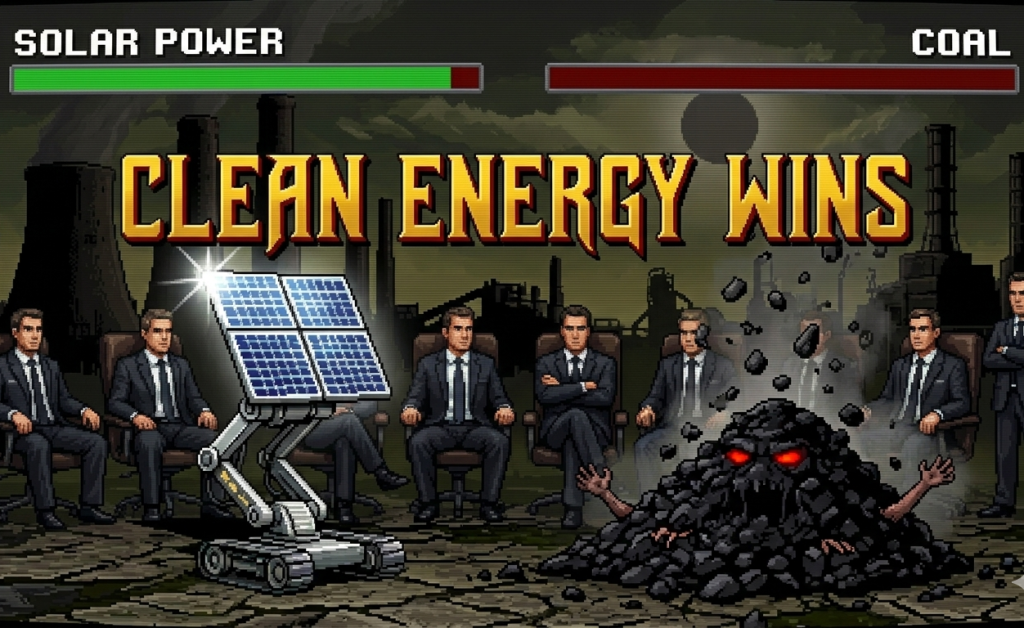

Clean energy fought the law, and clean energy won.
Despite constant pressure on multiple fronts from the Trump administration- including but not limited to pushing false “clean coal” rhetoric, undercutting tax credits, and literally paying companies to walk away from offshore wind leases- carbon-free power sources not only continue to come online, but comprise more and more of our electrical system.
The United States drew more power from solar panels than from coal generation plants in May, the first time that’s ever happened. Solar accounted for 12.8% of all U.S. electricity last month, while coal contributed a near-all-time low of 12.2%. Solar and battery energy storage represented 91% of new capacity added to the U.S. grid in the first quarter of 2026, including 7.8 gigawatts (GW) of new photovoltaic capacity, despite back-and-forth federal policies and an uncertain regulatory climate. In a particularly interesting wrinkle, states won by President Trump accounted for 74% of all solar capacity installed in Q1 2026; Texas, Florida, Ohio, Indiana, Michigan, Arizona, and Mississippi all rank among the top 10 states for new solar additions. The U.S. now boasts more than six million solar farms nationwide.
The pace of deployment will slow as federal incentives phase out, but the market is sending a strong signal now: Cost and speed-to-power matter more than anything else. Not everyone cares about “clean and green,” but when one type of technology is less expensive and can get a project online faster than another, that’s where money will flow, tax credits be damned. Look no further than Cypress Creek’s $3.5 billion financing of a complex, three-stage Arkansas project, with a “big tech” offtaker lined up for its first two phases. Investors have the stomach to plunk billions into clean tech to enable deep-pocketed developers, and there’s no sign they won’t continue to do so.
“In a world of fluctuating fuel prices, energy buyers have made it clear that they want the security, low cost, and speed of solar and storage,” concurred Darren Van’t Hof, interim president and CEO of the Solar Energy Industries Association (SEIA). “Yet, as power demand skyrockets, political and regulatory attacks are slowing down the exact resources we rely on. Impeding the only sector that is actively building new power is a reckless gamble that will only drive electricity bills higher. The stakes are simply too high for Washington’s permitting gridlock to continue.”
Trump campaigned on promises to address electricity demand growth by cutting regulatory red tape and speeding up permitting, but hasn’t delivered, instead throwing up myriad roadblocks. What will it take to convince the administration that solar and storage are the future… And the future has arrived?
Welcome to the Factor This Brief, a weekly collection of energy industry finance and development updates, delivered straight to your inbox on Monday mornings and hosted in a not-so-brief fashion here on Factor This, featuring the people, projects, and technology driving our electric future.
Thanks for checking it out. If you what you see or want to recommend a story for next week, drop me a line. In the meantime, may your next bowl of cereal stay crunchy for way longer than you expected.
PJM Adds Largest Standalone Storage Site
PJM Interconnection, the largest grid operator in the United States and a frequent punching bag for everyone who has an opinion about how the people who work there can do their jobs better, is adding the largest-ever standalone energy storage asset to its system.
Last Thursday, Elevate Infrastructure and investor ArcLight Capital Partners celebrated the ribbon-cutting of the now-operational Prospect Power Storage, a 150 Megawatt (MW) / 600 Megawatt-hour (MWh) battery energy storage system (BESS) in Rockingham County, Virginia.
“Today marks an important milestone for Elevate and for Virginia’s energy future,” observed Joshua Rogol, CEO of Elevate. “Prospect Power demonstrates how Elevate executes utility-scale battery storage at scale to strengthen grid reliability, support economic growth, and help meet the increasing energy needs driven by data centers, artificial intelligence, and electrification.”

“Battery storage is playing a growing role in supporting a reliable, resilient, and diverse grid,” added Stu Bresler, COO of PJM. “This project increases battery storage capacity within PJM by more than 50%, marking a significant milestone for energy storage in our region. Resources this add flexibility to the grid and help support reliability as demand continues to grow.”
Prospect Power is fully contracted under a 15-year power purchase agreement (PPA) with local utility Dominion Energy Virginia. Beyond its contributions to grid reliability, the BESS is expected to deliver lasting benefits to Rockingham County through revenue-sharing payments and property tax contributions.
ArcLight and Elevate acquired Prospect Power in January 2026. Its completion marks the latest milestone in Elevate’s expanding platform. In March, the New Jersey Board of Public Utilities selected the company’s 150 MW / 600 MWh Garden State Reliability Project as part of the Garden State Energy Storage Program. In April, Elevate closed a $50 million Energy Transition Supplier Finance Facility supporting a solar and battery storage project contracted to power a data center, and the company also submitted 7,600 MWh of new battery energy storage into the latest PJM queue process.
Distributed Solar and Storage Pipeline Attracts $300M Investment
Nexamp, the largest fully-integrated distributed generation and community solar provider in the U.S., has closed on a $300 million aggregation securitization facility with Crédit Agricole CIB that will support the deployment of distributed solar and energy storage projects in its pipeline. The construction-to-term facility offers Nexamp a scalable, flexible source of project-level funding suited to the volume and pace of its DG deployment aspirations.
“This facility underscores the strength of Nexamp’s long-standing business model and the growing recognition of distributed solar and storage as a mature, attractive asset class,” noted Zaid Ashai, CEO of Nexamp. “By pairing competitive construction financing with flexible takeout options, we can move faster to deliver the power that communities and businesses need—while opening the door for a wider range of institutional investors to support the energy transition.”
According to Nexamp, the aggregation securitization facility will be used to finance a diversified portfolio of community solar, commercial and industrial (C&I), and other distributed generation and storage assets across multiple regions. These projects will provide locally sited, flexible capacity that supports grid reliability, helps mitigate congestion, and expands access to energy savings for households, businesses, and public sector customers.
Now with More Geysers?
Calpine, a business unit of Constellation, has announced the completion of a 25 MW expansion project at The Geysers geothermal complex in Sonoma County, California. The addition s the completion of a 38 MW energy storage system at the site in 2024. The new capacity will generate enough electricity to power over 25,000 homes each year.
“As California’s electricity demand continues to grow, investments in reliable, around-the-clock renewable energy are more important than ever,” assessed Aimee Blaine, senior vice president of Calpine’s geothermal region. “The Geysers is one of the nation’s most important geothermal resources, and this expansion reflects our commitment to strengthening grid reliability while advancing California’s clean energy goals.”
The Geysers is the world’s largest operating geothermal complex, generating electricity by tapping natural steam reservoirs deep beneath the earth’s surface. For more than 65 years, the site has provided clean, geothermal energy across California. Of the 25 MW expansion, 18 MW will be directed to Clean Power Alliance (CPA), which serves customers across Southern California, providing reliable, around-the-clock renewable power as demand for clean electricity continues to grow. The remaining 7 MW, which were brought online last year, are being supplied to MCE to support Bay Area residents and businesses.

“Clean Power Alliance is committed to delivering dependable clean energy to our customers, and geothermal power plays an important role in providing around-the-clock renewable electricity,” said Matthew Langer, chief operating officer at Clean Power Alliance.
The recent expansion was completed under a Project Labor Agreement (PLA) with local labor unions, ensuring the work was performed by a highly skilled craft workforce under strong labor standards.
Community Solar Portfolio Lands Tax Equity Financing
Distributed independent power producer (IPP) GS Power Partners has closed on more than $51 million in tax equity financing from funds managed by AB CarVal to support an approximately 41 MWdc portfolio of eight community solar projects in New York, Maryland, and Illinois.
The transaction is part of a broader tax equity partnership between Greenprint Capital and AB CarVal, through which Greenprint structured and executed the financing. In addition to expanding access to affordable clean energy, the projects are expected to generate long-term economic benefits for the communities that host them.

“Distributed generation tax equity portfolio transactions are financial milestones that reflect the sophistication and creativity we bring to bear,” said Nick Kamphaus, General Counsel of GS Power Partners. “Closing this complex financing across three states underscores our strength in connecting capital to productive energy projects, and our commitment to delivering DG solar assets that meet the highest standards of compliance and accountability.”
CRC-IB acted as financial advisor to GS Power Partners. Stoel Rives LLP served as legal counsel to GS Power Partners, and Leverage Law Group acted as legal counsel to Greenprint Capital.
Big Battery Comes Online in Arizona
EDP Renewables North America and Salt River Project (SRP), a not-for-profit public power utility serving more than 2 million people in central Arizona, are celebrating the completion of Flatland Energy Storage, a 200 MW / 800 MWh BESS in Coolidge, Arizona.
Located in Pinal County, Flatland Energy Storage will enhance grid flexibility and improve energy reliability in the region. Flatland Energy Storage is the largest BESS within the EDP Group, with the capacity to power approximately 44,500 Arizona homes.
“Energy storage plays a critical role in maintaining a reliable and resilient electric grid, especially as demand continues to grow,” said Sandhya Ganapathy, CEO of EDP Renewables North America. “Projects Flatland Energy Storage ensure power is available when it’s needed most, while also delivering meaningful, long-term benefits to the communities that host them.”

“Flatland Energy Storage is part of SRP’s all-of-the-above approach to providing reliable, affordable, and sustainable power to our customers,” added Bobby Olsen, SRP associate GM and chief power system executive. “SRP will continue to invest in battery energy storage resources as part of its growing resource portfolio.”
Flatland Energy Storage represents more than $20 million in local and regional economic impact over its lifetime, including $19.2 million in revenue to support local public services and infrastructure, more than $1.3 million in regional spending, and approximately 142 jobs during construction.
EDPR NA’s nearly 600 MW portfolio in Arizona includes Sun Streams Solar (158 MW), Brittlebush Solar (200 MW), and Table Top Solar & Energy Storage (96 MW solar and 96 MW BESS).
Sumber Artikel:
Renewableenergyworld.com