
by Jeniffer Solis, Nevada Current
A proposal to build a hydroelectric power plant near the Red Rock Canyon National Conservation Area won preliminary approval from federal regulators earlier this month.
The Desert Bloom Project is a large-scale, closed-loop pumped storage proposal that promises to produce 1,170 gigawatt-hours of power annually – or enough electricity to power approximately 850 million homes – as developers race to meet growing energy demand and build new power generation stations.
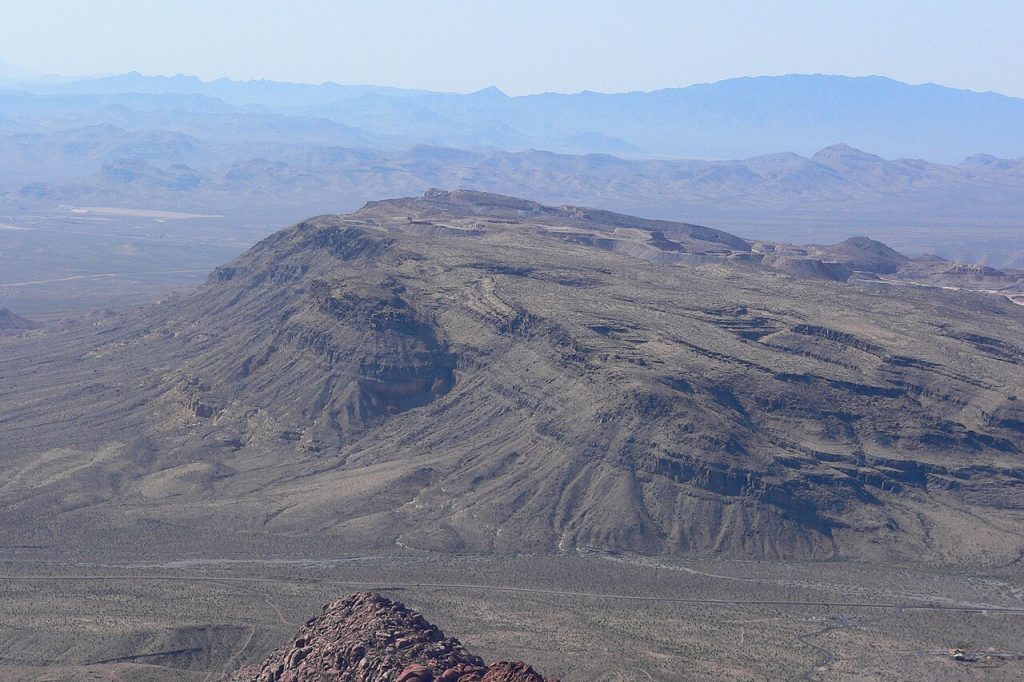
On May 4, the Federal Energy Regulatory Commission (FERC) issued a preliminary permit for the Desert Bloom Project, which would be located on public land adjacent to the Red Rock Canyon National Conservation Area on Blue Diamond Hill, about 15 miles southeast of Las Vegas, Nevada.
The permit does not authorize developers to move dirt or build anything at the proposed site, it only gives Desert Bloom Energy Storage, LLC, approval to study the feasibility of the project.
Pumped storage projects require massive amounts of water to generate hydroelectric power, which is achieved by pumping water uphill to a reservoir, then sending it back down to another reservoir through electricity-generating turbines during peak energy demand.

The proposed project would require 9,800 acre-feet of water stored across two reservoirs, about as much water as 5% of the total consumptive use across the Las Vegas Valley Water District’s service area last year.
It’s unclear how many acres in total the project would encompass or how Desert Bloom Energy Storage, LLC plans to acquire the water they need to complete the project. In the project proposal, the company notes the water used to fill and refill the reservoirs “will either be hauled or piped in from a yet-to-be-determined source.”
The Las Vegas Valley Water District, which serves the area, said the project is out of step with Southern Nevada water conservation policy.
“Southern Nevada has invested decades of work into reducing water use and stretching limited Colorado River resources. A project that will consume approximately 10,000 acre‑feet (about 3 billion gallons) of water simply does not align with Southern Nevada’s conservation goals. The priority is safeguarding community water supplies through efficient water use—not expanding large-scale water consumption,” said Bronson Mack, a spokesman for the Las Vegas Valley Water District, in a statement.
Daniel Greenwell, the Desert Bloom Energy Storage contact on the FERC paperwork, could not be reached for comment.
This is not the first time a pumped storage project has been proposed at the site. Various developers have explored pumped-storage projects on Blue Diamond Hill near the Red Rock Canyon National Conservation Area since at least 1989.
The Blue Diamond South Pumped Storage Power Company and Blue Diamond Power Partners Limited Partnership previously sought to develop a 200-megawatt hydroelectric project in the area.
Regulators issued a final environmental impact study for that project proposal in 1996 and licensed the project a year later, but regulators later terminated the project in 2005 due to lack of construction.
More recently, a company called Control Technology Inc, proposed a pumped storage plan nearly identical to the Desert Bloom Project in 2017. That proposal, dubbed the Blue Diamond Project, advanced to the scoping phase, but was ultimately rejected by regulators in 2024 after the company repeatedly missed deadlines.
That project was also panned by the Southern Nevada Water Authority, which determined it would have to reevaluate its entire resource plan to accommodate the project, a massive task for the strapped water district.
At the time, the Southern Nevada Water Authority noted in FERC filings that the water required for the project was “equivalent to the water needed to serve the entire Las Vegas Valley Water District’s service area for an average of 11 days” and would take about 420 days to completely fill the proposed upper and lower reservoirs.
The Bureau of Reclamation signalled they would not approve the project if the company could not acquire water rights due to the sensitivity of the area. The BLM noted that the area was home to the threatened Mojave Desert tortoise and three sensitive plant species, including the yellow two-toned penstemon, rosy two-toned penstemon, and Blue Diamond cholla.
“Any BLM decision to authorize your hydropower project prior to the approval of the use of State water resources would result in unnecessary and undue degradation of public lands,” BLM wrote in a 2022 letter for the Blue Diamond Project.
Jim Rodes, a major real estate developer who owns thousands of acres near the proposed project site where he once tried to build a master community, also expressed concerns about water usage for the project in a letter to regulators.
Control Technology Inc. attempted to revive the project again in 2024, but was once again rejected by regulators, who explained the project was identical to the project they proposed previously and was led by the same company and thus would not be reconsidered.
The new, nearly identical Desert Bloom Project, was filed with FREC under new leadership and is eligible to be considered.
The project has attracted opposition from the Center for Biological Diversity, which argues the Las Vegas Valley groundwater basin is already overappropriated, meaning there are more water rights issued than there is annual recharge. Last year, the conservation group intervened in the terminated Blue Diamond Project.
“Just we oppose Jim Rhodes putting a whole city on Blue Diamond Hill, we oppose a huge reservoir and industrial development on Blue Diamond Hill,” said Patrick Donnelly, the Great Basin director for the Center for Biological Diversity. “It’s on our radar because, fundamentally, pump storage is not appropriate for the desert. This is not how we need to be using our water in the West.”
Donnelly said it’s ly a full environmental review of the project would reveal substantial obstacles to final licensing, including severe impacts to Red Rock Canyon National Conservation Area.
“I think these guys are banking on the fervor about the energy emergency,” said Donnelly of the developers. “It’s just surprising. Given all the headwinds this project faces, it seems the least plausible project to get permitted anywhere in the state.”
Nevada Current is part of States Newsroom, a nonprofit news network supported by grants and a coalition of donors as a 501c(3) public charity. Nevada Current maintains editorial independence. Contact Editor Hugh Jackson for questions: [email protected].
Sumber Artikel:
Renewableenergyworld.com