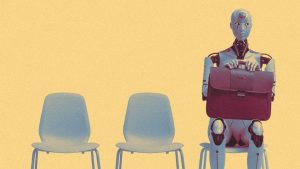
The AI era is fully here—and while companies bill it as a solution to problems, caveats mass layoffs, environmental effects, privacy concerns and the sloppification of culture have many people fed up with something they never desired in the first place.
The technology faces growing resentment from workers, who are being urged to embrace AI tools even as companies have rushed to reduce their workforces in favor of automation.
Online, many posts about AI have a common refrain: no one asked for these tools or the disruptions they’re causing.
“Nobody asked for Google to be worse—but AI made it happen,” one X user recently remarked. “No one asked for computer hardware costs to rise—but AI made it happen. No one asked for human customer service to be replaced—but AI made it happen.”
In another post, Sarah Hoyt, a science fiction, fantasy and mystery author, said she doesn’t hate AI, but is “begging all the crazy people out there to stop pushing AI where no one asked for it.”
The disenchantment plays out in the data: In 2019, 81% of Glassdoor reviews mentioning AI were positive, the company said, compared to 43% this year. Meanwhile, Pew Research found that 52% of Americans were more concerned than excited about AI, up from 37% in 2021; and in an Ipsos poll from June, 67% of respondents thought AI would worsen the worker experience.
“The closest analog is the replacement of physical labor throughout the long Industrial Revolution,” said Jiemin Tina Wei, an assistant professor of history at Florida International University. But in this case, it’s “brain work,” rather than manual labor, that’s being replaced.
“And now, the industries that are getting allegedly wiped out are the ‘low-hanging fruit’ of white-collar work,” she said.
But livelihoods being gutted isn’t the only reason many are anti-AI.
The productivity paradox
Louis Hyman, a historian at Johns Hopkins University who specializes in labor and the American economy, points to a “productivity paradox”: a contradiction that was also generally true of the rise of computers in the ‘80s, in which similarly dizzying investments didn’t necessarily make people better at their jobs as promised.
Hyman points to snags the frequency of software updates: that “every time you learn how to do something, suddenly they break it, and you have to relearn it.” With the introduction of AI, it’s “as if all software is being updated, all at once, everywhere.”
Another part of the equation, he said, is that it isn’t clear how some people are using AI tools.
Hyman said he uses AI to write software and automate “boring tasks”—for example, he wrote a script to rotate the thousands of photos he takes in archives so they all face right-side-up. But, he said, “most people are not wanting to sit down and write Python code to automate their job. They just want to do their job.”
Added to that is the deep fear of being replaced once the work is automated.
“I’m a tenured professor—I literally can’t be fired,” he said. “If I automate some boring part of my job, that just means I have more time to do the more interesting parts of my job. And that’s not true for all people, right?”
A new occupational hazard
Another reason many people push back on AI is the lack of adequate guardrails—especially when it could cause major issues at work.
In one case, an AI tool deleted a software company’s entire database. In another, AI was blamed for deleting an entirely edited season of a Swedish reality show mere weeks before the scheduled premiere. In medical settings, AI scribes have put inaccurate information in patient records, raising the question of who would be held liable for resulting medical errors.
Meanwhile, misreads by AI identification tools used by law enforcement have led to wrongful arrests and injuries, per the MIT AI Risk Initiative. Other AI-generated errors have popped up in court documents, federal reports, news stories and fast food drive-thrus.
“The main point I’ve pushed and will continue to push re: AI is ‘no one asked for this,’ ” radio host Adam Xii said on X, in response to news that Anthropic hallucinated details in their defense during a music copyright lawsuit. “So when a product or service no one asked for suddenly becomes ubiquitous, one must ask: why? Because AI tools are meant to generate more wealth for the wealthy at the expense of creatives.”
At the least, AI’s convenience is being offset by a need to check its work that has created new opportunities for human error. The proliferation of “workslop” even led a tech company’s CEO to fully ban AI use, as Inc. reported this summer.
“A lot of what I’ve seen is kind of annoyance at the proselytizers at work—or the people who are heavy adopters—creating a lot of extra work for the people around them,” because those people downstream then have to check the work, said Wei.
Wei said that content moderation and data annotation work “can be extremely mentally taxing.” Research has found that “good” challenging work will be both difficult and interesting to certain extents, she said. But checking output is both difficult, because you have to look for every small potential error, and boring.
“You’re not producing knowledge, but merely supervising the production of words, knowledge, content,” Wei said.
The unwanted technological advances continue
AI’s intrusive nature—accompanied, again, by the threat of replacement—is reflected in workers’ behavior, not just in fed-up storms. One report found that nearly a third of workers surveyed, and 44% among Gen Z, had tried to sabotage their companies’ AI strategies.
Section, an AI planning and upskilling company, recently reported that 69% of workers surveyed said their organization had encouraged the use of AI agents, but only 16% actually used them. Thirty-eight percent said they use other AI features.
The frustration hasn’t seemed to deter tech companies.
“We heard you wanted Copilot Mode at work,” read an X post from Microsoft that promoted Edge’s Copilot Mode for Business.
“No, you heard wrong,” a computer technician replied. “Literally no one asked for all this AI. In fact, everyone wants to know how to remove it.”
Questions of organizations
In some cases, it seems companies are starting to discover that automation has some shortcomings.
In the U.S., 32% of hiring managers who eliminated positions in favor of AI have had to reinstate the same or similar roles, according to research from consulting firm Robert Half. Similarly, Gartner, Inc. predicts that by 2027, half of companies that attributed reductions in staff to AI will rehire people to perform similar work.
Wei said the mismatch between the hopes for AI and the reality of its adoption relates to a quote from Bill Haywood, a famous labor organizer, who said that “the manager’s brains are under the workman’s cap.”
In other words, she said, “it’s really ultimately the workers who possess the knowledge and the know-how to run day-to-day operations. Some people have argued that the history of labor is just managers trying to take back that knowledge in an attempt to replace workers in the production.”
“And I guess some people experience AI that way—that it’s being [imposed] upon them so that they train, ultimately, their final, automated replacement.”
Hyman said that a better alternative to the “adapt or die” mentality would be for organizations to use the technology to empower their employees. They should “actually say, ‘okay, we’re gonna create organizational conditions that let you replace yourself, and then focus on the work that needs to be done’—because the amount of work to be done is not finite, right?”
“I get told on a nearly weekly basis that historians are going to be replaced,” Hyman said. “So, yeah: it depends on how valuable you think getting reliable information and history is.”
He added that a world “where the only source of history or journalism is from either Open AI or Anthropic” would feel an “Orwellian nightmare.”
“That seems not a great road to go down,” he said.
Sumber Artikel:
Fastcompany.com