

 Fayez Nureldine/AFP via Getty Images
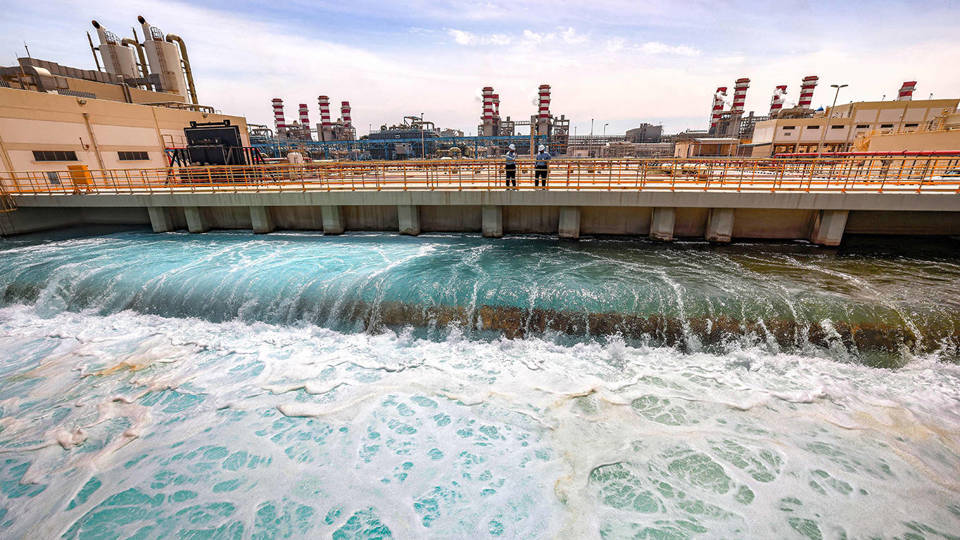
While the rest of the world is mainly concerned about the energy disruptions caused by the Iran war, the Gulf countries are more anxious about the Islamic Republic’s threats to their desalination facilities. If the US attempts to seize Kharg Island, it could spell disaster for the region’s “saltwater kingdoms.”
Listen to this commentary Please log in to listen to this commentary 0:00 / 0:00 Audio unavailable
That same day, Israel bombed some 30 oil depots in Tehran and nearby Alborz province. Oil spilled into streets as a dark haze of smoke and toxic fumes engulfed the capital city. Iran has since responded by widening its targets across the region. On March 8, Bahrain reported that Iran had caused “material damage” to one of its desalination plants, although authorities clarified that there had been “no impact on water supplies or water network capacity.”
The war has since escalated. Strikes from both sides have hit all types of civilian infrastructure, from hotels to airports, erasing nearly every pre-existing taboo and redline. Among the most concerning are strikes on or near nuclear facilities. Iran has targeted the town of Dimona, just miles from the Shimon Peres Negev Nuclear Research Center. Israel struck near Iran’s nuclear power plant in Bushehr, forcing Russian Rosatom staff to evacuate, and, more recently, attacked Iran’s uranium processing facility in Yazd and Khondab Heavy Water Complex.

Secure your copy of PS Quarterly: Winners & Losers – and $20
In the new issue of our magazine, leading thinkers examine how recent developments, from the AI revolution to intensifying geopolitical volatility, are reshuffling the economic and financial deck and generating new winners and losers across the global economy.
Subscribe to PS Premium now, with a $20 discount, to read the issue, featuring Claudia Goldin, Mark Blyth, Dambisa Moyo and others.
Subscribe Now
But global attention is squarely focused on fossil-fuel infrastructure. On March 25, French Finance Minister Roland Lescure said that 30-40% of the Gulf’s refining capacity has been damaged or destroyed, removing 11 million barrels per day from the international market and triggering an oil crisis, particularly in Asia. Moreover, Iranian strikes on Qatar’s Ras Laffan facilities have wiped out 17% of the country’s liquefied natural gas export capacity.
As oil prices surged and the Strait of Hormuz remained largely shut, US President Donald Trump issued a stark ultimatum on March 21, threatening to “obliterate” Iran’s power plants if the country did not reopen the strait within 48 hours. In response, Iranian military spokesman Ebrahim Zolfaqari warned that the Islamic Republic would retaliate by striking regional infrastructure, including “water desalination facilities.”
Shortly afterward, pro-regime Telegram and social-media channels began circulating a chilling list of potential targets, including Saudi Arabia’s Ras al-Khair and Shuaiba desalination plants and the UAE’s Taweelah desalination plant and Barakah nuclear power plant. As the Hudson Institute’s Can Kasapoğlu explains, the vulnerability of desalination infrastructure is a different category of risk. Undisruptions to oil markets, which primarily trigger economic consequences by raising prices and constraining supply, striking desalination facilities “directly threatens daily survival in some of the world’s most water-scarce states.”
Facing mounting pressure, Trump abruptly announced a five-day pause on strikes against Iranian power plants just hours before US markets opened on March 23, aiming to steady oil prices; he later extended the deadline to April 6. Despite Trump touting talks with Iran (which the Islamic Republic has denied are taking place), ongoing US military deployments to the region suggest a possible escalation. The Trump administration has also refused to rule out seizing Kharg Island—through which 90% of Iran’s oil exports flow—as part of an all-out effort to cripple the Iranian economy and force the reopening of the Strait of Hormuz.
If the US made such a move, the Gulf countries would ly bear the brunt of retaliation. After earlier US strikes on Kharg Island, Iran accused the UAE of facilitating the attacks. On March 25, Mohammad Bagher Ghalibaf, speaker of the Iranian parliament, warned that if America and Israel occupy an Iranian island with the support of a regional power, “all the vital infrastructure of that regional country will, without restriction, become the target of relentless attacks.” Although Ghalibaf was not explicit, the warning ly refers to the UAE and the islands of Kharg and Larak, but may also allude to the disputed islands of Abu Musa and the Greater and Lesser Tunbs, seized by Iran in 1971.
The Iranian regime is fighting for its survival. It cannot defeat the US or Israel directly, but it can inflict widespread economic pain and strain relations between the US and the Gulf, as well as among the Gulf Cooperation Council’s six members. As the clock ticks down to Trump’s deadline, will the US jeopardize the Gulf’s desalination lifelines in a risky bid to seize Kharg Island and reopen the Strait of Hormuz? If Iran retaliates “without restriction,” the consequences could devastate the Gulf’s saltwater kingdoms.
Featured
-
The Iran War Could Trigger a Global Food Crisis
Mar 13, 2026 Bram Govaerts & Sharon Burke
-
Are We Facing an AI Nightmare?
Mar 10, 2026 Raghuram G. Rajan
-
Trump Is Showing China How to Seize Taiwan
Mar 11, 2026 Brahma Chellaney
-
Is the Stablecoin Economy Structurally Sound?
Mar 13, 2026 Neha Narula
-
The Gulf’s Tough Choices
https://prosyn.org/ZOpBprB
It appears that you have not yet updated your first and last name. If you would to update your name, please do so here.
Please wait, fetching the form
Please wait, fetching the form
Please wait, fetching the form
Please wait, fetching the form
Please wait, fetching the form
Please wait, fetching the form
Please wait, fetching the form
Sumber Artikel:
Project-syndicate.org

