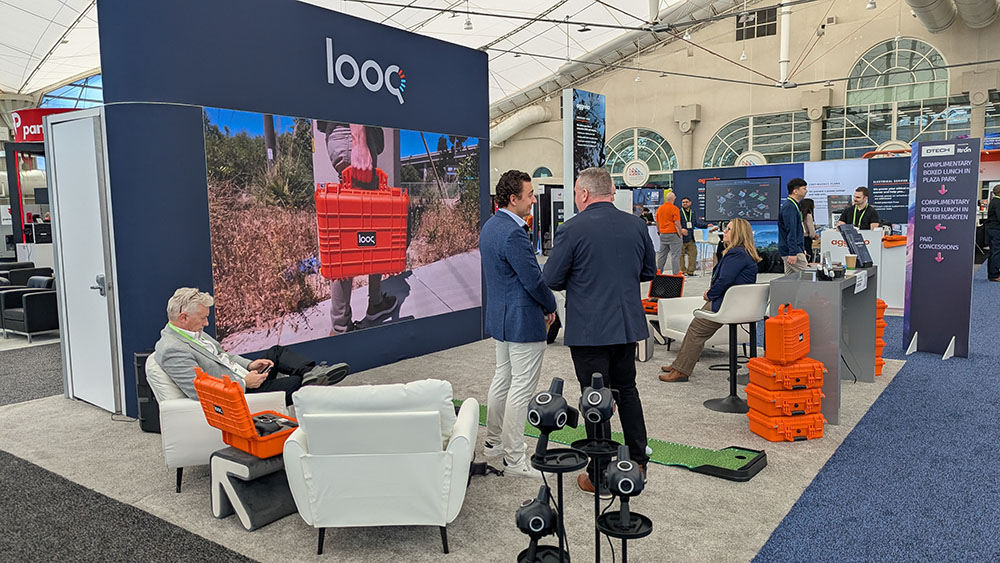

The scope and depth of the transmission and distribution products on the DTECH show floor is nothing short of astonishing, ranging from traditional transformers and microgrid components to advanced distribution management systems (ADMS) and distributed energy resource management systems (DERMS) solutions. While you can see and feel the current state of the industry on the show floor, the Initiate Startup Hub is where attendees can get a glimpse of the future, showcasing a variety of companies that are set to further transform the energy landscape.
That transformation is one you can literally see take shape over the past few years, with many of these companies becoming industry mainstays as they shift their focus from disruption to scale. A prime example is Looq AI, a company providing spatial intelligence for the energy sector. By bringing hardware and software innovation into a single solution, Looq AI has developed a technological bridge that can overcome utility-scale infrastructure challenges.
Looq AI’s significant presence at DTECH 2026 is a testament to its evolution from its beginnings in the Initiate Startup Hub. Their trajectory highlights what it takes to move from an early-stage startup to an industry leader, which isn’t about a single show or piece of technology. While much of that success is rooted in the core value of their product, the connections they made in those early days at DTECH continue to anchor their conversations at the event and beyond.
GOING FROM STEALTH TO SCALE

It’s been several years since Looq AI emerged from stealth mode, but the inherent value of their platform was evident from those early days. The company was first formed in recognition of a global need for technology that could accurately map and analyze physical assets. However, the true depth of that market demand was crystallized through the high-level technical conversations that took place during that first DTECH.
“We were in our infancy at that first show,” said Dominique Meyer, CEO and Co-Founder of Looq AI. “We had just come into existence when we were approached by a major engineering service provider. They asked if we could map out medium-voltage distribution poles, and that single interaction highlighted the massive scale of the opportunity. Over the last three years, we’ve focused on scaling our technology to meet that demand, resulting in rapid progress and successful industry adoption.”
That baseline understanding of user needs didn’t just happen in a vacuum but was instead a direct result of exploring the specific fits across the utility landscape. By listening to the challenges of actual grid operators, Looq AI was able to move beyond simply collecting bundles of data to instead answer specific prompts and problems the industry faces.
This required taking the difficult but necessary route of developing a proprietary hardware and software marriage. As utilities began adopting qPole, which is their software solution that converts photographs into accurate, engineering-ready 3D models, Looq scaled its processing pipeline to efficiently handle massive volumes of qCam captures and AI-assisted model generation. They were able to create these further efficiencies while maintaining reliable turnaround times.
“One of our primary goals is to achieve worldwide capture,” explained Shreyas Niradi, CTO and Co-Founder of Looq AI. “The more data we can amass for predictive analytics, the closer we get to building a digital replica of the world’s infrastructure. To get there, we’ve focused on scaling alongside demand, which has further meant optimizing our algorithms and compute distribution to solve core infrastructure problems on a global scale.”
In doing so, Looq AI has been able to not only solve core utility problems but can also identify and mitigate issues before they escalate in a way that resonates. These capabilities have opened up entirely new value propositions for utility teams.

WHERE UTILITIES NEED TO ALLOCATE THEIR TIME AND BUDGET
While the industry often focuses on individual hardware and software solutions, Looq AI’s approach represents a broader shift toward geophysical reasoning. Their platform moves beyond standard 3D modeling to capture data that is unique to a given asset, enabling predictive analytics that transforms how data is utilized. This evolution is supported by a sophisticated distribution of algorithms and infrastructure designed to monitor the long-term health of utility assets.
“A significant part of our work involves understanding how assets degrade based on weather conditions and material wear and tear,” said Niradi. “We’re looking at exactly what builds up the infrastructure but can also track degradation that might be the result of anything from woodpecker holes to structural stress. Once we can bake that intelligence into asset management over time, it becomes a massive factor in maintenance. It helps customers understand exactly where to allocate their time and budget.”
The impact of this technology is most evident in the qPole solution. By combining rapid field capture with AI-driven processing, Looq AI has reduced total pole modeling time from approximately 30 minutes to just seven minutes per structure.
Even with this speed, the system maintains sub-centimeter measurement accuracy for critical attributes attachment heights and geometry. By minimizing manual oversight and generating engineering-ready 3D representations within a 24-hour turnaround, Looq allows utilities to resolve potential issues before they turn into costly problems.
This level of detail opens up a new world for field teams. It allows them to inspect infrastructure that may have been in place for 50 to 80 years. In many cases, these were underground or otherwise inaccessible assets that are often deteriorating without the need for physical entry. Linemen can use the Looq AI camera-based capture tool to get the data needed for a full 3D model while staying at a safe distance from the asset. That has made a tangible difference for the people out in the field.
“A few years ago, I was on location with a technician for a major engineering firm who was using an old laser system that required them to be at the pole for a significant amount of time,” Meyer recalled. “All of a sudden, a semi-truck came out of nowhere and wiped out his work truck, missing him by only a few inches. It shows how many close calls are out there, and the more of those we can eliminate, the better off we are as an industry.”
Every minute a field operator spends outside of a hazardous environment is a minute that contributes to the significant safety impact of these tools. This commitment to a human-centric perspective is a key differentiator. Much of that focus can be connected back to the relationships they began building years ago in the Initiate Startup Hub, which are continuing to develop just as their involvement in the event similarly expands.

MEETING AND GROWING AT DTECH
While Looq AI occupies a far different position today than it did during its debut in the Initiate Startup Hub, the company’s trajectory highlights what’s possible when innovation meets the right audience. The conversations that began as introductions have evolved into deep, technical partnerships focused on real-time feedback and predictive failure analysis. However, these relationships require a perspective that connects with core industry priorities.
“You have to remember the utility timescale, which is measured in decades, not years,” said Meyer. “The ability to leverage data for serious capital budget decisions evolves alongside a utility’s embrace of the technology. It isn’t something that happens all at once after a single event but is instead the sustained connection that truly matters.”
The ability to act across different timescales is a necessity for utilities of all types. Looq AI bridges the gap between data and action, ensuring that information isn’t just available, but intelligent and accessible to drive decisions. No matter the specific requirements of a utility’s timeline, their goal is to empower people and teams with the info they need, when they need it.
This evolution requires a shift in mindset that sees individuals and entire organizations go beyond a focus on individual tools and toward a comprehensive technological strategy. Looq AI’s own trajectory at DTECH mirrors this journey. It’s proof that success is about more than a single conversation, sale, or event. Their significant presence at the 2026 event underscores the value of this long-term perspective and how it will continue to be cultivated at the next edition of DTECH and beyond.
“ing up year-to-year is vital because these relationships aren’t just one-offs,” Meyer concluded. “We know the value this brings to our customers and the broader sector, and we look forward to keeping that evolution growing at every event to come.”
Sumber Artikel:
Renewableenergyworld.com