
Global electricity consumption from data centers will roughly double by 2030, reaching around 945 TWh annually, and developers are on a mission to find every available electron.
Have they checked in the water?
While obviously not a fit for every project, wave energy is emerging as an interesting option to power artificial intelligence operations close to the shore. The motion of the ocean provides a continuous, highly predictable generation pattern much smoother than solar or wind, pairing nicely with data center load profiles and cutting down on the need for excessive on-site storage. Other perks include wave power’s modularity, natural cooling via seawater, and the ability to bypass some land and grid constraints.
Eco Wave Power CEO Inna Braverman sees the potential. The wave power pioneer recently joined the NVIDIA Inception program, an initiative advancing artificial intelligence, data processing, simulation, and high-performance computing technologies. Using physics-based simulation, machine learning, and operational data to create a digital twin, Eco Wave Power will better understand how its systems perform. That will improve forecasting and optimize future deployments- perhaps even for AI data center customers.
Braverman d her vision for the future of wave power in the ing Q&A with Factor This, lightly edited for clarity and conciseness.
Paul Gerke: Why is wave power a good fit for data center load?

Inna Braverman: We believe wave energy can become an important part of the renewable energy mix needed to meet this demand. Wave energy can generate electricity around the clock whenever sufficient wave conditions are present, and it can complement solar, wind, storage, and other energy sources as part of a diversified power mix.
Our technology also has a particular advantage for coastal infrastructure because it is installed on existing structures such as breakwaters, piers, and jetties, rather than requiring large areas of land. Many major data-center markets are located in coastal or near-coastal regions, where there is significant electricity demand and existing infrastructure.
This creates a compelling opportunity to generate renewable electricity close to where data centers consume it and potentially power part of that load directly. As AI drives an unprecedented increase in electricity demand, we believe wave energy can become an important new clean-energy source for the data-center industry.
What’s the size of that market, and do you get the sense developers might target coastal areas specifically for this purpose in the future?
Many major data-center markets are located in coastal or near-coastal regions, where developers can benefit from access to dense infrastructure, subsea connectivity, and, in some cases, seawater-based cooling solutions. That creates a particularly interesting opportunity for wave energy.
If a data center is already being developed near the coast, the same location may provide access to a renewable-energy resource directly adjacent to the facility. Eco Wave Power’s technology can be integrated into existing marine structures such as breakwaters, piers and jetties, creating the potential to generate clean electricity close to where it is consumed.
Looking ahead, we believe developers will increasingly evaluate sites not only based on land and connectivity, but also on access to reliable power and cooling. Coastal locations could become increasingly attractive where they offer both marine cooling opportunities and access to wave-energy resources.
For Eco Wave Power, the addressable opportunity could therefore be significant. As data-center power demand continues to grow, we see a natural opportunity to integrate wave energy into coastal data-center infrastructure and create a closer connection between where these facilities are located, how they are cooled, and how they are powered.
How big could these installations get?
Eco Wave Power’s technology is modular, so installations can range from approximately 1 megawatt (MW) to tens or potentially hundreds of megawatts, depending on the available coastal infrastructure, wave conditions, and project configuration.
As a general rule of thumb, around 200 linear meters of suitable coastal infrastructure can support approximately 1 MW of installed capacity. That means a relatively small section of an existing breakwater, pier, or jetty can support meaningful renewable-energy generation without requiring large areas of additional land.
At major ports, where breakwaters can extend for several kilometers, the potential scale becomes much larger. At the Port of Los Angeles, for example, we estimate that the existing outer breakwater could potentially support up to approximately 60 MW of installed wave energy capacity.
For data centers, this modularity is particularly important because the system can be sized according to both the facility’s electricity demand and the nearby coastal infrastructure available. A project could begin at the megawatt scale and then expand over time as additional capacity is required.
That flexibility allows wave energy to support everything from smaller coastal facilities to much larger energy-intensive infrastructure, including data centers and AI campuses.


Eco Wave Power’s technology is modular, allowing each energy generation site to dictate its scale. Courtesy: Eco Wave Power
What does maintenance and operations entail at a wave power site?
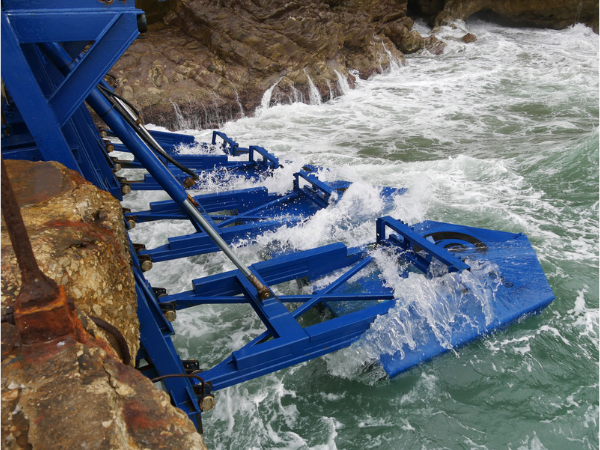
Our system was specifically designed to simplify operations and maintenance by keeping the power conversion equipment on land, much a conventional power station. The floaters are the primary components in the water, while the hydraulic and electrical equipment is housed in an onshore conversion unit that can be accessed directly for routine inspections, maintenance, and repairs.
The floaters themselves are connected to existing coastal structures, and during extreme wave conditions, they can automatically retract above the water to help protect the equipment from excessive loads.
This architecture makes maintenance significantly more accessible than technologies located far offshore or on the seabed, where servicing can require specialized vessels, divers, and more complex marine operations.
For data centers, this is particularly relevant because reliability and ease of maintenance are critical. A coastal data center located near suitable marine infrastructure could benefit from a renewable-energy system whose key operating equipment remains accessible from shore, while the wave-energy generation takes place immediately adjacent to the site.

How are your projects performing? Any interesting updates from Jaffa Port, Portugal, or Los Angeles?
At Jaffa Port in Israel, our grid-connected wave energy project continues to operate and provide us with valuable real-world performance data. We are now also advancing the implementation of our first digital twin platform for the technology, combining physics-based simulation, machine learning, and operational data to better understand system behavior, forecast energy production, and optimize future deployments.
The digital twin is being developed with AI engineering, using NVIDIA-accelerated computing technologies and NVIDIA Omniverse as part of the simulation and visualization environment. The first phase focuses on modeling the interaction between ocean waves and our floaters, with future phases expected to expand into the full energy-conversion system, real-time sensor integration, and AI-driven operational optimization.
In parallel, we are developing the architecture to connect wave-energy generation directly to data-center infrastructure. The concept goes beyond simply supplying renewable electricity. We are looking at how wave generation, energy storage, grid interaction, cooling, and AI/HPC workloads could ultimately be managed as one integrated Energy-Water-Compute system. We are also exploring secure methods for connecting, measuring, and settling energy transactions between wave-energy assets and data-center loads.
In Portugal, we are advancing our first 1 MW project in the city of Porto, where we have been progressing the civil and infrastructure work required for installation. Portugal represents an important step in scaling the technology from demonstration into a larger commercial installation.
At the Port of Los Angeles, we completed and demonstrated our onshore wave energy pilot in collaboration with AltaSea and Shell Marine Renewable Energy. The project provides us with an important U.S. reference site and a foundation for exploring larger applications of wave energy for ports, coastal infrastructure, and potentially data centers.
Across these projects, the common direction is clear: we are moving from simply demonstrating wave-energy generation toward building intelligent, digitally optimized energy infrastructure that can ultimately integrate directly with major electricity consumers such as data centers.
Learn more on Factor This: Riding the wave: A Chernobyl survivor is going global with her simple tech that harnesses the motion of the ocean
Let’s dive into your partnership with NVIDIA a bit. Why are they a fit for Eco Wave Power, and how does the chip maker jive with your longer-term aspirations?
NVIDIA is a natural fit for Eco Wave Power because the next stage of wave energy is not only about building physical infrastructure — it is about making that infrastructure smarter, more predictive, and easier to scale.
Eco Wave Power U.S. is a member of the NVIDIA Inception program, which gives us access to NVIDIA’s ecosystem, technical resources, and accelerated computing capabilities. Through our work with AI engineering, which is also an NVIDIA Inception member, we are using NVIDIA-accelerated computing together with technologies such as NVIDIA Omniverse and NVIDIA Warp to support the development of our digital twin platform.
Wave energy operates in a highly dynamic environment. Wave conditions constantly change, and every project site has different characteristics. That makes physics-based simulation, AI, machine learning, and digital twin technologies particularly valuable. Our objective is to combine real-world operational data from our wave-energy systems with high-fidelity simulation and machine learning so we can better predict system behavior, optimize performance, improve engineering decisions, and accelerate deployment at new sites.
Longer term, we see an even broader opportunity. We are exploring how wave-energy generation could integrate directly with coastal data-center infrastructure, including energy storage, cooling, grid interaction, and AI/HPC workloads. In that vision, the digital twin becomes more than an engineering tool — it can become part of an intelligent operating layer that helps coordinate how energy is generated, stored, and consumed.
NVIDIA is therefore relevant to us at two levels: first, as an enabling technology platform for the digitalization and optimization of our wave-energy systems; and second, as part of a much larger opportunity at the intersection of AI, clean energy and data-center infrastructure.
Our long-term aspiration is to make wave energy not only a source of renewable electricity, but an intelligent energy platform that can integrate directly with the infrastructure powering the AI economy.

There’s been movement recently on federal permitting that has some clean energy developers cautiously optimistic. Have you found siting projects to be difficult, or is it easier for a potential data center or other customer to “plug and play” with wave power?
Permitting is certainly an important part of any wave energy project, but our technology has a potential advantage because it is installed on existing man-made coastal infrastructure such as breakwaters, piers, and jetties rather than requiring the development of large offshore areas.
That does not mean permitting is automatic. Projects still need to address issues such as use of the marine structure, grid connection, environmental requirements, port authority approvals, and local regulations. The exact process varies significantly by country and by site.
However, in our experience, working with existing infrastructure can simplify several aspects of development. We are not asking to occupy large areas of seabed, build extensive offshore foundations, or create an entirely new marine site. The core conversion equipment is onshore, and the floaters attach to existing structures.
For a coastal data-center developer, that creates the potential for a more integrated approach. If the facility is located near a suitable breakwater, pier, or other marine structure, wave energy could potentially be incorporated into the broader site-development and energy strategy rather than developed as a completely separate offshore project.
So I would not describe it as truly “plug and play,” because permitting and site-specific engineering will always matter. But our approach is designed to make wave energy considerably more practical to deploy on existing coastal infrastructure, which could shorten the path from concept to implementation compared with more complex offshore technologies.
Sumber Artikel:
Renewableenergyworld.com