

 Rodger Bosch/AFP via Getty Images
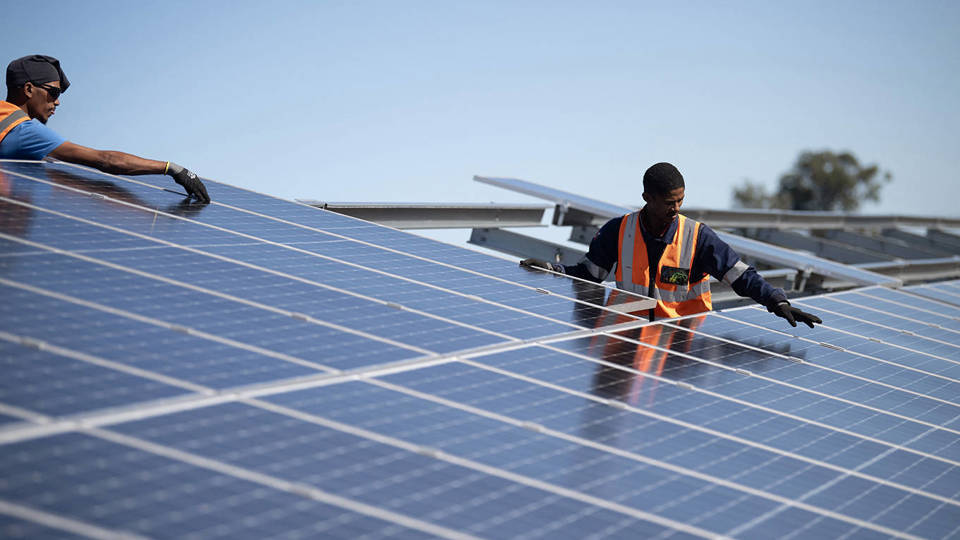
Foreign donors – including governments, NGOs, and development agencies – have long based climate-finance decisions on their own perceptions of risk, imposing solutions that do not necessarily reflect African priorities or perspectives. But with new investment platforms, Africa is taking matters into its own hands.
In practice, however, the climate-finance model in Africa remained largely unchanged. Climate action continued to be tied to soft power, funded by official development assistance, and implemented largely on a project-by-project basis. And mitigation continued to take precedence over adaptation, despite Africa’s acute vulnerability to the effects of climate change.
More fundamentally, outside actors – governments, NGOs, and development agencies – continued to base decisions on their own perceptions of climate risk, imposing solutions that did not reflect African priorities or perspectives. While individual projects might have sometimes delivered localized benefits, they consistently failed to close infrastructure gaps, let alone strengthen state capacity or transform markets and economic ecosystems.

Out Now: Watch the latest Insider Interview with Daron Acemoglu and Michael J. Sandel
In a new Insider Interview, produced in partnership with the Berggruen Institute, Daron Acemoglu and Michael J. Sandel examine the dark side of meritocracy, the limits of markets, the meaning of freedom, and tech companies’ tightening grip on the public sphere.
Read & Watch Now
These weaknesses were exacerbated during the COVID-19 crisis, when flows of climate finance to Africa stagnated, and they were not resolved in the pandemic’s wake, even as flows rebounded. According to the Climate Policy Initiative, climate finance to Africa surged by 48% between 2019-20 and 2021-22, from $29.5 billion to $43.7 billion, driven largely by renewed multilateral engagement and a partial recovery in private investment.
This recovery mirrored a broader global rebound: worldwide climate finance surpassed $2 trillion for the first time in 2024, representing approximately 8% growth year on year. Nonetheless, this was still slower than the 15% growth recorded between 2022 and 2023, reflecting headwinds including elevated interest rates, lower natural-gas prices, and grid infrastructure constraints. And Africa’s of the pie has not kept pace with overall growth.
There has also been a shift back toward mitigation-oriented investments. In 2019-20 and 2021-22, the of total finance dedicated to adaptation in Africa declined from 39% to 32%, owing largely to the expansion of dual-benefit finance that combines mitigation and adaptation objectives. While this dwarfs the elsewhere, including Latin America, South and Southeast Asia, and the Middle East (1-14%), the total remains insufficient to safeguard African countries from rapidly escalating climate impacts. The largest increases in climate finance in 2024 occurred in transport, particularly electric vehicles – making them mitigation-focused – with China, Brazil, Vietnam, and Indonesia leading the way.
Faced with stagnating adaptation financing and intensifying climate impacts, Africans are taking matters into their own hands, devising new approaches to climate finance that better reflect their needs. One prominent example is South Africa’s Just Energy Transition Partnership, a pioneering investment platform that seeks to align climate-related finance – particularly to support decarbonizing the energy system – with broader strategies for economic development and growth. Since the concept’s introduction at the 2021 United Nations Climate Change Conference in Glasgow (COP26), Indonesia, Vietnam, and Senegal have ed South Africa’s lead in signing JETPs with the advanced economies of the International Partners Group.
As the Africa Expert Panel noted in a recent report, investment platforms JETPs provide a structured mechanism for identifying bankable projects and reducing the cost of capital. This can reduce debt-related pressures, while mobilizing larger, more diversified sources of climate and development finance that would otherwise remain out of reach.
To be sure, important challenges still lie ahead. When both first-order (civil and political) and second-order (social, cultural, and economic) rights are at stake, no single program or platform can deliver inclusivity – not even one that, the JETP, is designed to promote justice and equity. Instead, a more inclusive economy requires broader political and institutional reforms, supported by political, financial, and economic elites who adopt an enlightened, long-term perspective.
But JETPs can bolster this effort. By embedding social-justice considerations in investment frameworks – including project selection, evaluation, and management – they would support gradual system-wide change. As such, JETPs represent a truly transformative model of climate financing, which is aligned with countries’ needs and interests.
Although the climate-investment models African countries are embracing remain in the early stages of development, they are already opening up new modes of engagement that are firmly anchored in the real economy. As they mature, they promise to mobilize larger amounts of new and concessional capital – exactly what Africa needs to sustain investment and productive capacity, support economic resilience amid climate and macroeconomic shocks, and advance long-term development objectives.
Featured
-
A Stronger Work Ethic Won’t Fix Advanced Economies
Mar 6, 2026 Jun Du
-
The Long Road to War with Iran
Mar 4, 2026 Carla Norrlöf
-
Magical Thinking Won’t Make Europe an AI Power
Mar 3, 2026 Cristina Caffarra
-
Can the US Afford Trump’s Iran War?
Mar 9, 2026 Desmond Lachman
-
Iran’s Energy-Warfare Strategy
Mar 6, 2026 Avri Schechter
https://prosyn.org/xvktIUy
It appears that you have not yet updated your first and last name. If you would to update your name, please do so here.
Please wait, fetching the form
Please wait, fetching the form
Please wait, fetching the form
Please wait, fetching the form
Please wait, fetching the form
Please wait, fetching the form
Please wait, fetching the form
Sumber Artikel:
Project-syndicate.org

