

▲ S&P 500 +—%|▲ Stock Advisor +—%Join The Motley Fool
S&P 500
7,688.62
+1.6%
+119.70
DJI
53,356.12
+3.0%
+1,569.40
NASDAQ
25,736.51
+1.4%
+364.50
Bitcoin
$80,269.00
+2.1%
+$1,689.06
SPCX
$135.92
-3.8%
-$5.39
AAPL
$349.51
+5.3%
+$17.61
AMZN
$266.03
+6.1%
+$15.34
GOOG
$287.30
+3.2%
+$9.03
META
$630.00
+1.4%
+$8.97
MSFT
$555.80
+6.7%
+$34.81
NVDA
$200.13
-3.2%
-$6.56
TSLA
$385.19
-3.3%
-$13.31
Free ArticleExplore Premium Services
By James Brumley – Nov 5, 2026 at 6:05AM EST
Key Points
-
It’s been a miserable past six years for Clorox investors, but there’s a light at the end of the tunnel.
-
Brookfield Renewable enjoys a flexibility that bigger utility names just don’t have, allowing it to maximize the income that ultimately gets turned.
-
There may be no major growth in store for the domestic telecom business, but there’s certainly plenty of reliable cash flow in the cards.
1. Clorox
Clorox (CLX +5.71%) hasn’t exactly felt a super-safe dividend stock to buy and hold lately. Although the consumer goods ticker rallied during and because of the COVID-19 pandemic, since its 2020 peak it’s peeled back by 60%, making a new multiyear low just last month.
Thanks to a 2023 cyberattack that did some surprisingly long-term damage and a migration to a new ERP (enterprise resource planning) platform that’s not gone as smoothly as hoped, the company’s simply struggled — with the shrinking sales and earnings to prove it. Never mind the fact that it just doesn’t have the same benefit of scale that much larger rival Procter & Gamble enjoys. P&G did $87 billion worth of business last fiscal year, for perspective, while Clorox only did $6.7 billion, down 5%.
CLX – Clorox
$99.16+$5.36 (+5.71%)
NYSE · As of 4:00 PM ET 11/04/26
Premium Feature
 Moneyball Superscore53/100
Key data points
Market capMarket cap calculated using publicly traded s outstanding only. Does not include unlisted, private, or dual-class non-traded s. Implied market cap may vary.$11.99B
Day’s range$94.44 – $101.09
52wk range$79.12 – $128.90
Volume677.6
Avg volume2.9M
Gross margin41.52%
Dividend yield5.02%
But with most of what was broken now fixed, the company’s looking for respectable organic revenue growth of between 3.5% and 4.5% for the fiscal year that began in July, driving a similar improvement in per-earnings. This turn ly does mark the beginning of longer-lived forward progress.
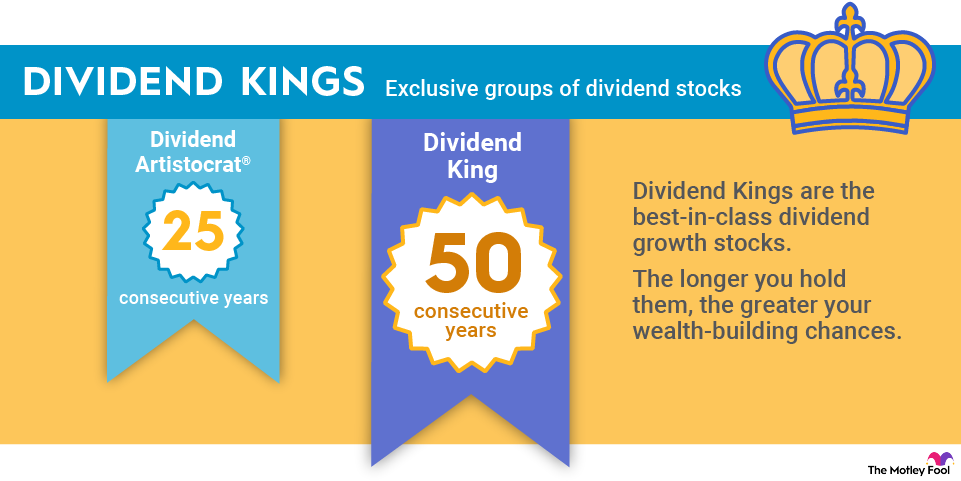
Lost in all the noise is the fact that Clorox has not only continued paying its dividend through this rough patch but has also continued growing it, now into a 49-year streak of annual per-payment increases. You can plug into this long-term growth trend that’s one year away from reaching Dividend King status while its forward-looking dividend yield stands at a frothy 5.7%, taking advantage of the overly aggressive sell-off that looks right past the fact that the company’s been planning a smart turnaround for a while now.
2. Brookfield Renewable
Utility companies are usually great dividend payers for the obvious reason: Their customers make a point of keeping their power turned on by faithfully paying their monthly bills.
The business is getting trickier, though. Aside from being capital-intensive and increasingly regulated, growth typically comes only from geographic expansion, which adds complexity and eats away at efficiency.
Brookfield Renewable (BEPC +2.63%) is taking a different tack. Rather than never-ending expansion into adjacent geographic territories, Brookfield Renewable picks and chooses to back — with capital — smaller cash-generating utility projects all over the world, its 38% stake in Colombia’s hydropower company Isagen, or its recently acquired of Canada’s wind power specialist Boralex.
These aren’t deals that would have been of much interest to a major U.S. utility outfit. Brookfield’s management team understands smaller and foreign wind, hydro, nuclear, and solar power opportunities though, knowing when to buy in, and sometimes, when to sell. This is flexibility that more traditional utility outfits just don’t have.
Perhaps more important, Brookfield Renewable is structured and invested in a way that prioritizes dividend payments and supports substantial dividend growth. While there is some capital appreciation to be reaped from the company’s portfolio of revenue-bearing assets, built for income, the organization believes its distributions will grow between 5% and 9% per year indefinitely. Newcomers will start with a solid, forward-looking dividend yield of 5.4%.
Just make sure you’re buying the right version of this stock. There’s a limited partnership version that trades under the ticker BEP, but owning stakes in partnerships requires additional tax-filing forms that aren’t always worth the trouble.
3. Verizon Communications
Finally, add Verizon Communications (VZ +2.06%) to your list of safe high-yielding dividend stocks you can buy and hold for the long haul, while you can plug into its yield of 6.3%.
Almost as much as they make a point of keeping their lights turned on and their water flowing, consumers keep their mobile phones connected to wireless networks. Many of them effectively feel they have to, in fact. Data from Harmony Healthcare IT says the average American spends more than five hours per day staring at their smartphones’ screens, suggesting addiction-level usage.
Mentally healthy or not, most consumers aren’t apt to let go of the digital centerpiece of their lives now. That’s a big reason Verizon’s been able to raise annual per-dividend payments for 20 consecutive years.
VZ – Verizon Communications
$46.17+$0.93 (+2.06%)
NYSE · As of 4:00 PM ET 11/04/26
Premium Feature
Moneyball Superscore68/100
Key data points
Market capMarket cap calculated using publicly traded s outstanding only. Does not include unlisted, private, or dual-class non-traded s. Implied market cap may vary.$191.36B
Day’s range$45.50 – $46.55
52wk range$38.68 – $51.68
Volume13.4K
Avg volume23.5M
Gross margin45.78%
Dividend yield6.09%
There’s no great potential for capital gains here, for the record. With data from Pew Research indicating 98% of adults living in the United States already own a mobile phone (91% of which are smartphones), the market is pretty well saturated, with most of the major companies in the mobile telecom business simply swapping customers with one another. Any net growth will come only from population growth and price increases, which won’t be much.
As a dividend-supporting cash cow, though, you’d be hard-pressed to find a better business than wireless telecom, and Verizon is one of its best.
Read Next
•By Matt DiLallo
Clorox vs. PepsiCo: Which Dividend Stock Could Make You Richer Over the Next 10 Years?
•By Eric Volkman
•By Matt DiLallo
Clorox (CLX) Q1 2027 Earnings Call Transcript

•By Matt DiLallo
5 Dividend Stocks Yielding Over 5%, Ranked By Safety
Macroeconomic Headwinds are Hitting Clorox From All Sides
About the Author

James Brumley is a contributing Motley Fool stock market analyst covering consumer staples and consumer discretionary stocks. James is a former licensed stockbroker with Charles Schwab, and a registered investment adviser. He holds a bachelor’s degree in business management with a specialization in finance from Transylvania University.
Stocks Mentioned

Clorox
NYSE: CLX
$99.16
(+5.71%)+$5.36

Motley Fool Stock Advisor’s Latest Pick
—% Avg Return

S&P 500 Index
SNPINDEX: ^GSPC
$7,688.62
(+1.58%)+$119.70

Verizon Communications
NYSE: VZ
$46.17
(+2.06%)+$0.93

Procter & Gamble
NYSE: PG
$167.32
(+3.25%)+$5.26

Brookfield Renewable
NYSE: BEPC
$31.56
(+2.63%)+$0.81
*Average returns of all recommendations since inception. Cost basis and return based on previous market day close.
Premium Investing Services
Invest better with The Motley Fool. Get stock recommendations, portfolio guidance, and more from The Motley Fool’s premium services.
Sumber Artikel:
Fool.com

