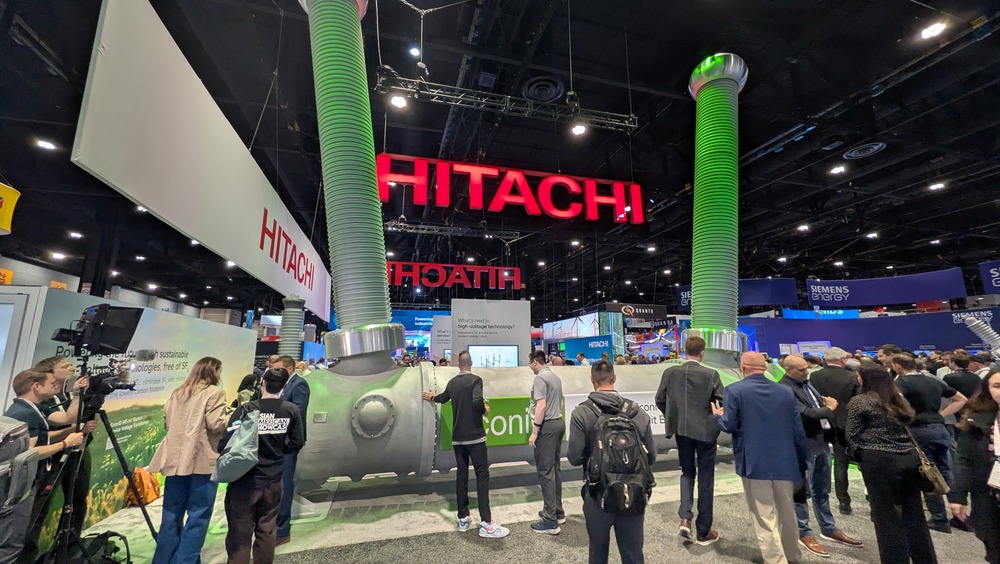

The biennial 2026 IEEE PES T&D Conference & Exposition brought together the energy industry from May 4-7th in Chicago, IL, to explore and detail the shifts and changes defining the present and future of the entire sector. Featuring thousands of attendees and hundreds of exhibitors, the event provided some amazing insights around what’s happening across the energy sector, along with plenty of talk about baseball and deep dish pizza in between.
David Perez, EVP & chief operating officer at ComEd, helped kick off the event with a message that the industry has reached an inflection point, outlining how utilities’ investment strategies today will shape the economy, communities, and a collective response to climate change. It was a message that helped frame the specifics of the conference session within a broader context.
While new products and innovations that will power the next wave of utility innovation were front and center, there were numerous topics and themes that came up in just about every discussion on and off the exhibit floor. While high-level trends the evolution of AI and the power of data have previously dominated these sorts of industry gatherings, the 2026 landscape is being defined by fundamental shifts in how utilities need to approach their core mission. They’re compelling an evolution in utility thinking that’s needed to ensure grid reliability and customer affordability in both the short and long term.
Affordability as a Collective Responsibility
It’s no secret that affordability has become a top priority across the utility industry, but conversations at IEEE 2026 showcased the importance of the topic on a whole new level. Affordability came up in just about every panel discussion, while exhibitors on the floor highlighted how their technologies can create efficiencies that are ultimately reflected in the bills that ratepayers see.
While a core focus on safety, reliability, and affordability has defined the utility industry for decades, the event showcased a shift in how leaders are prioritizing these pillars.
“The landscape around affordability has totally changed,” said Kevin Geraghty, chief operating officer and chief safety officer at San Diego Gas & Electric. “It used to be things decarbonization that drove decisions, but now, the bills cannot go up. We’re seeing state governors weighing in on rate cases. It’s seeping into the psyche.”
Other speakers talked about affordability as both an operational requirement and a collective responsibility. Because no utility project exists in a vacuum, organizations that can’t communicate the long-term value of these efforts to the people who are ultimately paying for them ensure they’ll just be focused on the price tag, which is a lose-lose proposition. It highlighted the importance of transparent, consistent communication with communities.
This focus was backed up by research presented at the event, which confirmed that the emphasis on affordability was well-founded but underscored how efforts to communicate those details need to become even more of a priority.

The importance of communication and community
Historically, consumers could flick a light switch without a second thought about grid reliability or the impact on their monthly bill, which is exactly the sort of expectation and service that utilities have prided themselves on for decades. Increasing utility bills, along with assumptions about who’s going to benefit from the installation of a data center in a given area, have changed the paradigm around both.
While it’s possible to transform data center backlash into a catalyst for grid modernization, doing so depends on a proactive communication strategy that communities are receptive to when it comes from the right place. Chris Kofinis is the CEO of Park Street Strategies, a firm specializing in using public opinion research to navigate regulatory and legislative challenges. As part of an update on their PES 2050 project, he discussed survey data showing that 75% of consumers are confident in engineers’ ability to develop solutions to future energy challenges. Even more striking was the finding that nearly 100% of respondents believe it’s essential for engineers to educate the public on these issues.
“I’ve been doing research for a long time, and we never see numbers 100%,” Kofinis told the crowd. “We know the energy industry has an opportunity in front of it when it comes to serving demand, but that number tells you how ratepayers want to see that opportunity communicated.”
This insight is especially relevant for infrastructure investments that may cause short-term rate increases but offer long-term stability, which includes using data centers as grid assets. These findings provide a clear framework for how the industry can define its value to the public. The effort to do so needs to be prioritized by individual utilities in a way that can then define industry-wide narratives.
Outlining what resiliency means
While affordability came up in just about every conversation at the event, resiliency was also top of mind. While everyone knows what resilience means as a concept, what does it actually mean to enable it in practice? That was a central topic of exploration throughout the event, and something multiple speakers got specific with.
“Resilience isn’t just one thing,” said Mark Baranek, SVP of technical services at ComEd. “We have to think in layers. It’s more about how to approach flood mitigation than what individual process or reaction was utilized for a specific event. Resiliency in multiple layers is the only way it works at scale.”
It’s a perfect illustration of a concept that many utilities define similarly in principle, but approach differently in practice. Every utility’s strategy for building resilience is inherently tied to its existing processes, its unique environment, and the available technology. These circumstances matter, but the ultimate success of such efforts depends as much on the people involved as it does on anything and everything else.
More on Reliability & Resilience

Michigan regulators to utilities: Incorporate virtual power plants, or else
The Michigan Public Service Commission has ordered the state’s utilities to consider virtual power plant programs in future Integrated Resource Plans or risk having future rate hike requests rejected.
8 min read
NewsPolicy & RegulationPower GridSmart GridsDTECH MidwestReliability and ResilienceRenewables

How JPS weathered Hurricane Melissa with one set of digital grid management tools
In a recent web event on Factor This, Jamaica Public Service detailed its preparation and response to Category 5 Hurricane Melissa, which devastated the island’s power grid.
10 min read
Grid ModernizationNewsOutage ManagementPower GridGrid ModernizationReliability and Resilience

Everything you need to know about PJM’s Reliability Backstop Procurement
PJM’s Reliability Backstop Procurement proposal includes two phases, starting with matchmaking buyers and sellers, and a capacity auction in March 2027, writes contributor Rao Konidena.
6 min read
NewsPolicy & RegulationPower GridReliability and Resilience
Workforce as critical infrastructure
It’s nothing new to say that the electric utility industry is facing unprecedented workforce pressures. Everything from accelerating retirements to a shortage of mid-level engineers to a need to fill new types of jobs is making the issue that much more challenging. The ability to attract, develop, and retain engineering talent remains a top priority, but what ideas and initiatives define the effort? During a “Workforce Strategies for a Changing Utility Industry” session, numerous speakers got specific with how they’re approaching each.
“Getting a newer employee to work under someone that’s nearing retirement or some other kind of shift out of that role ensures the insights they have stay where they need to,” said Jason Hawkins, director of electric transmission engineering at Dominion Energy. “This effort is doubly beneficial, as it also helps define a clear career path for newer employees, which directly supports long-term retention.”
It’s a good example of how utilities are changing their internal processes to align their workforce with modern tools, as part of a broader transformation of the industry. They’re taking place at every level of the industry, in a way that has and will further change expectations across the board.

Utility evolution
While concepts Virtual Power Plants (VPPs) are not inherently new, the recent openness we’ve seen utilities take when it comes to how they could improve grid reliability is significant. It underscores a wider evolution underway across the industry, as utilities are more open than ever to innovations that could change how they operate in the short term if they can provide a foundation for future growth.
Doing so will require a different way of thinking about models and frameworks that enable everything from the integration of renewables to widespread electrification applications. It will mean thinking differently about infrastructure, a theme the event highlighted in how data centers are being positioned.
“We need to see the emergence of data centers as a new class of grid assets, because they can’t just exist to serve load,” said Jeff Bladen, Head of Energy at Verrus. “These large loads can be part of the solution that keeps energy affordable, but that requires getting the policy and the frameworks right.”
Whether the focus is on specific infrastructure or how utilities communicate with their communities, these shifts are driving an evolution in utility thinking. Bridging the gap between that thinking and its realization is easier said than done, but doing so is more important than ever, since the effort will define how the entire world will be powered.
Sumber Artikel:
Renewableenergyworld.com