

Key Financial Metrics

DIS – Walt Disney
$106.15
+0.56% (+$0.59)

NFLX – Netflix
$71.14
–0.80% (-$0.57)
Market Cap
$182B
52wk Range
$92.19 – $117.09
Gross Margin
32.19%
P/E Ratio
21.77
EPS (TTM)
$4.85
Dividend & Yield
$1.50 (1.42%)
Market Cap
$299B
52wk Range
$65.08 – $124.86
Gross Margin
49.53%
P/E Ratio
22.59
EPS (TTM)
$3.17
Dividend & Yield
N/A
DIS – Walt Disney
$106.15
+0.56% (+$0.59)
Market Cap
$182B
52wk Range
$92.19 – $117.09
Gross Margin
32.19%
P/E Ratio
21.77
EPS (TTM)
$4.85
Dividend & Yield
$1.50 (1.42%)
NFLX – Netflix
$71.14
–0.80% (-$0.57)
Market Cap
$299B
52wk Range
$65.08 – $124.86
Gross Margin
49.53%
P/E Ratio
22.59
EPS (TTM)
$3.17
Dividend & Yield
N/A
The case for Walt Disney
Disney operates a multifaceted empire spanning theme parks, media networks, and theatrical production. The company remains a titan among streaming service stocks through its Disney+ and Hulu platforms, which leverage deep intellectual property from Pixar, Marvel, and Star Wars. In its latest annual report, filed for FY 2025, the company highlighted broad distribution agreements with cable and telecom operators, though it faced challenges a service blackout on YouTube TV. It also holds a significant interest in Fubo and has entered into a sportsbook partnership with DraftKings (DKNG +3.53%).
Financial performance showed steady progress in FY 2025, with revenue reaching nearly $94.4 billion. This represented a growth of approximately 3.4% compared to the previous fiscal year, as the company worked to balance traditional television declines with streaming gains. Net income for the period was close to $12.4 billion, producing a net margin of roughly 13.1%. This expansion in profitability indicates that the company is successfully managing costs while scaling its digital services and benefiting from strong demand at its domestic and international theme parks.
As of its September 2025 balance sheet, Disney maintained a debt-to-equity ratio of approximately 0.4x, which measures total debt relative to holder equity. Its current ratio, which gauges the ability to cover short-term debts with liquid assets, was nearly 0.7x. Free cash flow reached roughly $10.1 billion for the year, representing the cash left over after the company paid for capital expenditures. These funds allow the company to continue investing in new park attractions and high-budget content production to keep its audience engaged across all platforms.
The case for Netflix
Netflix is a pure-play streaming pioneer that earns revenue almost entirely through global membership subscriptions. In its latest annual report, filed for FY 2025, the company reported having over 300 million paid memberships across more than 190 countries. Its strategy focuses on a massive volume of original content, including TV series, films, and live events, while expanding into mobile games. To drive further growth, Netflix has partnered with internet-connected device manufacturers and telecommunications operators to bundle its service into consumer data plans and cable packages.
During FY 2025, the company saw significant financial expansion as revenue reached nearly $45.2 billion. This was an increase of approximately 15.9% over the previous year, driven by both subscriber additions and the successful implementation of an ad-supported tier. Net income was close to $11.0 billion, resulting in a net margin of roughly 24.3%. This high net margin highlights the scalability of the Netflix model, where the cost of producing content can be spread across an increasingly large global audience, leading to superior capital efficiency.
As of its December 2025 balance sheet, the company had a debt-to-equity ratio of approximately 0.5x. The current ratio was nearly 1.2x, indicating a solid buffer for meeting short-term financial obligations. Free cash flow for the year was roughly $9.5 billion, providing the company with the capital needed to fund its content budget and pursue strategic opportunities. By focusing entirely on digital delivery without the overhead of physical theme parks, Netflix maintains a lean operation that prioritizes technology and content spend.
Risk profile comparison
Disney faces risks related to regulatory and legal scrutiny, including an active antitrust class action settlement regarding streaming pricing and ongoing reviews of its broadcast licenses. The company also deals with significant programming cost inflation, particularly regarding long-term sports programming rights for its ESPN brand. Furthermore, the exit from joint ventures and the potential acquisition of new assets carry execution risks that could lead to asset impairments if projected synergies are not realized. Competition for advertising revenue remains intense, especially from tech giants and other media conglomerates.
Netflix is navigating the risks associated with its proposed $42.2 billion acquisition of Warner Bros. Discovery (WBD +0.07%) assets, which could cause financial disruption if regulatory approval is withheld or integration proves difficult. The company also has a heavy reliance on third-party cloud computing services, primarily Amazon (AMZN +0.12%) Web Services, and any dispute or service failure there could materially harm its operations. Additionally, Netflix must compete for leisure time against social media platforms and hardware-integrated services from Apple (AAPL +1.53%), while also managing the rising costs of fixed-price content commitments.
Valuation comparison
Netflix carries a higher premium for its superior growth and net margin, while Disney appears more affordable based on its lower multiple of sales and future earnings estimates.
| Metric | Walt Disney | Netflix |
|---|---|---|
| Forward P/E | 15.3x | 19.8x |
| P/S ratio | 1.9x | 6.1x |
Valuation metrics sourced from Financial Modeling Prep (FMP) and may differ from other data providers.
Which stock would I buy in 2026?
I’d go with Disney. Having parks, streaming, and film all pulling in the same direction simultaneously is not something Disney has always been able to claim, but it can right now. Its most recent quarter delivered record theme park revenue for the third consecutive time, streaming posted double-digit operating margins for the first time, and Toy Story 5 crossed $1 billion at the global box office.
Netflix has built something remarkable, with a global streaming platform boasting over 300 million subscribers and operating margins above 30%. The cheaper, ad-supported version of Netflix keeps gaining subscribers, and the company returned a record amount of cash to holders through buybacks last quarter.
But Netflix’s most recent quarter missed revenue estimates, Q3 guidance came in below expectations, and the stock has fallen significantly from its highs. When a business this well-run starts giving cautious guidance, it could mean the easy growth is behind it. Netflix may find its footing again, but right now, Disney is the one delivering the kind of results that make a stock easy to hold for the long haul.
Read Next
•By Robert Izquierdo
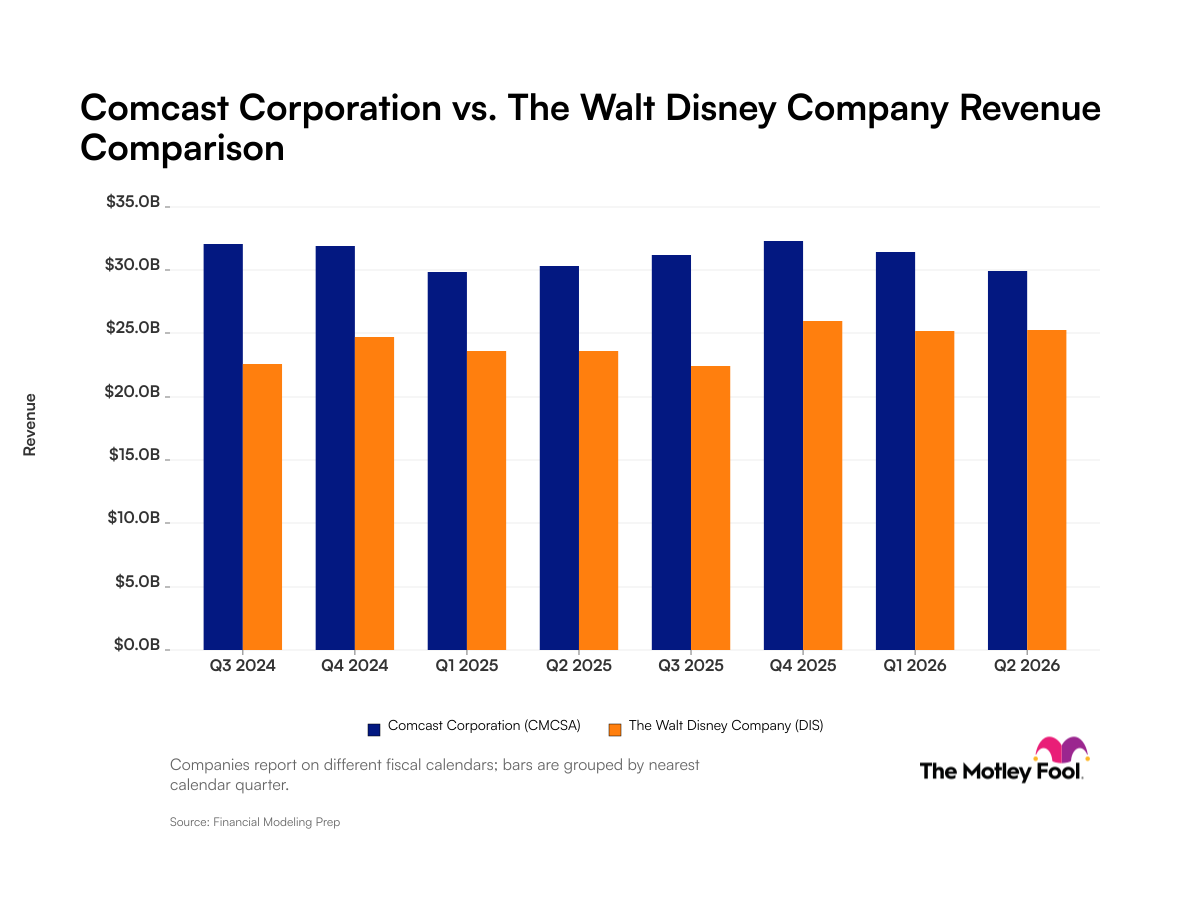
Comcast vs. Walt Disney: Comparing Recent Revenue Trends Between These Media Companies

•By Jeremy Bowman

•By Rick Munarriz
Is Disney’s New Price Hike a Genius Move, or Did It Go Too Far This Time?
•By Rick Munarriz
3 Reasons to Buy Disney Stock in the Fall

•By Rachel Warren
7 Best Travel and Tourism Stocks for 2026 and How to Invest
•By Neil Patel
Is Walt Disney Stock a Buy, Sell, or Hold 47% Below Its All-Time High?
About the Author

Sara Appino is a contributing writer at The Motley Fool. Previously she held roles at McGraw-Hill Education, Sourcebooks, and The Field Museum of Natural History. A graduate of the University of Chicago and Northwestern University’s Medill School of Journalism, Sara also managed a surf and yoga retreat in Costa Rica for nearly a decade and helped launch a nonprofit English language program in her community there.
Stocks Mentioned

Walt Disney
NYSE: DIS
$106.15
(+0.56%)+$0.59

Motley Fool Stock Advisor’s Latest Pick
—% Avg Return

Netflix
NASDAQ: NFLX
$71.15
(-0.80%)-$0.58
*Average returns of all recommendations since inception. Cost basis and return based on previous market day close.
Sumber Artikel:
Fool.com

