
Virginia Governor Abigail Spanberger’s amended version of the Facilitating Access to Surplus Transmission (FAST) Act was accepted by the Commonwealth’s General Assembly on Wednesday, clearing the way for the bill to become law on July 1, 2026.
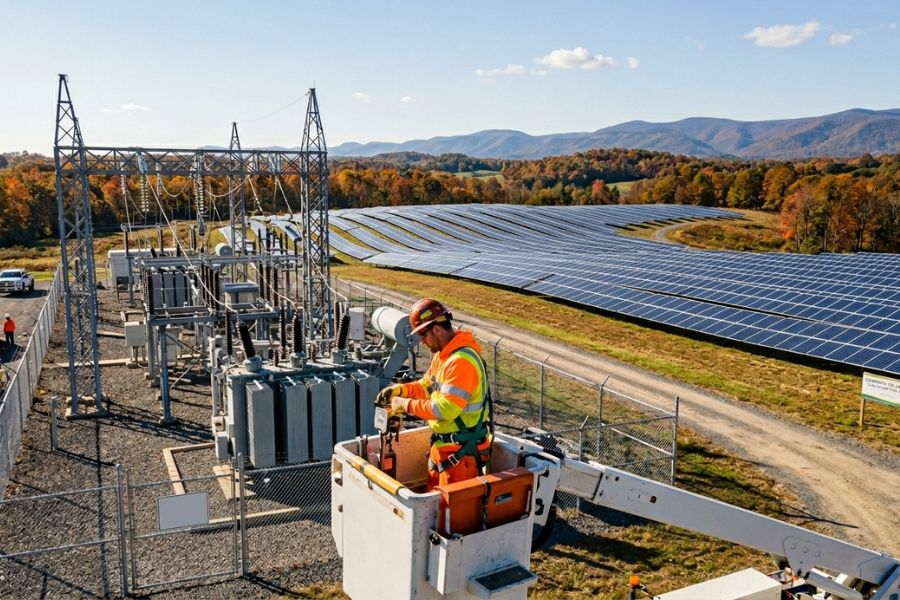
The first-of-its-kind pilot will tap into unused capacity at existing generation sites, creating a pathway to quickly deliver gigawatts (GW) to the grid without waiting for transmission upgrades. Under updated PJM rules, Surplus Interconnection Services (SIS) allow new solar, wind, and battery storage systems to plug in at an existing power plant’s grid connections: unlocking faster, lower-cost clean energy by using capacity that’s already built, already studied, and sitting idle, instead of waiting in PJM’s notoriously onerous interconnection queue.
“We’re excited to see this bill finally enacted into law, reacted Virginia Senator Schuyler VanValkenburg, an advocate of the legislation since the FAST Act was introduced in January. “We’re putting Virginia out front by moving power onto the grid faster and avoiding unnecessary costs. We’re doing what Virginians have asked of us: build the capacity our economy needs while keeping energy affordable.”
At scale, SIS could deliver an additional 2,000 megawatts (MW) of electricity to the grid, enough to power one million homes in the Commonwealth. Recent GridLab analysis found that fossil plant sites nationally could host up to 800 GW of clean energy today, with another 200 GW possible by 2030. That’s a major opportunity for Virginia, where many coal and gas peaker plants fire up only for a few high-demand hours and otherwise sit largely unused. Anything to make electricity more affordable in PJM is a welcome addition.
“Virginians have been clear that energy costs are too high, and this legislation addresses that problem head-on. We do not need to spend billions to build from scratch when we have capacity sitting on the grid,” said Virginia Delegate Phil Hernandez.
SIS provides multiple benefits, including:
- More affordable bills: By using grid connections that already exist, SIS can reduce the need for costly new gas plants, major transmission buildouts, and other upgrades- avoiding unnecessary spending that would otherwise show up on customers’ bills.
- Faster deployment of clean energy: SIS can bring new solar, wind, and battery storage online in months, not years, which is much faster than expensive new gas plants facing multi-year supply chain delays. Pairing solar and wind with batteries also brings significant cost savings to utility companies and customers a.
- Improved reliability: Pairing clean energy with storage makes the grid more durable, delivers power when customer demand is highest, and reduces Virginia’s dependence on aging fossil fuel plants.
- Community benefits: By opening existing power plant sites to new clean energy development, SIS keeps more energy development and the associated economic value in Virginia. Transitioning existing energy sites sustains local jobs, preserves local tax revenues, and supports long-term economic development while preventing stranded assets.
- Reduced Land Impacts: SIS prioritizes clean energy development at power plant sites that have already been studied, approved, and built for power generation and transmission, minimizing new land disturbance.
“The FAST Act is exactly the kind of common-sense grid reform we need right now: it cuts red tape and related costs, makes smarter use of existing infrastructure, and clears a faster path for resources to get built,” assessed Jim Purekal, Virginia policy director at national business association Advanced Energy United. “Governor Spanberger and the General Assembly have sent a clear message that Virginia isn’t going to sit on the sidelines while demand rises and energy costs climb. Virginia is stepping up, speeding up, and showing the rest of the country what modern energy policy looks .”
Virginia Expands Community Solar Program
Last week, Governor Spanberger signed bipartisan legislation that significantly expands the Commonwealth’s d solar programs beyond pilot-scale in further efforts to lower electricity bills and improve grid reliability. The bills were sponsored by Senator Scott Surovell and Delegate Rip Sullivan and passed with bipartisan support in the Virginia General Assembly.
Dominion Energy territory (SB 254 / HB 807): Virginia’s original 200 MW d solar program has been fully awarded across 52 projects, serving tens of thousands of customers and leaving additional projects and subscribers on waitlists. The signed legislation requires the release of 525 MW of new d solar capacity by July 1, 2026, including a dedicated portion for low-income subscribers, and establishes a clear, predictable process for future program expansion overseen by the State Corporation Commission (SCC).
Appalachian Power (ApCo) territory (SB 255 / HB 809): ApCo’s 50 MW d solar program launched in 2025 and was oversubscribed almost immediately. The signed legislation improves customer participation by establishing consolidated billing, aligning APCo’s program with best practices already in place elsewhere in the state, and laying the groundwork for future capacity releases to meet strong demand across Southwest Virginia, including the release of an additional 50 MW of capacity by July 1, 2026, and another 50 MW by January 1, 2028.
d solar projects, also known as community solar projects, are typically small- to mid-sized facilities located on farmland, rooftops, brownfields, and other underutilized sites. They can be deployed faster than traditional utility-scale generation, support local economic development, and provide landowners with stable, long-term revenue while preserving working lands.

Community solar in Virginia already s participating customers 10% or more on their monthly electricity bills, which works out to roughly $175 per year, while delivering system-wide benefits by reducing the need for costly generation, transmission, and distribution investments. A third-party analysis of expanded programs (based on 2 GW of new capacity) in Virginia found $64 million in net benefits in the first two years alone and more than $2.4 billion in net benefits over 25 years, with savings accruing to all utility customers whether or not they directly subscribe.
Together, the bills passed this month represent one of the most comprehensive state-level clean energy packages of 2026. According to industry analysts, this positions Virginia as a national leader in distributed energy policy, without new taxes or subsidies.
“Governor Spanberger has shown that affordability and local clean energy go hand in hand — and today’s signings are proof,” said Charlie Coggeshall, Mid-Atlantic director at the Coalition for Community Solar Access. “By expanding d solar into both Dominion and Appalachian Power territories, Virginia is building an energy system that works for every ratepayer, not just those who can afford rooftop panels. We are grateful for the Governor’s leadership and for the legislators who fought to get this across the finish line.”
“d solar has already proven itself as one of the fastest, most cost-effective ways to deliver real savings to Virginians,” added Sen. Scott Surovell, sponsor of the d solar legislation. “These bills are about scaling what works—giving more families access to affordable power while strengthening reliability and keeping investment here in Virginia.”
Sumber Artikel:
Renewableenergyworld.com