

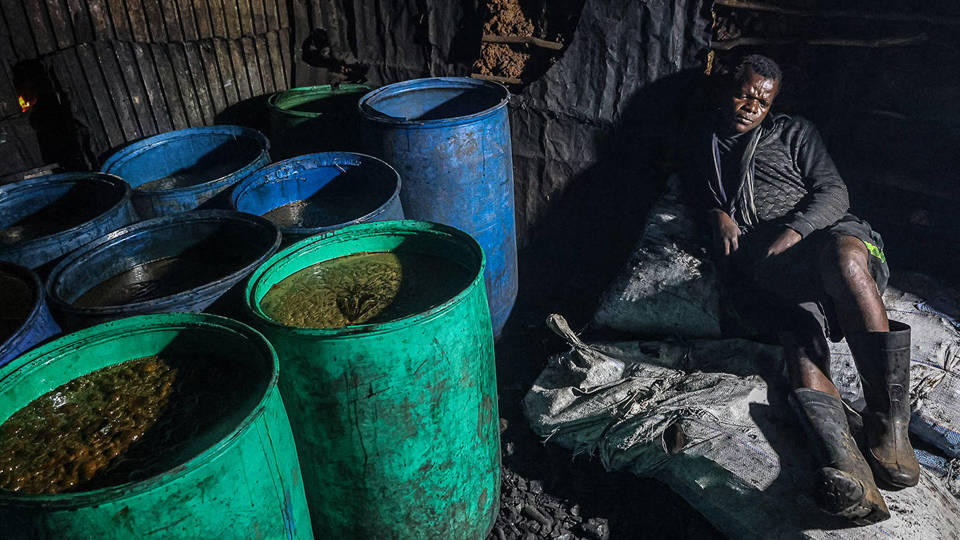
 Donwilson Odhiambo/Getty Images
The international community is increasingly trying to distinguish between climate, development, and humanitarian finance—as if they can be neatly compartmentalized. But this siloed approach overlooks how social-protection programs providing cash transfers to vulnerable households can strengthen resilience to climate shocks.
Listen to this commentary Please log in to listen to this commentary 0:00 / 0:00 Audio unavailable
Climate shocks trap poor households in a downward spiral. Droughts and floods not only wipe out crops but also destroy homes and kill livestock. Lacking insurance or access to safety nets, the poor are often forced into distress sales of the very assets they need for early recovery. Humanitarian aid may lives, but it invariably delivers too little, too late to prevent people from falling deeper into poverty.
How do we prevent the climate crisis from reversing decades of progress on poverty reduction? In our view, there are two imperatives. First, we must keep the 2015 Paris climate agreement’s goal of limiting global warming to 1.5° Celsius within reach. That means we cannot afford to move at the pace of the most recalcitrant negotiators. Thus, Brazil has called for multilateral coalitions willing to work at the speed and scale required to accelerate the transition to net-zero carbon emissions.

Secure your copy of PS Quarterly: Winners & Losers – and $20
In the new issue of our magazine, leading thinkers examine how recent developments, from the AI revolution to intensifying geopolitical volatility, are reshuffling the economic and financial deck and generating new winners and losers across the global economy.
Subscribe to PS Premium now, with a $20 discount, to read the issue, featuring Claudia Goldin, Mark Blyth, Dambisa Moyo and others.
Subscribe Now
Second, we must empower poor people to adapt to a crisis they played no part in creating. Here, too, speed and scale are critical. At the United Nations Climate Change Conference in Brazil (COP30), governments recognized that their national adaptation plans should be embedded within their development strategies. Overwhelmingly financed from national budgets, these plans present an opportunity to integrate climate adaptation with poverty reduction. Rich countries have now pledged to triple adaptation finance from the admittedly low current annual level of $40 billion.
We now need to ensure that increased adaptation finance delivers efficient and equitable results where they count—in the lives of the poor. The current architecture is unfit for that purpose because it is too fragmented and structured around increasingly anachronistic distinctions between climate, development, and humanitarian finance, as if these strands can be neatly compartmentalized.
Bilateral donors, multilateral development banks (MDBs), and mechanisms the Green Climate Fund, Global Environment Facility, and the Adaptation Fund account for most of what is currently categorized as climate-adaptation finance. As finance ministers noted ahead of COP30, delivery is marked by weak coordination, overlapping remits and associated turf battles, an emphasis on small-scale initiatives, and protracted delays between project approval and disbursement of funds. Governments typically have to parcel national adaptation plans into project-by-project funding requests—a process that comes with immense transaction costs.
Other interventions have been downplayed, partly because they are seen as part of a parallel “poverty finance” domain. Social protection is a case in point. National programs providing cash transfers to vulnerable households in response to climate shocks have a proven track record. Using digital identification, they can rapidly scale up support to address the impact of droughts and floods. Kenya’s Hunger Safety Net Programme provides regular support to around 800,000 people, but that number rises to around 4.5 million during droughts. Similar programs in Somalia, Ethiopia, and countries across the Sahel demonstrate that effective safety nets can be created even when governments have limited capacity and are mired in armed conflict.
From the perspective of the people at the sharp end of the climate crisis, the current system makes little sense. We need climate adaptation finance that improves access to meteorological information, drought-resistant seeds, and new irrigation technologies. But in the absence of increased investment in social protection, climate shocks will become the catalyst for unprecedented reversals in poverty reduction. Currently, just one in five people in the poorest countries are covered by a safety net.
Brazil’s experience is instructive. Under President Luiz Inácio Lula da Silva, social protection has played a central role not only in cutting poverty and combating hunger, but also in adapting to climate change. Efforts have been made to export this model through the creation of a Global Alliance Against Hunger and Poverty, which was established under Brazil’s G20 presidency. This international platform could enable donors, MDBs, and UN agencies to pool their resources and channel them through national social-protection systems that respond to climate risks. As an ODI Global report argues, such an approach would help prevent duplication, lower transaction costs, and reduce inefficiencies.
With international cooperation under attack and aid budgets falling, it is abundantly clear that we must change course. Vulnerable communities living on the front lines of the climate crisis have a right to expect more from multilateralism.
Help us strengthen our reporting on global health and development by taking a short survey.
Take Survey
Featured
-
After Orbán, Hungary Faces an Even Harder Battle
Apr 13, 2026 Maciej Kisilowski
-
The Hormuz Crisis and the Fate of the Global South
Apr 14, 2026 Laura Carvalho
-
The Decline and Fall of the Dollar Empire
Apr 9, 2026 Barry Eichengreen
-
Trump’s Next Coup Attempt
Apr 9, 2026 Timothy Snyder
-
To Work for Us, AI Must Not Think for Us
Apr 13, 2026 Dani Rodrik
https://prosyn.org/ttXso8K
It appears that you have not yet updated your first and last name. If you would to update your name, please do so here.
Please wait, fetching the form
Please wait, fetching the form
Please wait, fetching the form
Please wait, fetching the form
Please wait, fetching the form
Please wait, fetching the form
Please wait, fetching the form
Sumber Artikel:
Project-syndicate.org

