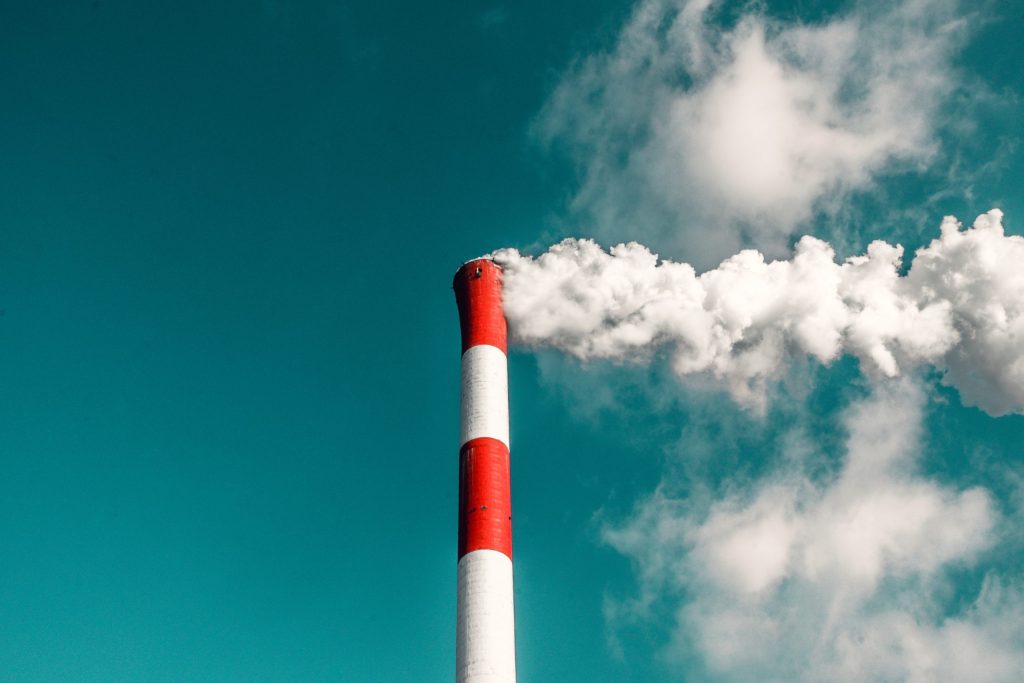

The “all-of-the-above” approach toward generation development in the U.S. is great for power-hungry data centers, but probably not-so-great for the air we breathe.
Anyone in the clean energy sector could ly have guessed that, but new analysis from BloombergNEF provides some additional data to back it up. According to Bloomberg, power developers are planning 99 new bespoke natural gas plants to power data centers. That’s a huge jump for an industry that only a few years ago was largely focused on replacing capacity from coal plant retirements and providing flexible power to balance renewable generation.
These 99 proposed plants could emit up to 318 million metric tons of carbon dioxide each year, which would mean a 20% increase in U.S. power sector emissions compared to last year’s 1,485 million metric tons overall, per EIA data. This assumes that all 99 of the plants get built, but the potential of such a large increase in emissions underscores how data centers’ appetite for power has revived the gas industry.
Coal is experiencing its own comeback: the DOE issued an emergency order directing the Midwest Independent System Operator (MISO), in coordination with Consumers Energy, to ensure that the 1,420-MW J.H. Campbell coal-fired power plant (Campbell Plant) in West Olive, Michigan is available to operate. The plant was originally scheduled to shut down on May 31, 2025, 15 years before the end of its scheduled design life.
And don’t forget heavy fuel oil (HFO): this week, the Department of Energy (DOE) issued an emergency order permitting PJM Interconnection to continue running the HFO-fired Unit 4 at the Wagner Generating Station in Anne Arundel County, Maryland. PJM had previously requested the order to continue operating the unit beyond its current operating limit to meet high demand in the region.
The grid is getting stretched thin, and emissions goals are getting tossed aside as the reality continues to set in.
Welcome to the Factor This Brief, a weekly collection of energy industry finance and development updates, delivered straight to your inbox on Monday mornings and hosted in a not-so-brief fashion here on Factor This, featuring the people, projects, and technology driving our electric future.
As you may have noticed, I’m filling in for Paul Gerke this week, who is about to return from a well-deserved vacation. Worry not, as Mr. Gerke (and his music taste) will be back in your inbox for the next edition of the Factor This Brief.
As always, thanks for reading. If you catch a piece of news you’d to see in our weekly roundup, please drop Paul Gerke a line. He’ll be back in action this week with an overflowing inbox as the price to pay for some much-needed time off.
The largest clean energy investment in North American history?

Canada’s Prime Minister, Mark Carney, announced C$10 billion (~$7.26 billion USD) in federal financing to upgrade and expand the hydroelectric Churchill Falls Generating Station; develop the Gull Island hydroelectricity project; unlock co-investment opportunities with the Innu of Labrador in a major new Labrador onshore wind project; and to build transmission lines.
The Canadian government touts these collective projects as the largest clean energy investment in North American history, at nearly C$70 billion ($50.4 billion USD). Together, these projects could deliver 14,000 MW of clean power, which nearly triples the current generating capacity of Churchill Falls.
Bring your own capacity… for data centers?
Households in the PJM and MISO territories are getting an opportunity to get paid for a demand response program supplying power to data centers during periods of high grid stress.
Sunrun, a provider of residential battery storage, solar, and home-to-grid power plants, announced an agreement with Voltus, a distributed energy resource platform, to support Voltus’s “Bring Your Own Capacity” (BYOC) programs for AI hyperscalers.
Under the agreement, Sunrun will provide energy capacity from a portion of its thousands of residential storage-plus-solar systems in PJM and MISO grid regions.

Last year, Voltus announced its BYOC program, which allows large loads hyperscalers to provide firm, flexible capacity to facilitate data center interconnection and support the grid. As part of that program, Voltus will orchestrate flexible distributed resources — such as batteries and smart thermostats — to reduce energy demand when the grid needs it.
“Meeting growing energy demand requires us to maximize every single electron available across the country,” said Sunrun CEO Mary Powell. “In collaboration with Voltus, we are providing critical capacity from home batteries supported by funding from hyperscalers. This is just the beginning of what distributed energy assets can achieve.”
The Sunrun-Voltus collaboration builds on the recent and separate initiative by Sunrun, Renew Home and Tesla focused on unlocking more than 16.8 gigawatts of flexible capacity from home batteries, solar, smart thermostats, and EVs.
Dimension Energy grows its distributed solar platform
Dimension Energy, a developer, owner, and operator of distributed energy infrastructure, announced that it has secured $857 million of additional capital to accelerate the growth of its distributed solar platform. This s Dimension’s closing of a $650 million portfolio financing earlier this year.
The $657 million financing will provide construction debt and tax equity financing for a portfolio of 29 distributed solar projects across Illinois, New Jersey, New York, Pennsylvania, and Virginia, totaling 149 MW.
The new capital comprises a $200 million upsize of the company’s corporate credit facility, with lead lenders being Nuveen Energy Infrastructure Credit and funds and accounts managed by HPS Investment Partners, together with a $657 million construction-to-term debt and tax equity financing package.
Dimension currently owns over 600 MW of distributed energy assets operating and under construction. The company argues these financings will support its growth to 1 GW of operating assets by 2028.
LG Energy Solution spins up a new domestic battery plant
Battery manufacturer LG Energy Solution has started production at its brand-new battery plant in Lansing, Michigan. The plant will build battery cells both for energy storage systems and electric vehicles.
The facility produces lithium-iron phosphate (LFP) battery cells for energy storage systems (ESS). The cells are integrated by LG Energy Solution Vertech, the company’s U.S. energy storage division, into complete systems for utility, grid-scale storage, and other commercial and industrial applications.

Additionally, the plant will produce nickel-manganese-cobalt (NMC) cells for Toyota’s battery powered vehicles, the 2027 Toyota Highlander EV.
At full production scale, LG Energy Solution hopes to reach more than 35GWh of annual battery-making capacity. Since 2022, LG Energy Solution has invested more than $2 billion in the Lansing facility, which currently employs about 900 employees. At full capacity, employment is anticipated to grow to 1,700.
Sumber Artikel:
Renewableenergyworld.com