
Contributed by Khalid Mandri, president of ABB’s Installation Products Division. Edited by Sean Wolfe.
The microgrid sector has evolved from a niche alternative into a cornerstone of the global energy architecture. Valued at roughly $36.4 billion in 2026 and projected to reach nearly $166 billion by 2035 according to Global Market Insights Inc., the market’s rapid expansion reflects a fundamental shift in how business leaders and engineers approach power delivery.
Once viewed primarily as localized backup for remote sites, microgrids are now recognized as essential tools for operational continuity, cost control and decarbonization. However, as the industry continues to grow, it faces a dual challenge of meeting surge demand while navigating physical bottlenecks at the traditional grid edge.
Capacity is no longer the singular core issue, but is intensified by physical connectivity, speed of deployment and infrastructure flexibility. Across the economy, dynamic power requirements are outpacing the physical grid. Onshoring initiatives, the rapid spread of high-density data centers, EV fleet hubs and temporary large-scale events create huge load spikes that local utility substations aren’t designed to handle so suddenly. More than 2,500 gigawatts of clean energy projects currently sit stalled in global grid interconnection queues. Even though utility companies are making great strides to modernize infrastructure and expand capacity, high-demand situations, such as those involving multi-day sporting events and disaster recovery operations to remote construction sites and fleet charging stations, can’t always wait for transmission upgrades that could take several years to complete.
The Problem with Yesterday’s Temporary Power
The delay results in heavy operational, financial and environmental expenses. For many years, the only option available for supplying power to temporary or remote installations was a single carbon-intensive method that relied on a series of diesel generators operating around the clock.
Besides environmental disadvantages, operational blind spots exist due to a lack of visibility of actual needs. Traditional generators kept running regardless of whether load demand was at 10% or 90%, burning fuel inefficiently and providing no real-time data on operational consumption.
To reduce the carbon emissions associated with temporary power and, at the same time, ease the burden on local municipal substations, it’s necessary to move away from static generation to an intelligent, hybrid approach. The aim shouldn’t be to get rid of generators all at once, but to optimize the whole system by combining Battery Energy Storage Systems (BESS), intelligent energy management platforms and smart switchgear.
Far from being simple stopgap measures, flexible microgrids act as the best testing ground for the permanent grid edge, demonstrating how digital energy management, battery storage and smart distribution equipment can provide clean power on demand without having to connect to local utility lines.
Lessons in High-Stakes Operations
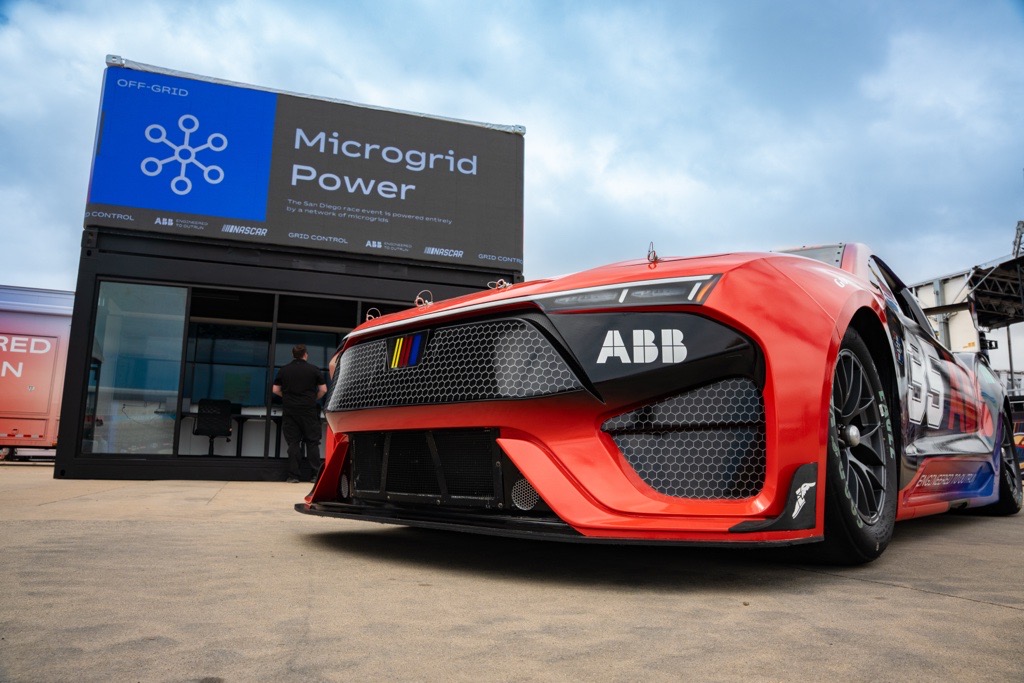
A good example of this hybrid microgrid architecture in action took place recently at the NASCAR San Diego Weekend.
The large amount of energy required to power a major race at a non-racetrack venue creates a massive, temporary energy footprint. Power is needed for a wide range of operations, the pit road and telemetry streams, as well as fan zones and broadcast compounds. Linking a temporary load of that magnitude to the local municipal electricity grids puts excessive strain on local utility lines that could threaten local grid reliability and cause voltage drops for surrounding communities.
To address this, NASCAR established an independent, temporary microgrid network that operated entirely without being connected to any existing grid. Working alongside equipment partners who supplied the physical equipment, including BESS units and generators, ABB introduced an overall energy management system to monitor and optimize the entire setup as part of being NASCAR’s official electrification partner.
The system operated on a hybrid strategy where containerized BESS served as the main power source for race operations while conventional generators were switched on for just two to three hours each day solely to recharge the batteries. This kind of hybrid setup reduced generator runtime from 24 hours down to a fraction of the time, leading to a significant decrease in fuel consumption and operational carbon emissions.
Most importantly, the deployment included real-time edge monitoring and telemetry sensors in five distinct event zones. Through an aggregated energy dashboard, engineers and operational leaders could monitor energy consumption, hybrid storage performance and carbon avoidance in real time – essential data to optimize future operations for stronger energy efficiency and lower carbon emissions.
For this one example, NASCAR delivered 24/7 electricity for fans, drivers, and operations throughout race weekend, while saving 380 gallons of fuel and lowering emissions an estimated 3.9 metric tons, which is equivalent to removing 19 semi-trucks from the road in a day. The savings that could be obtained over an entire NASCAR race season would be very significant.
Lessons from Mobile Deployments
The success of off-grid activations in high-stress, high-vibration environments offers valuable takeaways for power system designers, project developers and grid technology leads:
- Data loops transform hardware into intelligent assets
Getting battery storage or switchgear installed is only half the battle; it’s having real-time visibility that leads to efficiency or balance consumption. With the use of wireless sensors and cloud-based monitoring, operators can keep track of zone-specific consumption, spot load anomalies before they cause overloads and feed performance data back into future planning. As a result, site developers and energy engineers can eliminate off-hour waste, ensure future equipment needs are appropriately sized and cut energy-related operational costs.
- Modular hardware enables speed without sacrificing safety
In temporary or quickly deployed environments, equipment faces a lot of physical stress. Using movable power distribution panels, circuit breakers designed for rapid setup and equipment with specialized viewing windows ensures high reliability under compressed timelines.
- Hybrid systems provide immediate decarbonization
Pursuing net-zero operational goals doesn’t require an all-or-nothing approach. Using BESS as the primary power buffer while cycling backup generation for brief recharge windows creates a bridge strategy that delivers reliable power while cutting emissions today.
A Pressure-Relief Valve for the Broader Grid
As the demand for power continues to grow, mobile microgrid systems will play an increasingly vital role beyond sports and entertainment.
Whenever emergency services deploy to disaster areas, fleet operators set up temporary EV charging stations or industrial sites start off-grid projects. These flexible systems offer a proven way to deliver power rapidly. Above all, they function as an additional solution that complements the existing utility infrastructure, reducing the strain on local substations during peak usage times and enabling the utilities to have the flexibility needed to plan and carry out longer-term grid upgrades.
Meeting our increasing energy needs involves carrying out long-term, large-scale expansion of utility infrastructure as well as carrying out quick, small-scale innovation at the grid edge. Since the microgrid market is now approaching $36.4 billion, these flexible systems have shown that it’s possible not to have to make a choice between immediate power supply and long-term sustainability. Through the use of real-time data loops, flexible distribution equipment and storage-first energy strategies, we can reduce strain on local utilities while at the same time providing reliable, sustainable power wherever it’s needed – on the track, in our communities and across the modern grid.
Sumber Artikel:
Renewableenergyworld.com