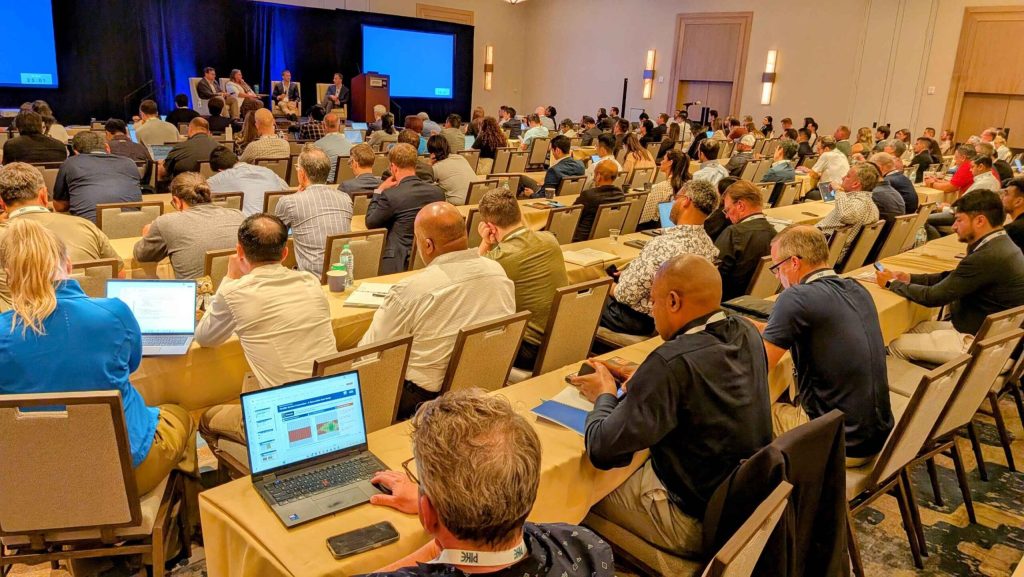

How utilities are managing a massive surge in data center power demand across the country was a top focus at DTECH Data Centers & AI. A lot has changed since the last iteration of the event, when questions about who pays for the AI boom dominated the narrative. In 2026, the most emergent challenge is enabling interconnection without compromising grid reliability or customer affordability, as highlighted by the team at Wood Mackenzie during the Innovations for Large Load Interconnection workshop that opened the event.
Known for its regular industry reports and deep expertise, Wood Mackenzie has dedicated teams specifically focused on grid transformation and large loads. Building on the heels of a recent webinar that teased these very dynamics, they brought together utilities, developers, and RTO representatives to explore how stakeholders on every side of these challenges are working to resolve them.
This variety of perspectives from across the nation demonstrated that there is no one-size-fits-all solution or data center model that will work everywhere and for everyone. However, just as utilities can transform data center backlash into a catalyst for grid modernization, they can also rethink how they approach, integrate, and position these facilities. Ultimately, this shift in mindset proved foundational to the entire event, underscoring that overcoming these challenges isn’t just about projects and processes but about policies and people.

Where Energy Demand Meets Utility Scale
Ben Hertz-Shargel, global head of grid edge at Wood Mackenzie, anchored many of the panel discussions through the event, but he opened it with a presentation that outlined where things are with the energy demand that data centers are designed to serve, as well as specifics related to how they’re supposed to serve it. One of his key observations was that not all data center loads are created equal, highlighting the inherent flexibility that many stakeholders want to see built in as a baseline capability. However, critical questions remain about what this looks in the long term.
“There’s a lot of talk around flexibility with data centers, and I think it’s an open question about whether or not this is a long-term vision at scale,” said Hertz-Shargel. “Are we going to see more flexible and essentially curtailable data centers, or is firm service through transmission-enabled generation the ultimate long-term plan?”
While some have made the case that intelligence is cheaper than infrastructure, with a push for demand-side flexibility, the disconnect between hyperscaler demands and utility capacity remains stark. Hertz-Shargel detailed the reality of the 187 gigawatts in data center commitments that utilities have made, and talked through how the ly much smaller number of additional gigawatts that will actually be added to the grid is why many are pushing toward co-location to bring this capacity online faster. However, plugging massive data centers directly into power plants introduces severe technical hazards. He detailed what these technical challenges look in current models, while also talking through how they’re set to evolve as chip technology and algorithmic training architectures similarly do.

Growth Paying for Growth
The traditional utility interconnection queue was built for a different era and has been entirely overwhelmed by an influx of gigawatt-scale data center requests. In response, utilities have moved away from sequential backlogs toward holistic, geographic cluster assessments. It’s the sort of shift we’ve seen with recent news out of PJM, but has also compelled a different approach from utilities themselves.
Arizona Public Service (APS) is the largest electric utility in Arizona, which has positioned the organization to manage a massive influx of data center power requests. To do so, they’ve worked to do things better formalize scoping meetings, compel higher financial deposits, set firmer deadlines for site control, and designate withdrawal windows in a way that is more about collaboration than antagonism.
“We’re partnering with our customers to figure out how to bring them to the grid,” said Christopher Parten from APS. “It’s evolving as we’re seeing more constraints with generation, but speed to market is the biggest thing. We want to make sure growth pays for growth, and we’re both on the same page with risk in terms of what we’re putting into the grid.”
This push for accelerated time-to-market requires major technological upgrades to utility planning processes, leveraging study automation software to drastically reduce the engineering hours required to evaluate new grid impact requests. It’s why utilities are breaking down deeply entrenched internal silos to pioneer joint planning for load and generation.
Beyond the planning phase, managing the real-time operational risks of these hyper-scale facilities demands a complete reimagining of grid defense strategies. Rapid data center dispatches and automatic load transfers to behind-the-meter backup generation have already triggered massive, unintended grid impacts, including severe voltage and frequency excursions. It’s an issue connected to the flexibility that is needed, as well as what interconnection looks , not just at an individual project level, but at scale across the industry.

Scalable Interconnection for the AI era
The massive infrastructure upgrades required to support data centers have introduced severe financial risks for everyday ratepayers. Projects across the nation have been canceled or delayed when communities make assumptions about who’s ultimately paying to meet this demand, which is why utilities are working to solve these challenges with commercial frameworks the Transmission Security Agreements to control costs and better showcase a project’s ultimate value. They’re essential tools, but require an understanding of jurisdictional boundaries that everyone needs to work within.
“FERC is essentially the commissioner of the soccer league,” explained Justin Felt of Exelon. “They set the parameters. The referee is PJM—they’re the ones blowing the whistle and calling goals. The players are the transmission owners and generators.”
This analogy illustrates the various stakeholders within the energy ecosystem, where everyone impacts affordability in different ways. No single entity controls the game or how others play it, as their roles are entirely interdependent.
While navigating these regulatory rules, the industry is simultaneously discovering that data center flexibility can become a powerful tool for lowering retail electricity rates. The Brattle Group found that integrating flexible data center loads could add up to more than $110 billion in customer savings.
Understanding these efficiencies at scale could completely reshape how the industry approaches data center energy demand. Ultimately, though, it all loops back to the foundational concepts of what, how, and when load flexibility is deployed, which Hertz-Shargel discussed to open and close the workshop.

Flexibility solutions for data center interconnection
Solving the data center interconnection puzzle is a challenge that begins and ends with operational flexibility. With the right framework, these assets can be transformed from static energy consumers into active grid resources.
Chief among these strategies is deploying large-scale, behind-the-meter battery storage directly at the data center site, allowing operators to shave peak demand and better manage localized ramp rates. Simultaneously, third-party aggregators are forming Virtual Power Plants (VPPs) that bundle these distributed energy resources to inject flexibility back into the system during regional constraints. Bring Your Own Capacity (BYOC) models are also supporting these frameworks by integrating self-supplied energy requirements directly into the interconnection agreement.
Deploying distinct frameworks and configurations forces developers to navigate complex approvals that have to be customized for individual grid topologies. Enabling them at scale will require a shift in the regulatory paradigm away from labor-intensive one-offs based on what’s worked for individual teams and utilities. Crucially, though, these shifts can draw on these individual lessons in ways others can similarly leverage.
“There is no single solution that is going to fix this challenge and everything that’s coming,” said Sarah Colvin of Camus Energy. “What does transmission and distribution coordination look ? Is it at the edge, or is it at the generation level? We need data across every level to drive insights and make actionable recommendations. It sounds easy, but it’s not. It’s going to take a true grid orchestrator to mold all of this together.”
Sumber Artikel:
Renewableenergyworld.com