

Datadog helps AI customers monitor their models, chips, and more
Datadog’s cloud observability platform helps businesses monitor their digital infrastructure, so they know immediately when a technical glitch disrupts an important sales channel or a mission-critical piece of software. This enables managers to fix the problem before it impacts the customer experience. The company has now developed a series of products to help businesses monitor their AI infrastructure in the same way.
In 2024, Datadog launched LLM Observability, which helps developers track costs, identify technical problems, and monitor output quality when building large language models (LLMs). These models power customer-facing AI software chatbots and agents, so they have to produce accurate outputs or else the business risks severe reputational damage.
More recently, Datadog launched another product called GPU Monitoring, which helps businesses track usage, costs, and technical bugs when deploying data center graphics processing units (GPUs). These are the primary chips used in AI training and inference workloads, so they must remain operationally healthy to keep software applications running smoothly.
Datadog had 33,400 customers at the conclusion of the second quarter of 2026 (ended June 30), and around 750 of them were AI-native enterprises. That included all 10 of the industry’s leading AI companies, and although Datadog didn’t name them specifically, investors can reasonably assume the s of OpenAI and Anthropic are on that list.
But AI usage is growing well beyond that small group of AI-natives. Datadog said Model Context Protocol (MCP) server calls quadrupled during the second quarter compared to the first quarter, just three months earlier. An increase in MCP calls simply means there is more AI-related activity happening in Datadog’s ecosystem; in other words, customers are rapidly adopting its AI products.
Expand

NASDAQ: DDOG
Datadog
Today’s Change
(-0.41%) $-0.97
Current Price
$232.55
Key Data Points
Market Cap
$84BMarket cap calculated using publicly traded s outstanding only. Does not include unlisted, private, or dual-class non-traded s. Implied market cap may vary.
Day’s Range
$227.11 – $236.56
52wk Range
$98.01 – $292.72
Volume
1.3K
Avg Vol
5.2M
Gross Margin
79.48%
Datadog’s revenue growth just accelerated to 36%
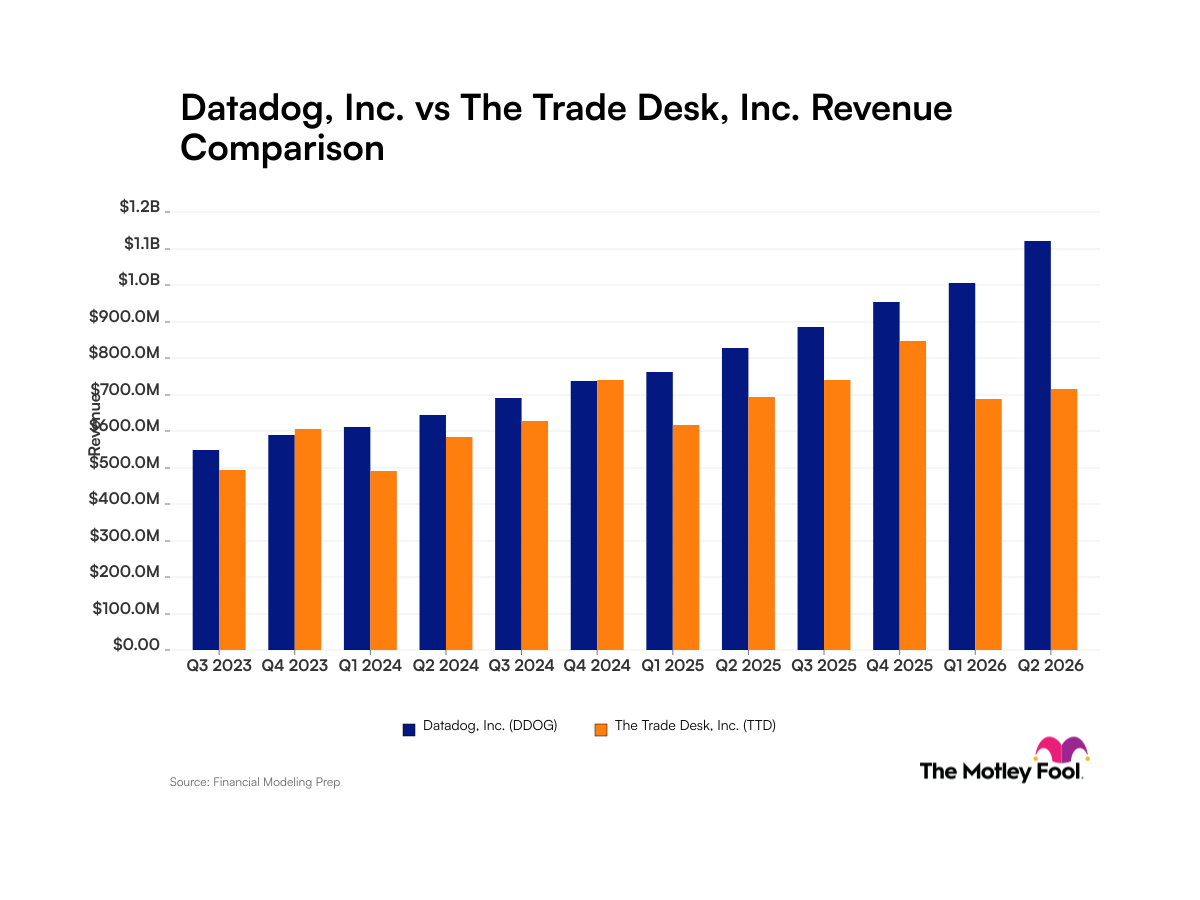
Datadog generated a record $1.12 billion in total revenue during the second quarter, topping management’s forecast of $1.075 billion. It was a 36% increase from the year-ago period, marking an acceleration from the first quarter when revenue grew by 32%.
The result was so strong that management increased its full-year revenue forecast for 2026 by $140 million, to $4.46 billion (at the midpoint of the guidance range).
Datadog used to sacrifice profits to drive rapid revenue growth, a strategy many technology companies use. But it’s actually having a great year at the bottom line, generating $97.1 million in generally accepted accounting principles (GAAP) net income through the first six months. That was a 255% jump from the same period last year.
On an adjusted (non-GAAP) basis, which excludes one-off and non-cash expenses such as stock-based compensation, Datadog generated a profit of $458.6 million in the first half of the year, up 38%.
But with a price-to-sales ratio above 20, Datadog stock isn’t cheap
Based on Datadog’s trailing 12-month revenue, its P/S ratio is 22.7. The company is quite unique with very few direct competitors in the public markets, but its stock is far more expensive than a basket of other top cloud and AI software names, including Microsoft, Alphabet, and Atlassian.
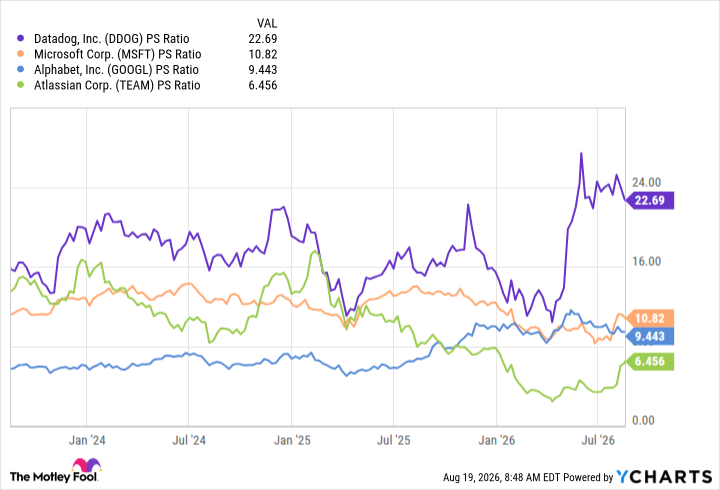
Data by YCharts.
To drive the valuation issue home even further, the Nasdaq-100 index trades at a P/S ratio of 6.2, so Datadog is significantly more expensive than a group of America’s most valuable technology stocks.
Even if we value Datadog stock based on Wall Street’s $5.47 billion revenue estimate for 2027 (provided by Yahoo! Finance), it still trades at a hefty forward P/S ratio of 16.1.
Therefore, investors who buy this stock hoping to earn a strong return over the next 12 months might be disappointed. Anyone who buys the stock today should maintain a long-term horizon of at least five years to maximize their chances of earning a positive return. Personally, I would wait for an opportunity to buy it at a cheaper price, which might come about if there is a sell-off in the broader market.
Read Next

•By Anders Bylund
8 Best Cybersecurity Stocks for 2026 and How to Invest
•By Robert Izquierdo

Datadog (DDOG) Q2 2026 Earnings Call Transcript

•By Robert Izquierdo
Datadog’s CEO Sellls Over 127,000 s for $36.5 Million. Here’s a Closer Look at the Transaction.
•By Daniel Sparks
Datadog Beat on Revenue, Beat on Earnings, and Raised Its Outlook. The Stock Fell 19%.

•By Robert Izquierdo
What Does the Datadog CEO’s Sale of Company s Worth $11.5 Million Mean for Investors?
About the Author

Anthony Di Pizio is a contributing Motley Fool technology analyst covering artificial intelligence, cloud computing, autonomous vehicles, and enterprise software. Previously, Anthony was a licensed fund manager, stock broker, and corporate advisor. He holds a bachelor’s degree in commerce and economics from Macquarie University in Sydney, Australia, along with ASIC RG146 certifications in financial securities and derivatives.
Stocks Mentioned

Datadog
NASDAQ: DDOG
$232.55
(-0.41%)-$0.97

Motley Fool Stock Advisor’s Latest Pick
—% Avg Return
*Average returns of all recommendations since inception. Cost basis and return based on previous market day close.
Sumber Artikel:
Fool.com

