

A potential $450 billion opportunity
Serve says the median distance traveled for a food delivery order in the U.S. is about 2.5 miles, and it currently costs between $8 and $10 to deliver by car with a human driver. The company believes it can reduce that cost to just $1 per order by using its Gen 3 robots, because they can eliminate driver wages and operate for 14 hours straight on a single charge.
The Gen 3 robots are powered by Nvidia‘s Jeston Orin platform, which provides all of the hardware and software necessary to achieve Level 4 autonomy. That means Serve’s robots can safely drive on sidewalks within designated areas without any human assistance, and they are now successfully doing so in at least eight major U.S. cities, including Los Angeles, Miami, and Chicago, where they boast an impressive 99.8% order completion rate.
Serve plans to grow its domestic and international presence to capture what it believes will be a $450 billion market for robotic and drone delivery. The company will have to expand beyond just food and retail delivery to build a formidable market , which is why it acquired another robotics enterprise, Diligent, in January.
Diligent developed its own Nvidia-powered robot for the healthcare sector called Moxi. It operates within hospitals, transporting medication, lab samples, and equipment across departments so nurses and doctors can spend less time running around and more time with their patients. So far, the move into healthcare has broadened Serve’s footprint to 44 U.S. cities across 14 states.
Serve just cut its 2026 revenue guidance by more than half
Serve generated $3.2 million in revenue during the second quarter of 2026, which was a 404% increase from the year-ago period. The company benefited from the inclusion of Diligent’s revenue, which was absent in the same quarter last year because it pre-dated the acquisition.
Serve came into 2026 expecting to generate $26 million in total revenue for the year, but management drastically reduced that forecast to $9 million to $10 million after the second quarter due to concerns about lower Uber Eats delivery volume than initially anticipated. Given that the company generated $6.2 million in revenue during the first half of 2026, that means it could bring in as little as $2.8 million in the second half — a dramatic decline.
Expand

NASDAQ: SERV
Serve Robotics
Today’s Change
(-1.80%) $-0.09
Current Price
$4.90
Key Data Points
Market Cap
$425MMarket cap calculated using publicly traded s outstanding only. Does not include unlisted, private, or dual-class non-traded s. Implied market cap may vary.
Day’s Range
$4.80 – $5.30
52wk Range
$4.32 – $18.64
Volume
31.4K
Avg Vol
4.8M
Gross Margin
-37009.37%
That also has implications for Serve’s bottom line. The company already lost over $113 million on a generally accepted accounting principles (GAAP) basis during the first half of this year, so unless management significantly cuts costs to offset its lower revenue forecast, there could be an even steeper loss in the second half.
Serve only had $240 million in cash, cash equivalents, and marketable securities on hand as of June 30, so it simply can’t afford to continue losing money at the current pace for much longer. If its bottom line doesn’t improve soon, it might have to take on debt or raise money from investors, which would dilute every existing holder.
More downside might be ahead for Serve stock
Despite already plunging by 80% from its 2024 record high, Serve stock is still very expensive. It’s trading at a price-to-sales (P/S) ratio of 46, a whopping seven times higher than the P/S ratio of the Nasdaq-100 index, which is 6.3. In other words, it looks heavily overvalued compared to a basket of America’s best technology stocks.
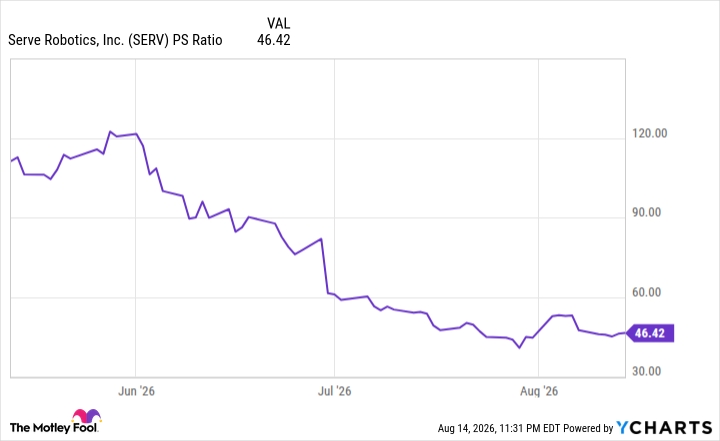
SERV PS Ratio data by YCharts
To make matters worse, investors who were willing to pay a premium for Serve stock because of its growth prospects just had their thesis shattered by management’s reduced revenue forecast. If we assume Serve does bring in $10 million during 2026, its forward P/S ratio remains at a sky-high level of 42.
Simply put, it might be a good idea to avoid Serve stock for the foreseeable future because its rich valuation opens the door to even more downside.
Read Next

Serve Robotics (SERV) Q2 2026 Earnings Call Transcript

Serve Robotics is Crashing: Buy the Dip?

How to Buy Serve Robotics Stock (SERV) in 2026
•By Keith Speights

•By Neil Patel
About the Author

Anthony Di Pizio is a contributing Motley Fool technology analyst covering artificial intelligence, cloud computing, autonomous vehicles, and enterprise software. Previously, Anthony was a licensed fund manager, stock broker, and corporate advisor. He holds a bachelor’s degree in commerce and economics from Macquarie University in Sydney, Australia, along with ASIC RG146 certifications in financial securities and derivatives.
Stocks Mentioned

Serve Robotics
NASDAQ: SERV
$4.90
(-1.80%)-$0.09

Motley Fool Stock Advisor’s Latest Pick
—% Avg Return
*Average returns of all recommendations since inception. Cost basis and return based on previous market day close.
Sumber Artikel:
Fool.com

