

It could be decades before quantum computers are truly useful
Rigetti is uniquely positioned to lead the quantum industry because it has built its own supply chain, which means it can bring new computers to market much faster than its competitors. It operates its own fabrication facility, developed its own quantum programming language called Quil, and it has also built a cloud platform where it rents quantum computing capacity to other businesses for a fee.
Rigetti’s flagship Cepheus-1-108Q quantum computer is the industry’s largest multichip system. With 108 qubits, it delivers three times the scale of the company’s previous Cepheus-1-36Q system, while boasting a median single-qubit gate fidelity of 99.9%. That means it makes just one error per every 1,000 quantum operations. But its two-qubit gate fidelity is 99.1%, implying nine errors per 1,000 operations, so it’s still impractical for solving many real-world problems.
Making multiple qubits work together in harmony is one of the biggest challenges in quantum computing, because they are highly sensitive to noise and interference. Rigetti believes it can upgrade Cepheus-1-108Q to achieve a two-qubit fidelity of 99.5% this year, but the company says a system with a two-qubit fidelity of 99.9% could be three years away.
According to an estimate by Ark Investment Management, it could take somewhere between 20 and 40 years before quantum systems are accurate enough to disrupt areas cryptography, so even as one of the industry leaders, Rigetti still has a long way to go.
Inconsistent revenue growth and steep losses
Rigetti’s revenue soared by 198% year over year in the first quarter to reach $4.4 million. The company intends to deliver an $8.4 million order for Cepheus-1-108Q to India’s Center for Development of Advanced Computing later this year, so that alone would result in revenue growth for 2026 relative to the prior year.
However, Rigetti’s revenue declined in 2025, so there isn’t a sustained upward trend just yet. This is a common trait of companies in the start-up phase, but that only makes Rigetti’s $7 billion market capitalization all the more problematic in my opinion (more on that in a moment).
Expand

NASDAQ: RGTI
Rigetti Computing
Today’s Change
(-1.91%) $-0.40
Current Price
$20.25
Key Data Points
Market Cap
$6.7B
Day’s Range
$20.17 – $21.42
52wk Range
$10.30 – $58.15
Volume
200K
Avg Vol
40.2M
Gross Margin
-5945.49%
The company’s bottom line is the main concern right now because it isn’t generating anywhere near enough sales to cover all of its costs. Its operating expenses totaled $27.3 million in the first quarter, resulting in a generally accepted accounting principles (GAAP) net loss of $20.5 million. That ed a $216 million net loss in 2025.
Based on these numbers, the government’s $100 million investment over three years won’t stretch very far. Fortunately, Rigetti had $569 million in cash, equivalents, and short-term investments on hand as of March 31, so it can sustain its losses for now. But I think a capital raise is ly within the next couple of years, which would dilute existing holders and hurt their future returns.
Rigetti’s sky-high valuation opens the door to downside
Elon Musk’s space transportation and satellite internet company, Space Exploration Technologies (SPCX 5.22%), went public last Friday, and its stock currently trades at a price-to-sales (P/S) ratio of 137.8. It’s wildly expensive when you consider the Nasdaq-100 index trades at a P/S ratio of just 6.9.
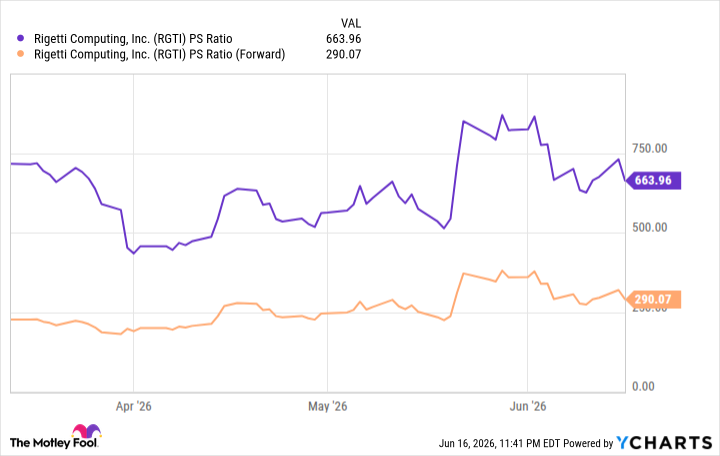
But brace yourself, because Rigetti’s P/S ratio is currently an eye-popping 663. Even if we value Rigetti based on Wall Street’s consensus 2026 revenue estimate of $23.6 million (provided by Yahoo! Finance), its forward P/S ratio is still almost 300.
RGTI PS Ratio data by YCharts
That means even if Rigetti’s stock plummeted by 50% in the second half of 2026, it would still be more expensive than SpaceX is today. I think a loss of that magnitude is entirely possible given the company’s lumpy revenue growth and steep losses. In fact, if it doesn’t hit Wall Street’s revenue target, its stock might fall even more sharply.
In summary, despite the long-term potential of quantum computing, Rigetti stock probably isn’t a great buy at the current price.
Read Next

•By Rich Smith
Why Rigetti Computing Stock Keeps Going Up

•By Matt DiLallo
3 Best Quantum Computing ETFs for 2026 and How to Invest

•By Anders Bylund
9 Best Quantum Computing Stocks for 2026 and How to Invest
•By Rich Smith
Why Rigetti Computing Stock Just Crashed

•By Johnny Rice
Why Rigetti Computing Stock Gained 46.4% In May
•By Adam Spatacco
About the Author

Anthony Di Pizio is a contributing Motley Fool technology analyst covering artificial intelligence, cloud computing, autonomous vehicles, and enterprise software. Previously, Anthony was a licensed fund manager, stock broker, and corporate advisor. He holds a bachelor’s degree in commerce and economics from Macquarie University in Sydney, Australia, along with ASIC RG146 certifications in financial securities and derivatives.
Stocks Mentioned

Rigetti Computing
NASDAQ: RGTI
$20.25
(-1.91%)-$0.40

Motley Fool Stock Advisor’s Latest Pick
—% Avg Return
*Average returns of all recommendations since inception. Cost basis and return based on previous market day close.
Sumber Artikel:
Fool.com

