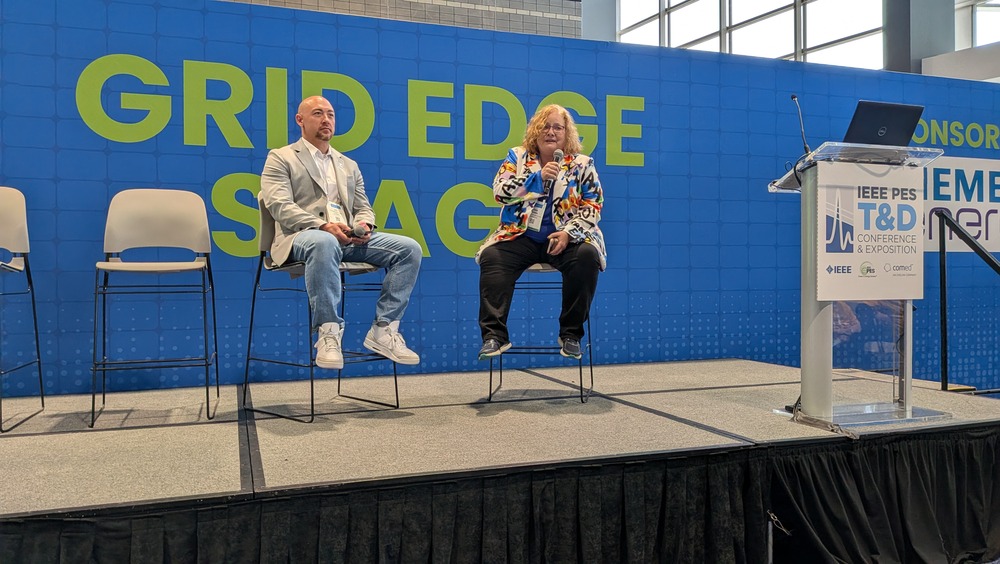

We’ve detailed how improved communications and connection define the utility journey, but the specific approach and technologies involved in the effort are essential to understand. On May 5th, at the 2026 IEEE PES T&D Conference & Exposition, experts took to the stage to outline details on broadband at the grid edge that utilities can incorporate into their short- and long-term planning.
Bobbi Harris, executive director at the Utility Broadband Alliance (UBBA), and Jimi Conway, senior manager of AMI strategy and data analytics at ComEd, d how their organizations are working to enable a more connected future. Both are extremely close to the topic, as UBBA was created to close the gap that exists around the next generation of utility broadband infrastructure, while the work that ComEd has done to deploy broadband to unlock new value streams and enhance resilience highlights what’s possible when this gap is closed.
Harris and Conway detailed how advances in communication have transformed Advanced Metering Infrastructure (AMI). In the past, the business case for AMI was straightforward, as it focused on quantifying the benefits of capturing every kilowatt-hour and reducing the cost of truck rolls. Today, the industry is moving toward AMI 2.0, where the meter is reimagined as a sophisticated edge sensor rather than a simple billing device. However, Harris said this shift shouldn’t be seen as the next version of AMI, but rather as “AMI too.” It connects with other ways of positioning AMI 2.0, highlighting what should be an ongoing evolution of the concept rather than the latest version of a specific technology.
This shift is central to Conway’s work, which reimagines communication and networking as the keys to unlocking a new tier of operational benefits. Doing so requires a change in how communication networks are conceived and positioned to open the technology to multiple teams and departments.
“It’s an asset that’s typically been sandboxed,” Conway said. “But if all of a sudden it’s a platform rather than just a meter, you have data and connections that can enable entirely new capabilities.”
Conway views this evolution as a fundamental transition, much the leap from a fixed landline to a modern smartphone. While the original goal of moving away from a phone with a cord was simply freedom and basic efficiency, the real opportunity lay in a fundamentally different way to communicate. It’s similar to communication networks that contain distributed computing and intelligence built directly into the grid’s hardware. By embedding these capabilities at the edge and connecting them back to the network, utilities can manage the system with a level of visibility and coordination that was previously impossible.
That opportunity comes with challenges, though, as this shift means there’s that much more data to capture and manage. It’s one of the reasons that, rather than pull every granular data point back to a central server, the next generation of grid technology is focused on analyzing information at the source. This distributed computing power allows meters to process complex waveforms and transmit only the specific insights or answers a utility needs to act.
“That process can prevent data overwhelm and allow teams to focus on the questions that actually matter whenever you’re talking about a new piece of technology or a system upgrade,” Conway said. “What does it mean for all of this to be a supplement to established processes? That’s the question everyone involved has to be able to answer.”
Preventing a deluge of data helps ensure the system stays interoperable and reliable, even during major weather events. By bringing intelligence to the edge, utilities can isolate faults and automatically restore service, creating a self-healing grid that maintains power for customers while operators address the underlying physical challenges.
For these edge capabilities to be effective, the underlying communication network has to be as reliable as the power it manages. Utility telecommunications are often taken for granted until a crisis occurs, but they represent the foundational layer for every smart device in the system. It’s why high-performance networks private LTE are increasingly necessary to provide the low latency and high security required for real-time command and control. This infrastructure allows utilities to move away from dozens of disparate, aging wireless technologies and toward a consolidated, hardened strategy that should be thought of as distinct from those disparate networking solutions.
“You can’t take it for granted,” Harris told the crowd. “The telecom network is the fundamental backbone that supports every other operational goal, which is why all of your teams need to be talking with one another. It can’t be just a communications team thing, or just something for the security team. It has to be everyone.”
Enhanced communication networks can help ensure that, as the grid expands and integrates more renewables and data centers, energy remains both affordable and accessible, helping address issues that remain a top priority for utilities. That will require a shift in perspective around who utilizes these networks, how they’re improving processes, and what it means for them to create value. Harris and Conway underscored why communication networks can no longer be thought of as a single platform or as the purview of a single team, but as something multiple departments need to leverage to support collective efforts that will ultimately enable a more resilient grid.
Sumber Artikel:
Renewableenergyworld.com