
(Boston, MA) – Grid operators, utilities, and energy infrastructure developers in the Northeast United States face distinct challenges, including hardening against increasingly severe weather, modernizing some of the oldest electric grid assets on the planet, and navigating ambitious-yet-not-entirely-aligned climate goals across multiple states. They must integrate more distributed energy resources (DERs) in often constrained environments and adopt new technologies while keeping costs in check. It’s a lot, but thankfully, there’s strength in numbers.
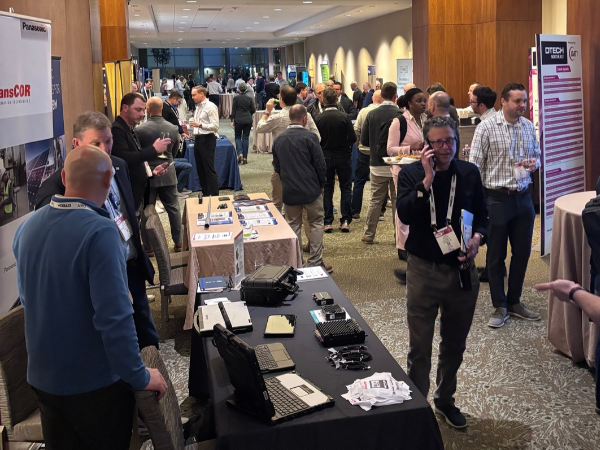
Energy experts from across the Northeast and beyond are coalescing their collective compute to tackle some of the toughest topics together in Boston, Massachusetts, at DTECH Northeast, an annual assemblage of regional stakeholders that grew out of GridTECH Connect, Clarion Events’ former interconnection-focused summit.
in many other parts of the U.S., times are changing in ISO New England and New York ISO (NYISO) territories. New large-load additions, primarily manufacturing/fabrication facilities and data centers, have driven a demand surge in places that experienced flat (or even negative) electric load growth for more than a decade. NYISO has more than 12 gigawatts (GW) of prospective large loads in its interconnection queue, including more than 8.3 GW added in 2025 alone, prompting the system operator to consider process revisions. Industrial expansion in the Northeast is complicated by the aforementioned state decarbonization mandates that, in turn, fuel rapid electrification of heating and transportation, further compounding load growth and potentially shifting the region to a winter-peaking system in the not-so-distant future.
“We’ve seen more changes in the electric power industry in the last 10 years than in the last 100,” said Wayne Bishop, executive vice president of Clarion Events North America during Tuesday’s keynote address. “We hear a lot about the energy transition, but really it’s an energy transformation.”

The Center of the Industry
While grid operators grapple with market reforms, Northeast utilities are trying to balance urgent needs for new transmission capacity, generation resources, and long-duration storage with rising cost pressures on retail ratepayers.
Paul Chodak, executive vice president and chief operating officer of Eversource Energy, welcomed the DTECH crowd by congratulating them for being at “the center of the industry,” citing the ever-critical importance of reliable power delivery. Eversource serves more than 4 million gas and electric customers across Connecticut, Massachusetts, and New Hampshire. To keep with the times, Chodak says the utility is thinking differently.
“We’re really looking at ways to leverage new technology and build different relationships with our customers, find new ways to interact with them,” he explained. “How do we drive incremental value out of the assets we have, and how do we be really smart about the new assets that we add to make sure we’re maximizing customer value for that dollar?”
Chodak d examples of notable bang-for-the-buck investments, including Eversource’s Cape Cod microgrid, which features a 25 megawatt (MW) / 38 megawatt-hour (MWh) battery energy storage system developed by TRC and the Town of Provincetown, MA, to help outer Cape Cod maintain power during severe weather. The project went live in September 2022, becoming one of the first such solutions in the country and setting a new standard for utility climate resiliency in storm-battered New England.
“It’s been super important for reliability, and that was the main reason that it was installed,” Eversource’s EVP & COO told DTECH Northeast, recounting a massive snowstorm last February that dumped more than three feet of snow onto Cape Cod.
“That battery performed admirably, serving 5,000 customers for several hours,” beamed Chodak.

Eversource is looking to add incremental value from similar systems via peak shaving and other market mechanisms. The utility is also pursuing other opportunities to reduce customer costs, such as retrofitting a solar farm in Western Massachusetts built in 2010 with new inverters and a communications suite.
“That allows us to do a better job of navigating that duck curve in Western Mass and really managing voltage control in a much more nuanced way,” Chodak detailed.
Customer engagement is another shifting battlefield for Eversource and its contemporaries, particularly as those customers face interconnection headaches. Too commonly, the cost or wait time to connect to the grid is too cumbersome for developers and investors to bear. The relatively new phenomenon of flexible interconnection may offer a quicker pathway to powering projects, however.
“We’ve been working with new resources as they come on to lay out our contracts such that they can flex their generation or they can flex their load in ways that allow them to connect more cheaply, with fewer upgrade costs to the system,” said Chodak. “Really just working on that relationship out front with the customer… to drive costs down.”
Eversource is also in the midst of its advanced meter infrastructure (AMI) 2.0 deployment, figuring out how to best design a grid edge system to leverage computational capacity where it previously didn’t exist. Among the tough things to tinker on: which tasks the control room manages versus which functions can be run locally, either via AI agents or other scripts; how much distributed capacity can be counted on during load events when customers can opt out of participation; and proactive transformer repair and replacement via load forecasting.
Ultimately, it comes down to leveraging technology to maximize value for Eversource’s customers. While affordability is drawing headlines, the topic is hardly news to utilities, Chodak argued.
“How do we make it better every single day? That’s really what the next level of affordability looks ,” he concluded.
The Why Behind AI
Salah Khuhro, senior vice president at OATI, the event’s presenting sponsor, focused his keynote comments at DTECH Northeast on the “why behind AI” in the energy industry.
For starters, DERs are arriving en masse. Solar photovoltaics, electric vehicles, battery energy storage (which can function as both load and generation), and more demand intelligent control and response layers that, frankly, classic assets do not. Meanwhile, data centers and other large load customers are reshaping grid reliability.
“8.3 percent of electricity is going to be used by data centers. That’s huge,” Khuhro reacted, warning of continued transmission bottlenecks and impacts on generation queues.
“So you kind of see a dichotomy here, right? On the one hand, you have DERs which are distributed all over the place. On the other hand, you have these data centers which are load in one location. So you’ve got two different kinds of load hunting against each other.”
Data overload is a real issue for Northeast grid operators and utilities. More information rarely comes along with extra time to make decisions, and there’s no room for error. AI can be a difference maker in this regard, Khuhro contends, without needing to build infrastructure from the ground up or replace it.
“It’s really about adding intelligence to what you already have,” he suggested. “Being able to see and analyze more data and being able to make the fastest decisions.”
To use everyone’s favorite new technology effectively, OATI’s Khuhro recommends an energy-native AI system that’s conversational and compatible with existing systems and policies. A good AI tool should adapt to your business processes, rather than you having to adapt to it, he insisted.
Khuhro envisions four core ways in which AI can aid the energy industry:
- Operator: Communication with customers, serving as an advisor, quickly distributing information from a large knowledge base
- Automation: Streamlining workflows and routine activities, including creating reports
- Reconnaissance: Monitoring information inclement weather forecasts, assessing current load and future generation capabilities, warning operators of potential problems and making recommendations
- Autonomous reconnaissance: The end goal; think of it as a “trusted employee,” capable of taking action on behalf of operators, then reporting back.
OATI has been building AI tools with California ISO (CAISO) over the last year and a half. Before AI, it took CAISO years to analyze the impacts of outages, particularly on other transmission areas. Autonomous agents are now tackling 500 or so outages per day in eight minutes.
“It’s just amazing to think how much time you can ,” OATI’s SVP said.
And if utilities operate with a growth mindset, they can use these exciting new tools to tackle load growth head-on and do more than ever before without shedding staff.
“Then you’re not going to be cutting headcount. What you’re going to end up doing is deploying AI to make your existing workforce do a lot more and do a lot more better,” Khuhro predicted. “In other words, enabling them rather than losing them.”
Sumber Artikel:
Renewableenergyworld.com