
The pace of technological innovation in the utility sector has been more of a revolution than an evolution. With smart sensors, AMI 2.0, and increasingly capable distributed energy resource solutions, utilities have access to an arsenal of new tools to meet unprecedented energy demand. Understanding how to deploy them is only half the battle; scaling them across an entire ecosystem is the only way to unlock a real operational revolution.
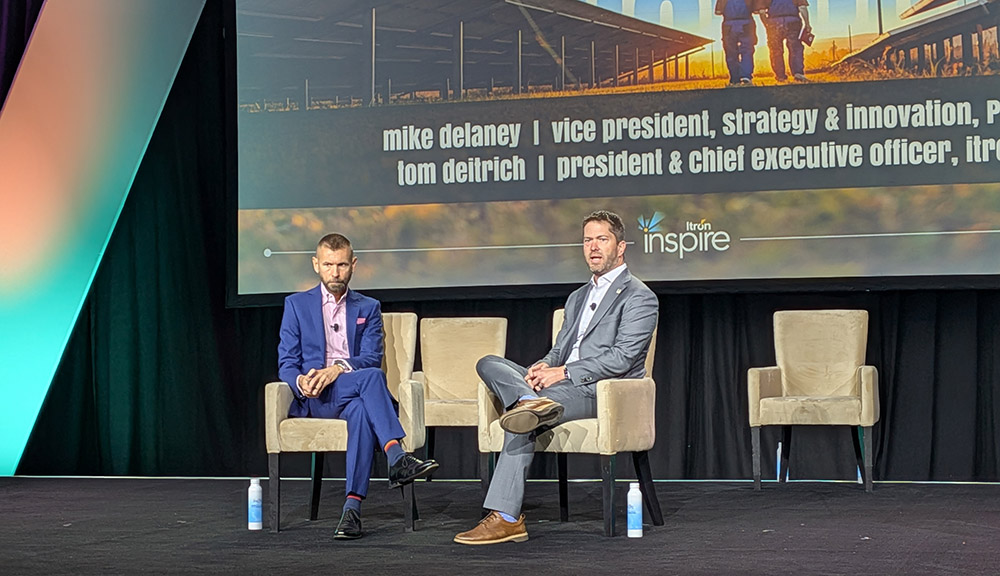
Mike Delaney, vice president of strategy and innovation at California utility Pacific Gas & Electric, is plenty familiar with this challenge. He’s detailed how and why smart infrastructure investments can reduce long-term system rates, but success with these efforts isn’t about proving a piece of hardware works; it’s about eventually connecting them to an improved customer experience.
He took to the stage during the keynote at Itron Inspire 2026 to further highlight many of these insights, but we caught up with him afterward to dive deeper. Hear what he has to say about why collaborative partnerships with technology providers are so essential, why the approach to pilot programs might require an industry-wide realignment, and more.
Jeremiah Karpowicz:At DTECH this year, you talked about how PG&E is using data to solve problems for your customersand how new technological innovations can positively impact the affordability challenges that define just about every conversation these days. Can you give us a few recent examples of what that’s looked for your team or your customers?
Mike Delaney: It’s about using technology in service of something, which for us, is typically about the impact to our customers. Is this solution going to enable a positive customer impact?
Affordability is absolutely something all utilities are thinking about, but it’s at another level for us in California given where our rates are. We can spend lots of time talking about how we got to where we are with those rates based on projects that never came to life or a given policy decision, but I’d rather focus on doing something about it that can ultimately lower rates for our customers. We’re continuing to drive towards getting flat rates, but we really want to make them lower for our customers, because we know that’s critical. The best thing we can do to make that impact is to continue to execute, so that’s what we’re focused on doing.
You’re obviously executing on several notable programs, but what does it mean to focus on those specific innovations or solutions? As you mentioned on stage, you look at hundreds of potential solutions every year, and many claim to deliver that ultimate positive impact on affordability.
An overarching principle for us—and something that’s true with the actual concept of innovation—is that you’re always dealing with infinite possibilities.
I truly am a nerd at heart. I’m inspired and happy to see technology innovations having a real impact on people’s lives. It’s an expectation that California’s families and businesses have as well, as they want to see technology turn out to be in service of improvement. But that effort needs to be focused.
One example of us focusing on a technology and program that creates this value is PanelBoost and ChargeBoost, which are utility programs designed to help smaller residential customers add their EVs and home electrification appliances without paying for panel or service upgrades. We saw this program as a real opportunity, because it’s simple enough to buy an EV today, but a real pain you run into is with your electrician, who says you need to upgrade your service panel. That ends up being thousands of extra dollars you now need to spend, plus waiting six to twelve months to leverage that asset.
What can make these upgrades even more complicated is if we also need to upgrade the transformer on the utility side. That’s potentially tens or even hundreds of thousands of dollars to replace that equipment, much less the time it takes to do so.
So we took a real pain and a real problem that customers had and applied technology to solve that in a different way, thanks to the help of companies Itron.
You mentioned the importance of partnerships and working with companies Itron on the stage. Are there any lessons the wider energy industry can take from your approach to these collaborative relationships?
It’s critical for us to work with partners and to align with them because we know we’re not going to solve all of the problems ourselves. We need these technology partners, and we want them to listen to us and know that we’re speaking as representatives of our customers. That’s why starting with that customer pain and the problems we’re trying to solve should be the organizing principle for any partnership.
That said, I think there’s a realignment that needs to happen with these relationships, because one of the common complaints is that it’s easy to get piloted to death as a startup or a vendor, but much of that is on us as utilities. We’ve gotten comfortable doing technology demonstrations, and while they often answer a question, they’re too often the easiest ones to answer.
Also, the baseline around these collaborations is whether or not a given innovation or solution will technically work, but the bigger question is what value it will enable for customers. What are the tests we can conduct to start capturing those answers? That’s why running experiments in the fastest, cheapest way possible with our partners is a focus for me. But that requires a different relationship than just a traditional vendor or solution provider relationship.
All of that needs to consider scale, which you also mentioned on stage.
Yes, and that’s a literal part of our technology adoption process, which is broken into four phases. Ideate, incubate, accelerate, and then scale. That’s how we think about new ideas or any new solution.
I mentioned on stage that the ideate phase is the one where we get the most stuff coming in the funnel. We’re around a three percent pass rate, but I actually want that to be more one or two percent. I want to see as many good ideas as possible, but also want to methodically filter through them as part of that first phase.
This is where our work with partners Itron and others is enabling a different way of operating. That incubation phase is so important, because we all need to be comfortable with sorting out whether or not something is going to work as fast as possible. The faster we can get to that point to decide, the faster we can focus our resources and go on to those next phases. It’s why having the right type of partner that can have honest, and sometimes tough, conversations is critical. Because as great as it is to keep going, the majority of the time it’s not going to make sense, so we need to know we’re working with someone that can provide open and honest communication but also receive it.
More from Itron Inspire

Inside CenterPoint Energy’s effort to build the most resilient coastal grid with Ed De Varona
CenterPoint Energy launched the Greater Houston Resiliency Initiative in 2024 to enhance the region’s power grid against extreme weather.
4 min read
Grid ModernizationNewsOutage ManagementPower Grid#Reliability and Resilience

Understanding the new era of utility weather risk with Sunny Wescott
Sunny Wescott discussed extreme weather impacts on utilities at Itron Inspire, emphasizing proactive grid planning and collaboration.
4 min read
Grid ModernizationNewsPower Grid#Itron#Reliability and Resilience#weather

Inside NET2GRID’s approach to AI and AMI 2.0 with Emily Fisher
Emily Fisher from NET2GRID discussed how energy AI is evolving from possible theory to practical reality for utilities at Itron Inspire 2026
4 min read
Grid ModernizationNewsPower Grid#AI#Grid Modernization#Reliability and Resilience
The value that these innovations can create is quantifiable, but successful adoption often requires a shift in terms of how teams operate, which is no small feat. How much about success with any of this is related to the technology versus company culture versus something else?
We have the data to enable that sort of change. And we have the systems for it, because yes, teams often do need to think and operate in a different way. So what does it mean to enable that and get people comfortable doing something a little different?
I won’t claim that we’ve nailed this, and it’s really one of the hardest parts of the job. It’s something that comes up in the accelerate phase, which is why once we’ve incubated an idea, we run small experiments to get people confident and excited. We want them to feel good about what we’re doing and what they’ll be doing, so that once it’s rolled out to the larger ecosystem, they’ll be comfortable with those shifts and changes. We know it’s not easy, but that’s why we’re focused on intentionally building a practice around acceleration, so that we don’t reinvent the wheel every time we adopt a new piece of technology.
That underscores why the value really doesn’t come from the technology itself. The value comes when we’re able to change the way we do our work, and some of that is about winning the hearts and minds of the teams that are doing it. We’ve been successful in some areas with that, but we know we’ve got more to do in other places.
Looking past current deployments, what emerging capabilities get you most excited for the future of the grid?
Honestly, and I’m not just saying this because I’m at Itron Inspire, but I really do think the opportunity we need to focus on is around the meter. We have untapped potential with the meter becoming a technology platform for the utility.
With that framing, you can come up with some really compelling use cases, but what does any of that translate into? It can be as simple as electrification projects that see residential homes install 100-amp / 24,000 watts panel capacity to thousands of dollars, which is something we’ve done. But all of that is on account of what the meter lets you do.
There are some other interesting ones I’ve been talking about lately that are associated with enabling a better understanding of the sizes of our lines to avoid having to send out crews to capture that info when we need it. That can strip out direct costs to our customers.
If we can use the technology inside the meter to provide a better sense of what’s existing and what’s possible, we’re going to be in such a better place. We’re going to have hundreds of thousands and then millions of data points with sensor technology, and when that’s combined with the meter, that’s going to fundamentally change how we understand and gain awareness of the system, as well as how we operate in the future. Driving scale with any of that to ensure it will positively impact our customers requires us to focus, and that’s why I want to continue to double down on the work we’re already doing.
Sumber Artikel:
Renewableenergyworld.com