
As the second-largest manufacturer in Chicago, S&C Electric Company has established itself as a global leader in the design and production of equipment and services for electric power systems. Since its founding in 1911, the Rogers Park-based firm has specialized in switching, protection, and power-quality products for transmission and distribution networks. On the heels of launching its latest interoperable control solution at DTECH, the company leveraged the IEEE PES T&D Conference to highlight how its portfolio of American-made technology is driving affordability across the industry.
This commitment to affordability was showcased in a case study with Florida Power & Light (FPL) that challenges the status quo of grid reliability. Their efforts demonstrate what a commitment to modernization that keeps electricity accessible can look from a utility and technology perspective, as it detailed what it means to maintain rates for customers that sit 30% below the national average.
To demonstrate how these solutions work in practice, the S&C team invited members of the press to its headquarters. This behind-the-scenes access revealed the philosophy and manufacturing effort that are helping redefine utility reliability while also directly addressing affordability concerns that remain pervasive across the industry.

Continuing a journey that began
As only the fifth CEO in S&C Electric Company’s 115-year history, Anders Sjoelin is focused on maintaining a balance that honors this century-old legacy while also spearheading the transformation of the modern power grid. Leading an employee-owned organization dedicated to a more resilient and sustainable energy future is a massive undertaking, but Sjoelin has sharpened that mission by focusing on the challenges of the distribution grid, where minor issues can be resolved before they become major problems.
“Resilience is the core of what we do, especially with the distribution grid,” Sjoelin explained. “It’s part of the ecosystem that is something taken for granted, but 90% of all outages occur on the distribution side, and 70% to 80% of those could be avoided because they’re caused by wildlife, tree branches, or the weather, all of which are temporary disturbances. That’s why our technology and investment remain firmly focused on the distribution side.”
This strategic focus is a direct response to accelerating load growth. While some hesitate at the price tag of modernization, Sjoelin argues that the cost of inaction is far higher, noting that the economic impact of grid failure can be three times the cost of the investment itself. Beyond traditional reliability, he is also weighing the implications of data center expansion and the need to socialize those infrastructure costs in a logical, equitable way.
At the heart of S&C’s forward-looking strategy is a commitment to an interoperable grid that doesn’t sacrifice safety for innovation. Sjoelin is focused on a future where connecting smart devices is intuitive rather than cumbersome, ensuring that teams can easily address those disturbances on the distribution grid before they turn into outages. It’s an approach that has impacted the specific engineering choices made across a variety of their products.

Understanding product development priorities
As S&C’s chief product development officer, Joe Matamoros leads the engineering and service teams responsible for both maintaining a legacy of reliability and driving new product development. It’s difficult to modernize a system built on 50-year assets, but Matamoros believes we’re at a unique moment. As market needs and technical solutions synchronize, utilities are being empowered to make strategic choices that will expand grid capacity and improve long-term operational flexibility.
“The resilience gap is what’s shaping our product development priorities,” Matamoros said. “We focus on where technology has the greatest potential for operational impact, and also where that technology can be deployed at scale. What we’re seeing is that the biggest opportunities aren’t really happening at the center of the grid but are now taking shape at the edge. That’s where we think we can really help our customers.”
While grid automation has existed since the 1990s, it’s traditionally been managed from the center out. S&C is shifting that focus by bringing automation directly to the edge of the grid. By moving visibility, intelligence, and coordination closer to the end user, the system can isolate faults and automatically restore service, helping transform how utilities manage disruptions.
For this automation to be truly scalable, Matamoros talked through the importance of interoperability in the short and long term. Systems need to communicate and integrate seamlessly to function reliably regardless of the situation, which can be at night, in the rain, or during major weather events. This kind of capability provides operators with the real-time situational awareness needed to manage a self-healing grid and allow crews to utilize multiple systems and data to address underlying physical challenges on their own timeline, rather than in the midst of a wider outage.
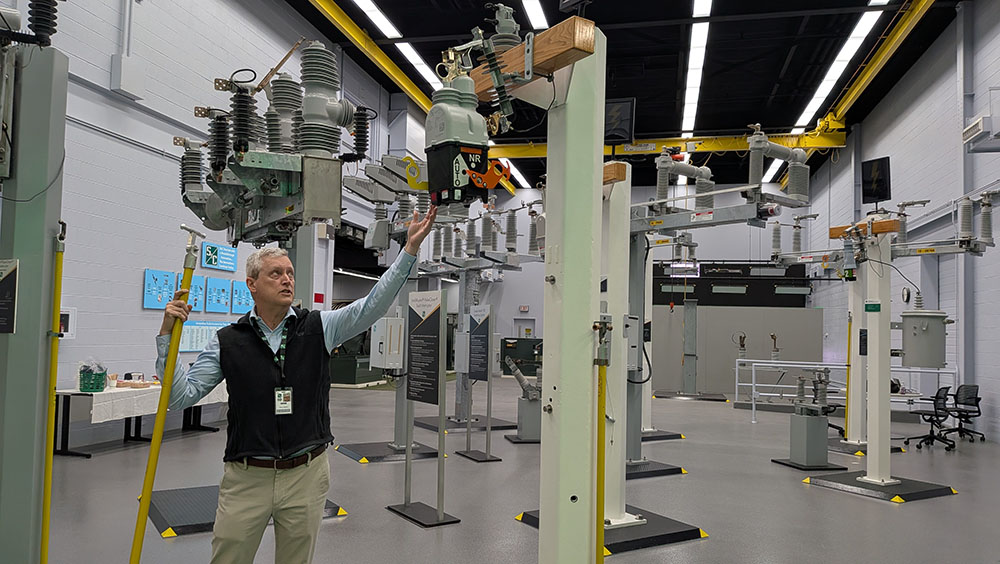
This approach to capabilities and development is evident across a variety of products in the S&C portfolio, as demonstrated by the S&C team in their Rogers Park showroom.

Next-Generation Automation and Intelligent Underground Restoration
The Tripr FXR Recloser represents the next generation of lateral automation, building on the features that debuted with the Tripr II Cutout-Mounted Recloser. Designed with higher ratings and greater flexibility, the value that Tripr FXR represents to utility teams is literally built into the name, as it’s designed to eliminate unnecessary truck rolls for temporary faults. This can drastically reduce operational expenses while also mitigating disturbances to the distribution grid that Sjoelin mentioned.
The FXR introduced several key operational improvements, all specifically designed with the line worker in mind. It features dedicated open/close and automatic/manual levers, simplifying field tasks. The FXR also utilizes a modular, open-standard architecture. By moving away from proprietary systems, S&C has given utilities the option to swap communication modules in the future, ensuring that if a utility’s communication needs change, its hardware can stay the same.
Beyond overhead applications, S&C is seeing a massive shift toward utility-grade equipment from large power users data centers. While both utilities and developers are moving toward underground distribution to mitigate weather risks, protecting those circuits presents a unique set of technical hurdles. Nevertheless, the same core philosophy of usability and practicality defines how products work.
To protect this underground network, S&C utilizes its low-stress PulseClosing Technology. Featured in the IntelliRupter PulseCloser Fault Interrupter, this solution tests for faults rather than slamming the circuit, making it a universal protection option for both overhead and delicate underground systems.
Complementing this is the EdgeRestore Underground Distribution Restoration System. Specifically designed for suburban underground loops, this automated sectionalizing switch allows for rapid, autonomous restoration. In a typical configuration, these units are placed at the normally open point and at various intervals along the feeder. When a fault occurs, the system performs a high-speed Fault Location, Isolation, and Service Restoration (FLISR) operation.
The S&C team demonstrated what these types of faults can look in their demo area, ranging from deteriorated cable insulation to water ingress. In the simulated neighborhood environment, the EdgeRestore system showed how it can isolate a fault and close the normally open point to restore power to thousands of customers in just 17 seconds. To ensure visibility, S&C offers smart metering integration, allowing utilities to monitor the system’s state even when it resolves an issue so quickly that customers might not even notice a blink.
Both of these solutions were on display at the IEEE PES T&D Conference, offering attendees a clear look at the technology available today. By embedding intelligence and interoperability now, they’re defining the core capabilities required for the next generation of utility infrastructure.

What’s Now and What’s Next for S&C?
The impact of data center expansion and long-term sustainability is a primary focus for the S&C team, driving a product roadmap designed to meet new energy demands that aren’t slowing down anytime soon. For Sjoelin, while specific product initiatives are important to the company’s current momentum, he’s more focused on the broader structural shifts that will define S&C’s next 115 years.
“The core focus has not really changed at all,” Sjoelin surveyed. “But the speed of change really has accelerated significantly over the last decade. New technology is emerging constantly, which is why we’re embedding intelligence directly into our products themselves, rather than relying on centralized control, and that’s something we’ll look to do in bigger and different ways. We really are sitting in the middle of that innovation, which makes this an incredibly exciting time to be in this space.”
Sumber Artikel:
Renewableenergyworld.com