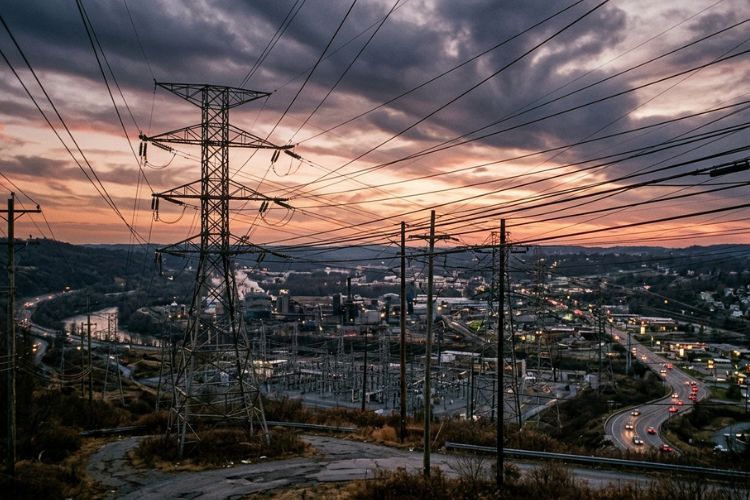

PJM Interconnection has earned its place in the pantheon of bottlenecks, wedged somewhere alongside first-ballot Hall of Famers ‘hourglass’ and ‘Los Angeles traffic.’
The largest grid operator in North America, whose purview spans parts of 13 states and Washington, D.C., became notorious for an interconnection queue so backlogged that the regional transmission organization (RTO) effectively shut it down in 2022 to rework its processes. The timing, considering unprecedented electric load growth in the region and beyond, was less than ideal. PJM reopened its queue in late April and is currently reviewing applications for 811 new generation projects capable of generating 220 gigawatts (GW) of electricity.
The transmission to support those sites cannot come online fast enough.
According to software company Gridraven, a lack of adequate transmission capacity cost PJM a staggering $1 billion in a single month, May 2026.
Gridraven, which helps unlock additional transmission capacity on existing lines using sensorless dynamic line rating (DLR), released a congestion cost study of PJM Interconnection on Wednesday and launched its Congestion Tracker, a public tool designed to show where transmission bottlenecks in PJM and beyond are driving increases in electricity costs.
“In May, a single transmission line generated almost $150 million in congestion costs in just 72 hours,” Gridraven GEO Georg Rute d on LinkedIn. “At the same time, DLR would have been able to provide 12.3% extra capacity on this line. This would have enabled savings of around $100 million in just three days. Our DLR would have paid back in 60 seconds.”
Rute is referring to a constraint on the Ashburn–Goose Creek 230 kV line between May 26 and May 29, 2026, which coincided with an unexpected early-season heatwave, driving electricity demand sharply higher across one of the most energy-intensive regions in the United States. Indeed, that single 230 kV line drove nearly $150 million in congestion costs in a mere three-day span.
Gridraven estimates DLR implementation could have d PJM $186 million from May 1 to May 31, 2026.
Between March 30 and May 1, 2026, it found that transmission congestion costs across PJM totaled $564 million, including $75 million attributable to 42 monitored constraints on 250 historically congested transmission lines that were actively tracked. Those constrained lines had an average of more than 14% untapped transmission capacity that software-based DLR could help unlock, representing $49 million in potential monthly congestion savings across PJM, per Gridraven.
PJM congestion costs rose from approximately $1.8 billion in 2024 to $3.2 billion in 2025, highlighting growing pressure on the grid as electricity demand increases due to data centers, industrial load growth, and mass electrification.

“Congestion raises our bills by making electricity more expensive,” added Rute. “The lack of sufficient transmission capacity is an increasing challenge that prevents the lowest-cost power from reaching us.”
One transmission line analyzed by Gridraven, the Graceton–Manor 230 kV line between southeastern Pennsylvania and northern Maryland, generated nearly $2 million in congestion costs in a single 24-hour period. Using publicly available PJM market data, Gridraven’s software-based DLR, and its new Congestion Tracker, the company found that software-based DLR could have reduced those costs by roughly 70% by increasing capacity during that time period.
“Small increases in transmission capacity can create disproportionately large economic savings,” said Rute. “By making the most of our existing grid, it’s possible to reduce bills in the short term, while we build more transmission.”
Between 2024 and 2030, PJM expects electricity demand to increase by more than 30 GW, driven largely by data centers.
On March 4, 2026, PJM became the first RTO to implement Ambient-Adjusted Ratings (AAR) under FERC Order 881. While AAR improves upon static transmission ratings, Gridraven’s analysis since March suggests there is still additional capacity that could be unlocked using DLR, particularly where congestion is driven by the thermal limits of transmission lines. Congestion is not a system-wide issue, but a highly localized one, where only a few elements can cause large price differences for larger areas.
While DLR implementation does not replace the need to build new transmission lines, the technology can take pressure off electric bills and create headroom to pay for the new lines that are sorely needed. Building more grid and using the existing grid better need to happen in parallel, concludes Rute.
Unstatic transmission ratings or ambient-adjusted ratings (AAR) that do not fully capture the cooling effect of wind conditions, Gridraven’s software-based DLR uses hyper-local weather forecasting, terrain modeling, and machine learning to determine how much additional electricity specific transmission lines can safely carry. That additional headroom can allow lower-cost power, including renewable generation, to reach demand centers.
Additional highly congested lines from other independent system operators outside of PJM are being added and monitored on an ongoing basis through the Congestion Tracker. Gridraven’s software-based DLR technology is already operating on full-scale transmission networks in Europe, including deployments with Fingrid in Finland and Elering in Estonia, each spanning approximately 5,000 km of transmission lines. The company plans to announce its first U.S. projects later this year.
Sumber Artikel:
Renewableenergyworld.com