Text settings
Story text
SmallStandardLargeStandardWideStandardOrange
* Subscribers only
Learn more
It’s a bit worrying when a scientific paper begins, “How long will life on Earth survive?” But in this case—a study by Jacob Haqq‐Misra of Blue Marble Space and Eric Wolf at the University of Colorado Boulder—the billion-plus-year timeline under consideration shouldn’t cause you too much existential panic.
The context for this question is that we understand the Sun will brighten as it eventually matures into a red giant that swallows the Earth in a solar furnace. So, where along that 5 billion-year path will life on Earth, in fact, be cooked?
Weathering and the weather
This isn’t just a question of incoming radiation. Among the thermostat-stabilizing feedback loops in Earth’s climate, the cycling of CO2 through the solid Earth is a major factor over timescales this long. The weathering of silicate rocks at the surface converts atmospheric CO2 into carbonate that ends up on the seafloor, where it can be subducted into the mantle with tectonic plates. (And eventually, it can cycle back out to the atmosphere through volcanoes.)
The weathering of bedrock depends, in part, on temperature. Warmer temperatures and a more active hydrologic cycle mean an increased rate of weathering, which pulls more CO2 out of the atmosphere. That slows rising temperatures. But in this scenario, it could also lead CO2 to fall to extremely low levels—and photosynthesis requires CO2.
This far-future puzzle has been the focus of many model simulations over the past few decades. With a steadily brightening Sun, when does the Earth either get too hot or too CO2-starved for the base of the food chain to survive?
Some of those models have been relatively simple equations. Others have been more complex one-dimensional layer models, representing an ocean and an atmosphere separately in the math, for example. This new study brings a 3D model to the party and uses a pair of scenarios that mark opposite ends of a spectrum.
The difference between the scenarios is based on extreme views of the temperature/carbon relationship described above. That was done in part because the idea that CO2 would eventually fall to very low levels has been challenged recently, based on some evidence of a much weaker relationship between bedrock weathering and global temperature. So in one scenario, the researchers held the planet’s temperature constant (equal to today’s) and let CO2 drop to compensate exactly for the brighter Sun. This is a world where strong weathering acts as a perfect thermostat. In the other scenario, CO2 is instead held constant at a modern value while temperature increases, representing a very weak weathering thermostat.
Too hot to handle
With weak weathering, the world is around 21° C (38° F) warmer 1.5 billion years from now, and it jumps an additional 40° C (72° F) between then and 2 billion years. Even with CO2 remaining at 400 parts per million, those temperatures would wipe out land plants on Earth.
Specifically, the physiological limits of most land plants are crossed by 1.68 billion years, and the rest are toast at 1.87 billion. (Boiling off the oceans and losing our water to space wouldn’t be far behind.)
In the strong weathering scenario, the temperature doesn’t change. But after 1 billion years, CO2 drops to about 34 parts per million, and after 2 billion years it falls to less than 1 part per million. The limit for most land plants is around 150 parts per million, while the much less common C4 plants could survive down to 3–10 parts per million. The latter limit gets hit between 1.35 and 1.64 billion years in.
A few plants, cacti as well as some marine life, can cheat by using bicarbonate in the water if dissolved CO2 is low. They can probably make it down to 1 part per million. That would buy them a little more time, and they’d make it to about 1.84 billion years.
Model timelines for the weak and strong weathering scenarios. Temperature in the top plot is in kelvins—a change of 1 kelvin is equivalent to 1 °C. Carbon dioxide in the bottom plot is on a logarithmic scale. (101 is 10 parts per million, 102 is 100 parts per million, etc.) 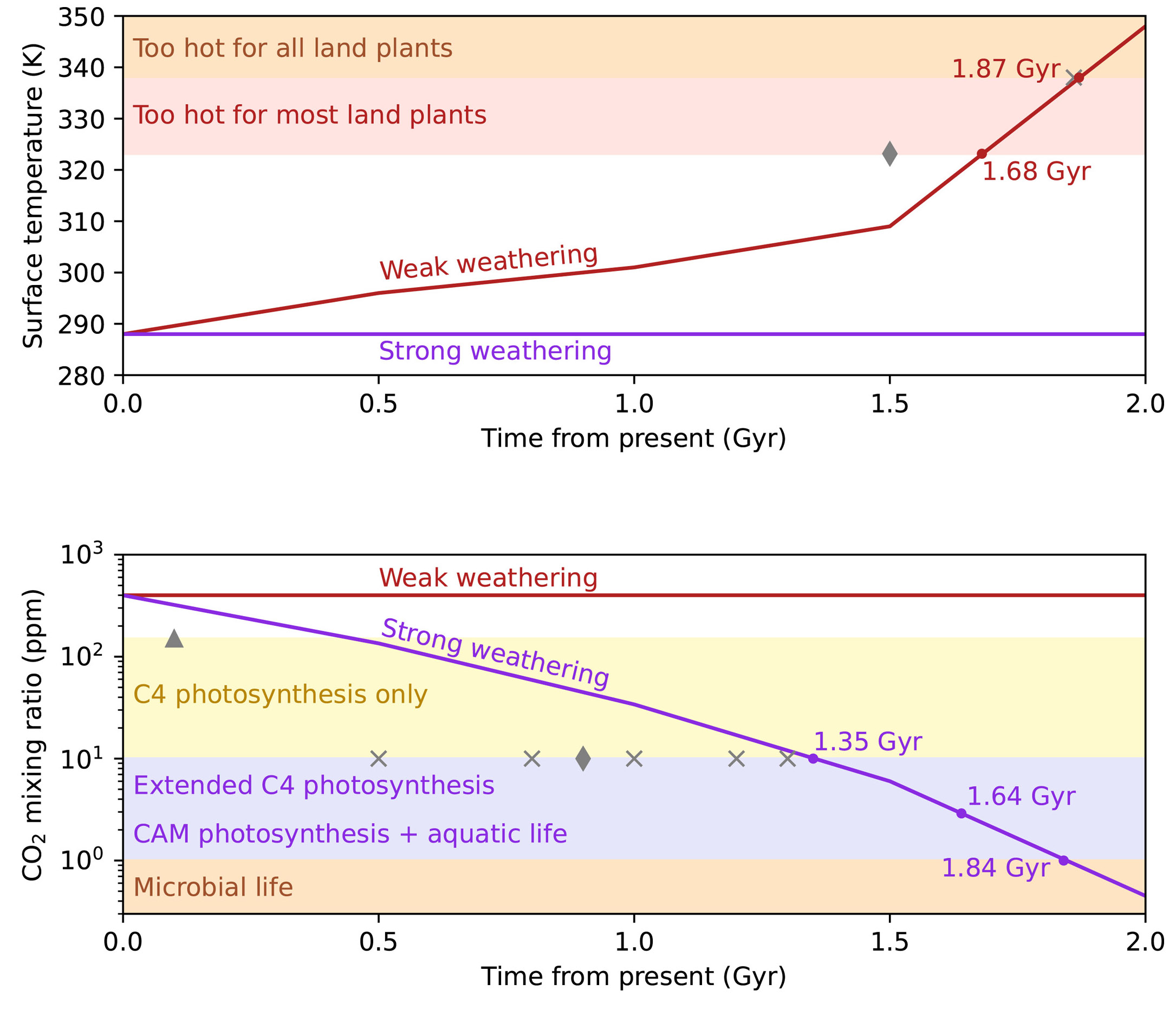
Model timelines for the weak and strong weathering scenarios. Temperature in the top plot is in kelvins—a change of 1 kelvin is equivalent to 1 °C. Carbon dioxide in the bottom plot is on a logarithmic scale. (101 is 10 parts per million, 102 is 100 parts per million, etc.) Credit: Haqq-Misra and Wolf/JGR Atmospheres
That’s optimistic?
The, uh, good news about these estimates for the demise of complex life on Earth is that they’re actually a bit more optimistic than most previous studies. That’s down to the 3D model producing a little less warming for a brighter Sun, the expectation that CO2 declines more slowly over time, and a slight expansion of the CO2 range believed to be survivable by plants. Many previous estimates had put life’s expiration date at less than 1 billion years from now.
Obviously, there are a bunch of additional considerations that could significantly alter this story, and the researchers mention a few. If civilization persists long enough to see some of these changes, geoengineering would certainly be an option—spreading aerosols in the stratosphere to reflect sunlight, for example.
There are even some wilder suggestions out there, moving Earth’s orbit farther from the Sun or removing some of the Sun’s mass to tame the red giant. (We have a billion years to work on the logistics, after all.)
Less speculatively, evolution could have a say in the physiological limits of Earth’s plants. Any adaptations that expand the range of survivability would extend the timeline.
Ultimately, the point of modeling this kind of thing is not to make a confident prediction. Apart from the simple natural curiosity about what will happen to our world, this is also relevant to wondering about the potential for life on other worlds. The window of time during which life on Earth is possible tells us something about where to look outside our Solar System.
Land plants have been present on Earth for almost 500 million years, and if this new estimate is right, they could stick around for almost 1.9 billion more. As was the case for a few billion years early on, microbial life might again have the place to themselves for a while after that.
JGR Atmospheres, 2026. DOI: 10.1029/2025JD045586 (About DOIs).
Scott K. Johnson Associate Writer
Scott has written about geoscience and energy at Ars as a freelancer since 2011.
Sumber Artikel:
Arstechnica.com