
PJM Interconnection, the largest grid operator in the United States, faces a nearly 7 gigawatt (GW) capacity shortfall by 2028, underscoring an urgent need to interconnect more generation resources as soon as possible.
Myriad efforts are underway to retool PJM’s processes, markets, and even its governance to address rapid load growth before the rolling blackouts start, including a new, temporary Expedited Interconnection Track (EIT). The EIT opened July 31 for large-scale endeavors backed by a primary siting authority that can begin operating within three years, enabling individual states to accelerate specific projects based on their resource adequacy needs. Late last week, PJM accepted the first three of up to 10 requests it plans to greenlight this year: a pair of battery storage sites and a natural gas generator upgrade with more than 2,100 megawatts (MW) in combined nameplate capacity slated to come online in mid-2029.
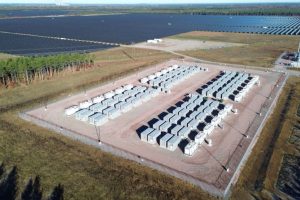
The battery energy storage systems (BESS), both courtesy of ENGIE, will add a much-needed 1,660 MW of storage capacity to a system with surprisingly little. PJM claims roughly 686 MW of battery energy storage across 42 operating utility-scale projects (and about 90 MW behind-the-meter), a paltry sum compared to its contemporaries.
California’s CAISO and Texas’s ERCOT, which now house about two-thirds of all U.S. battery capacity, have rapidly adopted utility-scale storage over the last few years. CAISO expanded its fleet from about 500 MW in 2020 to more than 16 GW in 2026; ERCOT’s installed BESS capacity has now eclipsed 15 GW, nearly doubling from about 8 GW at the start of 2025. While CAISO and ERCOT took different paths to scale storage (California leaning on policy mandates and capacity contracts, Texas on merchant markets), the result is the same: improved reliability.
Simply, batteries make the grid better. Projects can come online quickly to enable integration of intermittent renewables, regulate frequency and voltage, shave peaks, defer infrastructure upgrades, address generation shortfalls, or solve any number of other problems. Everyone else is catching on: the U.S. had 43.6 GW of total battery capacity at the end of 2025 and now boasts north of 52 GW, with 54 GW more on the way through 2028.
PJM customers are due a slice of that action, as its pipeline is chock full of battery projects. The grid operator accepted more than 60 GW of storage into the first cycle of its reformed interconnection process. Not all of that will come online, but a fair chunk absolutely must. A recent Brattle Group report for the U.S. Energy Storage Coalition estimates PJM will need at least 16 GW by 2032, 23 GW by 2040, and 43 GW by 2045 to maintain reliability.
PJM can approve up to 17 more 250 MW+ EIT projects through 2027 before the program is phased out. More storage is ly in store.
Hello and welcome to the Factor This Brief, a weekly collection of energy industry finance and development updates, delivered straight to your inbox on Monday mornings and hosted in a not-so-brief fashion here on Factor This, featuring the people, projects, and technology driving our electric future.
Thanks for checking it out. If you what you see or want to recommend a story for next week, drop me a line. As always, here’s a jam for the journey- it’s the one I set you up for with the header image. Turn it up, and when the work week goes full stream, remember to kick back and let the current carry you every once in a while.
Double Dip
Global independent power producer (IPP) ContourGlobal is celebrating two major project milestones.
ContourGlobal and Platte River Power Authority have completed the second phase of the Black Hollow Sun project near Severance, Colorado, bringing northern Colorado’s largest solar project fully online. ContourGlobal has also begun construction of Project Sterling, a hybrid solar-plus-storage facility located roughly 20 miles north of Lake Havasu City in Mohave County, Arizona.
Black Hollow
The Black Hollow Sun complex includes a 324 MWp (257 MWac) solar facility that will generate about 608 gigawatt hours (GWh) of clean electricity per year, enough to power more than 73,000 homes and businesses across Platte River’s owner communities of Fort Collins, Estes Park, Longmont and Loveland.
“This project represents years of commitment, perseverance and partnership,” said Jason Frisbie, general manager and CEO of Platte River. “From project selection in 2019 through global supply chain disruptions, inflationary pressures and construction challenges, our teams remained focused on delivering a resource that advances our d energy goals while supporting reliability and affordability for our owner communities. Today’s celebration recognizes the dedication of everyone who helped make Black Hollow Sun a reality.”


Courtesy: ContourGlobal
The approximately 1,700-acre facility includes more than 500,000 photovoltaic solar panels and uses single-axis tracking technology to maximize energy production throughout the day. Phase I, a 185 MWp (150 MWac) plant and ContourGlobal’s first large-scale solar PV construction in the U.S., entered commercial operation in September 2025. Phase II began construction in April 2025 and reached commercial operation in September 2026, four months ahead of schedule. ContourGlobal owns and operates both phases. It is the largest solar complex in ContourGlobal’s portfolio, which has grown to 2.7 GW of generation capacity in operation or under construction in the United States.
Platte River is the project’s offtaker via a long-term power purchase agreement (PPA). Hanwha Qcells was its engineering, procurement, and construction (EPC) contractor.
Project Sterling
Project Sterling in Mojave County, Arizona, will combine 509 MWp / 450 MWac of solar PV with 360 MW / 1.4 GWh of battery storage across a footprint of more than 2,000 acres in the Mojave Desert, one of the sunniest regions in the United States. Construction began in early October and will continue through 2028.
Once operational, Sterling is expected to generate more than 1.1 terawatt-hours (TWh) of clean electricity annually—comparable to the yearly residential electricity demand of a city of 100,000 to 120,000 people—making it ContourGlobal’s largest renewable asset worldwide. The plant has a long-term PPA with Tesla that covers around 90% of its expected output, making it one of the largest corporate solar-plus-storage PPAs ever signed for a single hybrid plant in the United States.
Local construction teams will carry out civil works, road construction, and site logistics to install more than 760,000 solar modules and over 300 battery storage containers using advanced lithium iron phosphate (LFP) technology, with liquid cooling and integrated fire protection.

The Jurassic Era
Canadian-headquartered global power producer Northland Power has reached commercial operations at its 80 MW / 160 MWh Jurassic BESS in Cypress County, Alberta, Canada. The project is Alberta’s largest battery energy storage facility.
Located about 12 kilometers southwest of Jenner, Alberta, the Jurassic BESS will be paired with a 220 MW solar project as part of a $500 million undertaking.


The 80 MW Jurassic BESS in Alberta, Canada. Courtesy: Northland Power
Northland reports that the Jurassic BESS facility was delivered ahead of schedule and under budget, constructed with zero lost-time incidents across nearly 75,000 hours worked. Jurassic has a 15-year offtake agreement covering 100% of its capacity with members of the Alberta Schools Commodities Purchasing Consortium.
“Achieving commercial operations at Jurassic BESS demonstrates Northland’s ability to consistently deliver energy infrastructure safely, efficiently, and as planned,” assessed Christine Healy, president and CEO of Northland Power.
Northland owns, in whole or in part, 3.6 GW of gross operating generating capacity, 2.4 GW under construction, and an approximately 8 GW development pipeline.
Power From the People
Distributed energy resource wrangler Voltus has raised $225 million in an oversubscribed Series D financing round led by Generation Investment Management alongside co-leads Activate Capital and Vitol. Other investors included Broadscale Group, Climate Investment, NGP, Ajax Strategies and All Aboard Fund.
Voltus will use the funding to help close the grid’s capacity gap, aiming to grow its virtual power plant (VPP) platform to 20 GW by 2030 as it executes on its Bring Your Own Capacity (BYOC) program in PJM and MISO.
Voltus taps latent capacity in batteries, cooling systems, and industrial processes at thousands of businesses and homes and dispatches it into electricity markets every day, making the grid’s demand side more flexible. Participants that reduce, shift, or supply power can lower their energy bills and earn new revenue, and by getting more out of existing infrastructure, flexibility can help bring down electricity rates for everyone.
“Electricity is now the constraint behind almost every major ambition we have, but it doesn’t have to be. The question is no longer whether the grid needs flexibility, it’s how quickly we can make it foundational,” said Dana Guernsey, CEO of Voltus.
“As electricity demand rises, the fastest, most cost-effective and lowest-carbon source of new capacity is often the one already connected to the grid,” added Dave Easton, partner at Generation Investment Management. “Voltus turns the flexibility of businesses, homes and batteries into reliable power, helping the AI buildout meet its growing energy needs while reducing pressure to build new fossil-fuel infrastructure and making it easier to integrate renewables.”
Learn more about how Voltus is approaching PJM’s capacity shortfall on the Factor This Policycast.
A Mammoth Accomplishment
Doral Renewables is celebrating imminent commercial operation at the Mammoth South, Mammoth Central I, and Mammoth Central II phases of its massive Mammoth Solar project in Indiana. Together, these three phases have a combined capacity of 900 MWac and complete a 1.3 GW site, one of the largest operational solar projects in the country.
The three phases now coming online were constructed over 18 months. During peak construction, approximately 1,800 workers attended the site every day. At one point, Doral reports that 20,000 panels per day were being installed. During operations, Doral Renewables will explore multiple partnerships and efforts to deploy large-scale dual-use practices, also known as agrivoltaics, which will include agricultural and farming activities inside the project area. Among others, the company is exploring specialty crops, sheep and cattle grazing, and an ongoing partnership with Purdue University.

“Today is the culmination of true partnership between the Pulaski County community and Doral”, recollected Nick Cohen, President and CEO of Doral Renewables. “We started this project as a vision to bring a major economic development project to the county and an energy project to the state, and it grew beyond our wildest dreams. We are hoping to make this one of the leading dual-use sites in the country and further grow the partnership between Doral and local farmers.”

Mammoth was named after a well-preserved mastodon fossil that was discovered in Pulaski County, where the project broke ground. Parts of that specimen are on display at the Smithsonian National Museum of Natural History. Learn more and see the bones in a previous feature on Factor This.
Doral’s solar and storage development portfolio exceeds 22 GW, including nearly 450 MWac in active operation, 900 MWac imminently reaching commercial operation, and over 1,700 MWac under construction.
A Community Investment
Distributed solar and storage IPP Pivot Energy has closed on a $173 million term loan facility for a portfolio of 51 community-scale solar projects totaling 135 MWdc across six states.
Long-time financial partners First Citizens Bank, Huntington Bank, and BankUnited provided the takeout financing. The facility refinances the projects from Pivot’s construction warehouse and consolidates Pivot’s first three portfolios under a single term structure, marking the company’s first term loan financing. The transaction also frees up capacity in Pivot’s revolving construction facility to support continued construction of additional projects.

“Closing our first term loan across a consolidated portfolio is an important step for Pivot,” said Bret Labadie, chief financial officer at Pivot Energy. “This financing gives us the flexibility to grow faster and deliver lasting value where our projects are built, from community investment and agrivoltaics to local jobs and economic development. As the electricity landscape becomes more complex, we’re proud to work alongside utilities, corporate energy buyers, and ratepayers to deliver local, reliable power that strengthens the grid.”
Sumber Artikel:
Renewableenergyworld.com