ByTed Reed,
Senior Contributor.
Forbes contributors publish independent expert analyses and insights.
Charlotte-based reporter Ted Reed covers airlines and airline labor.
–:– / –:–
This voice experience is generated by AI. Learn more.
This voice experience is generated by AI. Learn more.
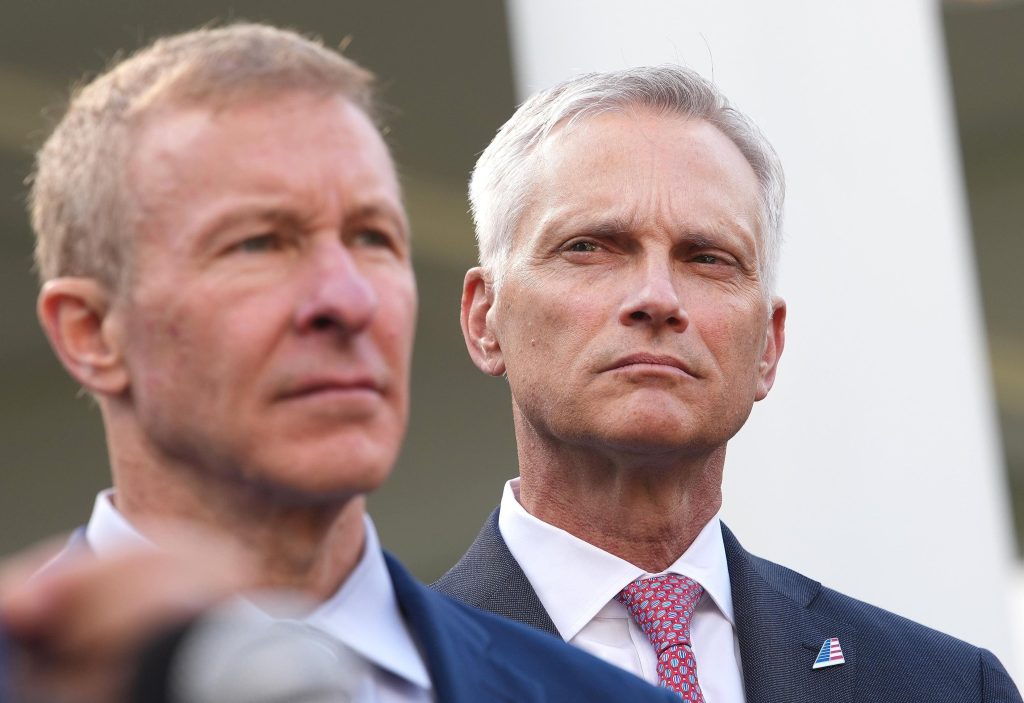
United CEO Scott Kirby (L) and American CEO Robert Isom listen as Vice President JD Vance speaks to Washington reporters during the October shutdown. (Photo by Kevin Dietsch) Getty Images
Ten years ago in August 2016, Scott Kirby was fired as American Airlines president and hired as United Airlines president the same day. He became United CEO in May 2020. Meanwhile, Kirby’s departure cleared the path for Robert Isom to become American CEO in April 2022.
Over time the two men, who worked together at American as well as at predecessors America West Airlines and US Airways, grew to become the airline industry’s foremost adversaries. One chapter in this relationship played out last week, after Kirby was reported to have “floated” the idea of a United/American merger to the Trump administration.
It is not known what Kirby said, or even how serious he was when he said it, or really much of anything about it, but on Friday American put an end to a week of chatter with a late afternoon press release. American said it “is not engaged with or interested in any discussions regarding a merger with United Airlines” and that “a combination with United would be negative for competition and for consumers.” It added: “Our focus will remain on executing on our strategic objectives and positioning American to win for the long term.” In other words: Note to Scott, go away, we can fix this ourselves.
In the end, it was just another week when Kirby set the agenda and Isom had to respond.
After departing American in 2016, Kirby went on to be mentored by United CEO Oscar Munoz. The mentoring slightly subdued Kirby’s audacity. “He became a bit more refined, but one thing not sounded down was his desire to win,” said Dennis Tajer, spokesman for the Allied Pilots Association, which represents American’s 16,000 pilots.
In the past year, Kirby has taken to heckling American, saying regularly that it does not operate at the same level as United and Delta, which account for nearly all of the industry’s profits. Kirby has said that American loses $800 million annually at Chicago O’Hare; he apparently told some United pilots that American may have to dehub ORD, (as related by X poster JonNYC), and he told the Airline Confidential podcast that “I would not want to play the other hand at cards; I know when to hold them and I know when to fold them.”
MORE FOR YOU
On Friday, American got what it wanted at O’Hare, because the Federal Aviation Administration capped summer flights, ending a too-rapid buildup announced by United. “On paper, this looks a victory for American Airlines,” wrote blogger Matthew Klint in “Live And Let’s Fly.” More importantly, Klint noted, “This is not a case of American ‘winning’ and United ‘losing,’ it is a case of both airlines being relieved from a system that encouraged inefficient flying.” Whenever carriers can operate efficient hubs, everyone wins.
Still, with American and United both set to report earnings this week, it appears that United and Kirby will retain the upper hand, with American expected to lose money while its rivals earn profits.
Last month, United staged a media day at Los Angeles International Airport. There was Kirby, at times surrounded by reporters, always comfortable, taking questions, joking and chatting and posing for pictures. Isom, by contrast, almost never talks to reporters, either because he doesn’t want to, or because he is surrounded by staffers who won’t let him. Isom has chosen the Kamala Harris route, where every interview is a big deal, rather than the talk-to-reporters-everyday path chosen by the successful presidential candidate.
It’s not that Isom can’t do it: we once chatted comfortably for about 40 minutes during a car ride in Dallas-Fort Worth. Frequent, comfortable, public interactions with media are a component of leadership. In recent months, Isom has talked to just two reporters, Jordan Parker of The Dallas Morning News and Phil LeBeau of CNBC.
Relations with unions also matter. Union presidents are elected leaders , and at American they have large constituencies. The Association of Professional Flight Attendants, with 26,000 members, has called for Isom to step down, while pilots union APA is in a continuing dispute with him. While Isom recently agreed to meet with pilot leaders, he won’t bring a member of the board to the meeting. “American pilots are stakeholders, not just passing through,” Tajer said. “We want to work on behalf of a winning team and we don’t care who leads it, as long as were winning. But right now this team is not winning.”
Most importantly, Isom is hindered by the airline’s imbedded approach, which has only recently started to change. When the America West Airlines management team took over American in 2012 after taking over US Airways in 2006, it chose to compete on cost, as it always had, rather than on premium service, as American always had. It chose domestic focus, which it had, rather than American’s international heft, which was jobbed out to partners led by British Airways and Japan Air Lines. Now United and Delta have larger widebody fleets to carry international passengers.
Domestically, American has pulled back in New York and Los Angeles, where it once led. In 2011 US Airways transferred 132 slot pairs at LaGuardia to Delta, getting slots at DCA in return. It gave up 24 more LGA slots in 2014 as part of a merger agreement. Now it is said that American has its New York hub in Philadelphia and its California hub in Phoenix. The deals, done before Isom took over, put American behind because New York and Los Angeles are wealth centers at a time when airlines are often viewed as credit card companies, luring the wealthy with fleets of airplanes.
Not to say that American Airlines cannot be fixed — perhaps with Isom at the helm, perhaps without. Isom’s burden is that if he has a vision for American’s future, few have bought in. Start with the pilots. “We just had a 100th anniversary celebration for American, and the pilots weren’t even involved,” Tajer said. “It’s not that we missed the sheet cake. It’s that the strategic long-term plan at the airline is so top secret that nobody knows what it is.”
Editorial StandardsReprints & Permissions
LOADING VIDEO PLAYER…FORBES’ FEATURED Video
Sumber Artikel:
Forbes.com