
Not everyone agrees on how best to serve surging electricity demand in the United States, much less who should pay for the corresponding buildout. But getting the most out of the grid we’ve got has emerged as a delightfully nonpartisan issue.
Late last week, the Department of Energy (DOE) announced $1.9 billion in federal grants supporting 31 projects in 26 states that pledge to wring out 23 gigawatts (GW) of additional capacity, enough to power 16 million homes. They’ll do it by reconductoring or rebuilding transmission lines and deploying Grid-Enhancing Technologies (GETs) across nearly 21,000 miles. By maximizing existing rights-of-way, the projects will target congestion bottlenecks to improve reliability while avoiding expensive greenfield construction, lowering operating costs for utilities and grid operators and helping reduce consumer electricity bills for about 100 million Americans. In addition to the government’s backing, the projects will also receive $3.25B in recipient cost-funding.
The grants stem from DOE’s Speed to Power through Accelerated Reconductoring and other Key Advanced Transmission Technology Upgrades (SPARK) initiative, launched in March to accelerate what the agency identified as “urgently needed” upgrades to the nation’s power grid. SPARK builds on the success of the Grid Resilience and Innovation Partnerships (GRIP) Program, which provided up to $10.5 billion in competitive funding over five years to states, tribes, electric utilities, and other eligible recipients to strengthen grid resilience and innovation. Both are enabled by the bipartisan Infrastructure Investment and Jobs Act (IIJA), passed in 2021.
GETs, long-underutilized on this side of the Atlantic, have started to catch the attention of state lawmakers, too. Some are mandating electric utilities at least consider using advanced transmission technologies (ATTs), including GETs and advanced reconductoring, when planning transmission upgrades. The Commonwealth of Virginia was among the first to pass legislation requiring ATT consideration when Governor Glenn Youngkin signed H.B. 862 into law earlier this year.
“One of the things that’s been very encouraging is that these bills are passing in states across the political spectrum,” assessed national business association Advanced Energy United’s Leah Rubin Shen on a recent Factor This Policycast podcast episode. “We’ve seen bills pass in Colorado and California, in Maryland and New Jersey. We’ve also seen them pass in Utah, Indiana, and Montana… They really are having a sort of a bipartisan moment.”
The DOE said it prioritized projects that could come online quickly for SPARK funding. Recipients range from small utilities North Carolina’s Four County Electric Membership Corporation and the Kit Carson Electric Cooperative in Taos, New Mexico, to big boys Duke Energy and the New York Power Authority. Each endeavor promises some combination of solving a bottleneck, easing congestion, increasing flexibility, lowering costs, and making the grid more reliable. And frankly, it’s nice to not have to debate over whether that’s a good thing.
Hello and welcome to the Factor This Brief, a weekly collection of energy industry finance and development updates, delivered straight to your inbox on Monday mornings and hosted in a not-so-brief fashion here on Factor This, featuring the people, projects, and technology driving our electric future.
Thanks for checking it out. If you what you see here or want to recommend a story for next week, drop me a line. As always, here’s a jam for the journey. And if you get your mitts on any early access Halloween candy, snag me a piece?
Storage in the City
Big city battery energy storage system (BESS) developer NineDot Energy has cut the ribbon on the company’s new site in Hunts Point, The Bronx.
Fully operational in time for next summer’s heat waves, the system will deliver nearly 20 megawatts (MW), enough to power nearly 20,000 homes during peak demand hours in a community which has long suffered environmental injustice and disinvestment.

“Hunts Point has historically been overburdened by high-emitting fossil fuels, and this battery storage facility marks an inflection point in improving the local environment and grid reliability,” noted Adam Cohen, NineDot’s co-founder and chief technology officer.
More than 10,000 diesel trucks travel through the area each day, and two high-emissions peaker plants are located in nearby Port Morris. In 2023, the combined Hunts Point – Mott Haven area recorded asthma-related ER visits at 2-3 times the citywide average, which can be attributed to fine particle air pollution. Energy storage will be integral not only in retiring these gas-fired plants – which operate only during peak grid hours, as battery storage does – but also in providing grid resiliency as Hunts Point moves toward an electrified produce and fish market, truck fleet, and more.

The NineDot battery storage site replaces the former home of a fuel oil trucking company, exemplifying the transition to a modern energy grid.
NineDot Energy says it’s on track to meet its goal of having 400 MW of battery storage in operation, construction, or development by the end of 2026. The company currently boasts 11 operating projects at six locations, totaling 39 MW in Staten Island and The Bronx – the largest battery fleet operating in Con Edison’s NYC service territory. It has more than 60 additional projects in development and a pipeline greater than 1 GW.
New Capacity? Yes, Please
Exus Renewables North America has completed its Highland North and Cambria wind repower projects, adding new capacity to the grid when it is desperately needed.
Cambria is a 61.6 MW wind farm in Adams Township, Pennsylvania, and Highland North is a 75 MW project, also in Cambria County. Vestas supplied the turbines for both repowerings, with JMS Energy serving as the Balance of Plant contractor. Construction was financed through roughly $356 million led by KeyBanc Capital Markets.
The repower replaced each turbine’s nacelle, blades, and generator on the existing towers and foundations, extending operating life another 30 years. Cambria’s output is contracted under a signed power purchase agreement (PPA) with a Fortune 500 technology company, one of a growing number of corporate buyers turning to repowered wind sites for capacity that can come online without the multi-year interconnection timeline a new project requires.
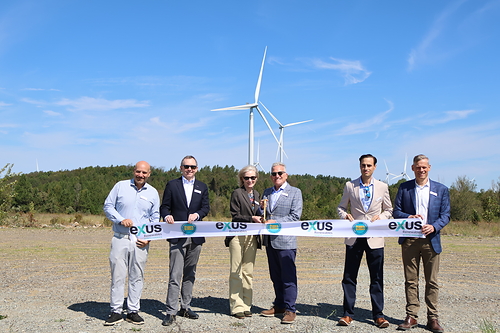
“Highland North and Cambria show what repowering can deliver: proven wind resources, established infrastructure and a faster path to new capacity,” said Jim Spencer, president and CEO of Exus Renewables North America. “Completing both projects is a milestone for our Pennsylvania portfolio and for the communities that have supported this work.”
Both sites have served the community for close to two decades. Cambria was completed in 2008 and Highland North in 2012. Together, the projects bring Exus’ owned wind capacity in Pennsylvania to 306.9 MW.
The repower brought more than 100 workers to the sites during construction and supports nine full-time operations and maintenance jobs. The projects are expected to add roughly $6 million to the local economy through procured materials and services, and to contribute approximately $77 million over 30 years in taxes, fees, and landowner payments.
If it Ain’t Broke…
Classic token of wisdom: If it ain’t broke, don’t fix it. While that doesn’t quite apply to the wind repowering story above, it certainly carries weight when considering partnerships between project developers and financial institutions.
With that in mind, Invenergy, North America’s largest privately held developer, owner, and operator of independent power infrastructure, and HA Sustainable Infrastructure Capital (HASI) are leaning into what’s working. The duo is expanding their partnership to support a 2.7 GW portfolio of select Invenergy undertakings across the United States, including utility-scale solar, solar-plus-battery storage, and wind projects. Invenergy will retain control and majority ownership and continue to lead day-to-day operations.


Sullivan County, Indiana.


All photos courtesy of Invenergy
The portfolio comprises 10 projects across six major U.S. power markets and seven states: Arizona, New Mexico, Texas, Arkansas, Indiana, Ohio, and New York. More than 850 MW are currently operating, with the remaining projects expected to come online by the first quarter of 2027. HASI will fund each project as it reaches commercial operation. Each is backed by long-term PPAs with “investment-grade offtakers, including corporate, utility, and public-sector entities.”
| Project | Size / Technology | Location |
|---|---|---|
| Chalk Bluff Solar | 450 MW solar | St. Francis County, Arkansas |
| Alle-Catt Wind | 340 MW wind | Allegany, Cattaraugus & Wyoming Counties, New York |
| Delilah II Solar | 310 MW solar | Red River County, Texas |
| Cadence Solar | 240 MW solar | Union County, Ohio |
| Hashknife I | 275 MW solar + 275 MW battery storage | Navajo County, Arizona |
| Pleasant Prairie Solar | 240 MW solar | Franklin County, Ohio |
| Trade Post Solar | 200 MW solar | Sullivan County, Indiana |
| Tip Top Solar | 110 MW solar | Lea County, New Mexico |
| Number Three Wind | 104 MW wind | Lewis County, New York |
| Samson II Solar | 200 MW solar | Lamar and Red River Counties, Texas |
“The transaction with HASI underscores Invenergy’s industry-leading execution abilities and allows us to recycle capital and support the company’s long-term growth,” said Meghan Schultz, EVP and chief financial officer. “HASI continues to be a great partner as we continue to deploy power infrastructure that meets the needs of our customers and communities.”
CIBC Capital Markets acted as advisor to Invenergy for this transaction. Sidley Austin LLP served as legal counsel to Invenergy, and Baker McKenzie served as legal counsel to HASI.
Hart in the Right Place
NorthStar Clean Energy has announced the completion of its 120 MW Hart Solar Project, a utility-scale renewable energy facility in Oceana County, Michigan.
The project is expected to generate more than 200 gigawatt-hours (GWh) annually, providing electricity to Executive Energy Services and Michigan Public Power Agency (MPPA) through long-term PPAs. Hart Solar will stave off 96,000 metric tons of carbon dioxide emissions each year, supporting the state’s ambitious clean energy transition.
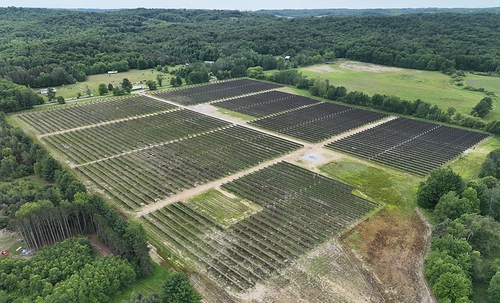
The project created more than 300 construction jobs and will provide long-term tax revenue to support local services and infrastructure. As a result of the project, Hart Township also received roughly $600,000 via EGLE’s Renewables Ready Communities Award Program to fund community improvements. Additionally, the CMS Energy Foundation granted a local food bank, Lakeshore Food Club, $100,000 to further support community well-being and access to essential resources.
“Hart Solar is an important investment in Michigan’s energy future and demonstrates how strong partnerships can help deliver clean energy solutions to communities across our state,” stated Brian Hartmann, president and CEO of NorthStar Clean Energy. “By working with organizations Executive Energy Services and MPPA, we’re helping meet customer energy goals while strengthening Michigan’s energy infrastructure with additional renewable generation.”
Pumping a PA PJM Pipeline
Distributed developer, owner, and operator Renewable Properties has acquired its first portfolio of projects in the PJM wholesale market from Prospect14, a local solar developer. The portfolio includes three sites totaling 71.8 MWdc of capacity: a 26 MWdc and a 27 MWdc project in Central Pennsylvania and an 18.8 MWdc project in western Pennsylvania.
This marks the second deal Renewable Properties has done with Prospect14. In August 2025, Renewable Properties purchased a 38.13 MWdc Prospect14 portfolio of 10 solar net-energy-metered projects, also located in Pennsylvania.

“Renewable Properties is pleased to expand on our successful partnership with Prospect14,” said Aaron Halimi, founder and CEO of Renewable Properties. “Together, we have built a strong foundation that will enable us to continue bringing renewable energy and its many benefits to Pennsylvania, with both distributed solar and PJM solar projects.”
Renewable Properties will sell energy and renewable energy certificates from the projects to wholesale customers and will participate in the PJM capacity market. With this acquisition, Renewable Properties will expand its Pennsylvania project pipeline to over 150 MWdc. The area has recently become an attractive solar market, thanks to increased electricity demand in Pennsylvania and the regional PJM energy market, driven in part by the planned growth of new data centers.
Renewable Properties says it has more than 2 GW under development and over 335 MW under construction or in operation across 19 states.
Sumber Artikel:
Renewableenergyworld.com