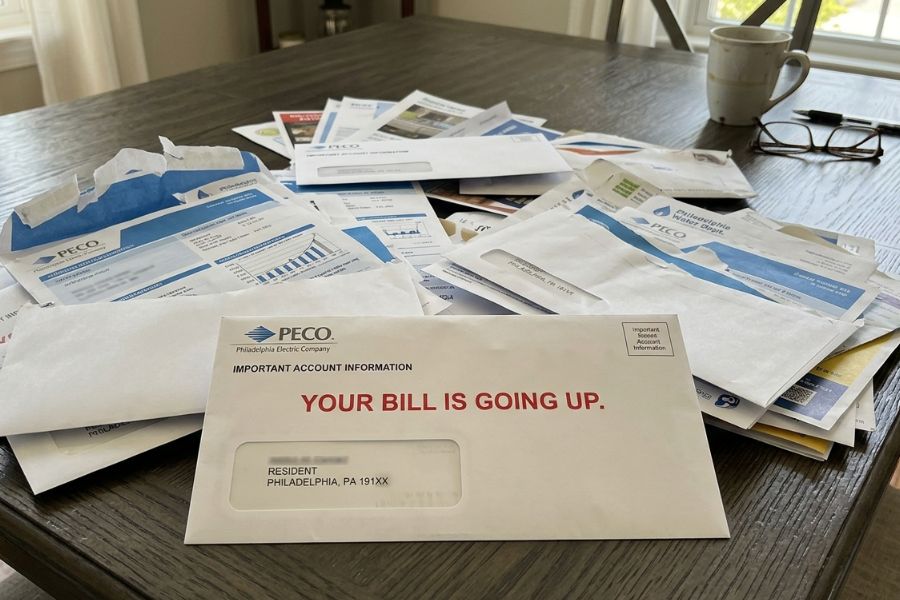

Southeastern Pennsylvania utility PECO, an Exelon subsidiary serving about 1.7 million electric and more than 553,000 natural gas customers, has filed requests with the Pennsylvania Public Utilities Commission to increase its annual electric distribution revenue by approximately $429 million and its gas revenue by $81 million.
If approved, the new rates would take effect on January 1, 2027, two years to the day after the utility enacted a $354 million increase that added about $30 per month to many of its customers’ bills.
How Much More Will I Have to Pay?
If its latest rate hike is approved, PECO estimates that its average residential electric customer will see their bill go up by 12.5% per month, or about $20.08. A typical residential natural gas customer can anticipate a monthly 11.4% increase ($14.52). Commercial customers using 10,000 kilowatt-hours (kWh) can expect bills bubbling up by 5.9%; 200,000 kWh-per-month customers will notice a 4.2% increase.
“We understand that any increase in costs is difficult for families and businesses, and we don’t take this request lightly,” ventured David Vahos, PECO president and CEO, in a statement. “Our customers deserve a system they can count on – especially as severe weather grows more frequent. These investments will strengthen the grid, reduce outages, and ensure we’re delivering the safe, reliable service our customers expect every day.”
“We recognize that energy costs are a concern, which is why we need to strike a balance in ensuring reliable service, while keeping costs as low as possible,” continued Vahos. “That’s why we’re proposing two rate tools designed to spread certain costs over time, helping to reduce customer bills.”
Those mechanisms, a Vegetation Strategic Initiative Rider and an EE&C Regulatory Asset Rider, are designed to extend the cost recovery period to 10 years, rather than the traditional one-year cycle, which PECO estimates will provide an $88 million revenue reduction in 2027 compared to a standard recovery method and deliver nearly $300 million in total customer savings.
Why Does PECO Want to Increase Rates Again?
Between the start of this year and the end of next, PECO says it will have invested more than $2.8 billion in new and replacement electric distribution infrastructure, a significant chunk of the nearly $10 billion in upgrades planned for the next five years.
According to the filing, if PECO doesn’t raise rates again, the company’s overall rate of return over that period is projected to be “only” 5.4%. More importantly, the indicated return on common equity at current rates is expected to be only 5.94%, deemed “inadequate by any reasonable standard and far less than required” to provide PECO with “a reasonable opportunity to attract capital.” The company argues that such returns would jeopardize its ability to invest appropriately in the infrastructure needed to maintain and improve PECO’s safety, reliability, and customer service levels.
The majority of PECO’s capital investments are made in respect to its Long-Term Infrastructure Improvement Plan (LTIIP III), which the Pennsylvania PUC approved in late 2025. Those plans earmark $1.97 billion for targeted reliability projects to prevent storm-related outages, upgrade electric cables, and replace or retire substation equipment and small substations. They include expanding services and programs such as energy assistance; enabling electric vehicle (EV) adoption, solar, and other distributed energy resource interconnection; and maintaining customer service while preparing the grid to support growth from large load users, including data centers.
Where Will The Money Go?
PECO has big plans for the $429 million rate hike, if approved.
The utility intends to modernize its grid by deploying an upgraded Advanced Distribution Management System (ADMS) to provide real-time operational tools for managing storm resiliency and integrating distributed energy resources (DERs). $1.97 billion (as outlined in LTIP III) will be spent on targeted reliability projects, including cable replacement and substation retirements.
PECO is also introducing a “Vegetation Strategic Reliability Improvement Initiative” to reset the baseline for tree trimming in high-interruption areas and drastically reduce future outages. The funds will further improve operational resilience by recovering higher-than-anticipated operations and maintenance (O&M) costs, ballooned by inflationary pressures on labor, contracting, and materials.
In a statement relaying the rate increase requests to its customers, PECO touts improvements in safety, reliability, and service achieved through investments across its territory, including:
- Upper Darby, PA: PECO invested an estimated $66 million to upgrade electric infrastructure in Upper Darby, helping deliver more reliable power to approximately 7,690 customers across Delaware County.
- Philadelphia: A $56 million investment in a new substation in the Overbrook section of Philadelphia is helping ensure more dependable electric service for approximately 17,200 customers across Philadelphia and Montgomery Counties.
- Center City Philadelphia: A $52 million investment to retire the Mall and Lombard substations modernized the electric system and supported more reliable service for approximately 2,900 customers in Center City.
- Marple Township: A new natural gas reliability station is enhancing the safety and reliability of natural gas service for customers across Delaware County.
- Natural Gas Neighborhood Pilot Program: Through this program, PECO has completed more than 260 neighborhood‑level projects, expanding natural gas service and providing reliable energy to over 2,000 new customers.
More Grid Modernization

Why more electric utilities are trying on the ‘Apple Watch’ of the power grid
Grid-enhancing technologies Heimdall Power’s Neuron can unlock more than 40% more capacity on high-voltage power lines.
10 min read
NewsPower GridSmart GridsDTECH Data Centers and AI

How utilities are rethinking resiliency with AI planning tools
Mishal Thadani, CEO of Rhizome, discusses how utilities are shifting to proactive, data-driven resilience planning to address climate threats.
9 min read
DTECHGrid ModernizationNewsOutage ManagementPower GridAIGrid ModernizationReliability and Resilience

Tackling flexibility and stability with envelio CEO Luigi Montana | DTECH Interview Studio
At DTECH 2026, we sat down Luigi Montana, CEO of envelio, to discuss how utility conversations are shifting towards affordability, flexibility, and grid stability; and to get a closer look at envelio’s Intelligent Grid Platform, including the recent addition of the automated strategic grid planning feature.
1 min read
DTECHGrid ModernizationNewsPower GridReliability and Resilience
BESS Leasing Pilot
Nestled deep in the second of four volumes of court docket R-2026-3060859, PECO included details on a proposed residential battery energy storage system (BESS) leasing program.
The company’s pilot will offer a discounted lease on a home BESS for up to 200 residential customers who previously installed rooftop solar systems without an energy storage component. PECO estimates that the average installed cost of each BESS will be $15,000, or $3 million all-in, with each unit expected to have a 15-year useful life. The company expects to collect $2.1 million in prepaid lease payments.
In testimony provided to the Pennsylvania PUC, PECO senior manager of strategic planning Steven DeMott describes how the pilot will work and what the utility hopes to learn.
Eligible customers may lease a BESS owned by PECO for 10 years with a one-time upfront payment equal to 70% of the battery’s installed cost. The company will purchase the BESS, which will be installed at the participating customer’s home by a manufacturer-certified contractor. PECO will then monitor charge and discharge data from the BESS and use the system to reduce demand during peak periods. By doing so, the utility expects to reduce costs for all of its customers, including nonparticipants, deferring needs for distribution system expansion and reducing transmission capacity costs.
Participating customers will be able to use the BESS to reduce their electric bills by shifting energy use to off-peak hours to take advantage of time-of-use (“TOU”) rates and to discharge stored energy as backup power during outages. Only about 5% of PECO’s residential solar customers have thus far chosen to install a BESS, and only a small subset of those customers are enrolled in the company’s TOU generation rates.
To assess the value of these savings, PECO cited the “Avoided Cost of Transmission and Distribution Capacity Study” prepared for the Commission by Demand Side Analytics in July 2024. Using that report, DeMott’s team calculated that the BESS program could generate $1,178 in value per participating customer over its 15-year useful life, under specific assumptions. On average, each BESS installed in the program will shift 1.95 kWh of load from peak hours.
Through the pilot program, PECO aims to understand:
- Whether and how it can best engage residential customers with installed solar systems and batteries to shift daily peak load to non-peak times
- Customer behaviors with respect to self-scheduled TOU arbitrage and utility-scheduled load shifts
- The potential for a BESS leasing offering to encourage the adoption of a BESS by residential customers who have already installed a solar system
- What operating procedures are needed to effectively use BESS as a non-wires solution for peak shaving
PECO intends to issue a request for proposals in the second half of 2026 to select both the specific equipment to be used in the program and one or more installers of that equipment. Should the PUC approve the pilot, PECO says it will be positioned to execute a contract in late 2026 or early 2027 in support of a marketing launch in mid-2027. Given the small scale of the proposed pilot, PECO believes that it can be executed most effectively using equipment from a single OEM.
Sumber Artikel:
Renewableenergyworld.com