BusinessHollywood & Entertainment
ByRegina Kim,
Contributor.
Forbes contributors publish independent expert analyses and insights.
Regina Kim covers Korean and Asian American entertainment.
(L-R) V, J-Hope, RM, Jung Kook, Suga, Jin and Jimin in “BTS: The Return” screenshot from Netflix
The new Netflix documentary BTS: The Return s the K-pop juggernaut as members RM, Jin, J-Hope, Suga, V, Jimin and Jung Kook reunite in Los Angeles to work on ARIRANG, their first album after a nearly four-year hiatus. Directed by Bao Nguyen (Be Water, The Greatest Night in Pop), the film captures BTS at a crossroads, documenting their creative process as they reflect on their legacy and race to complete their album on schedule.
BTS: The Returnoffers a surprisingly raw look at the world’s biggest pop group, but there are some scenes that would probably benefit from additional context, especially for viewers who aren’t fully versed in Korean culture, language and history. So if you’ve watched the movie, here are some key facts and details you *might* have missed, in roughly chronological order.
BTS member J-Hope wearing his military uniform in “BTS: The Return”
screenshot from Netflix
1. South Korea’s mandatory military service has a huge impact on the careers of Korean male celebrities—and BTS is no exception.
All able-bodied South Korean men are required to serve in the military, and for famous actors and artists, that often means stepping out of the spotlight just when they’re at the peak of their careers. Although top athletes, classical musicians and now even e-sports players who win certain competitions may be exempt from military service, K-pop idols—including global superstars BTS who’ve contributed immensely to South Korea’s image and economy—are not.
MORE FOR YOU
While many Korean male celebrities fade into obscurity after completing their military service (which usually lasts from 18 – 21 months), BTS managed to stay relevant through staggered solo projects and a steady stream of content released by their agency during their hiatus.
Still, one can’t help but get the sense that military service has somewhat disrupted their lives and their careers. Early in the movie, there’s a dinner scene in which the members express anxiety over making their comeback after nearly four years. It’s a candid, intimate look at the band as it tries to regain its collective footing and figure out how to move forward in a K-pop landscape that has shifted in its absence.
“Soju ain’t something you drink with your mouth—you drink it with your heart!” Jimin says in his native Busan dialect.
screenshot from Netflix
2. BTS member Jimin shows off his endearing Busan dialect.
In this adorable scene—after J-Hope says that he knows what Jimin is about to say just by looking at his eyes—Jimin suddenly slips into his native Busan dialect and playfully channels the image of a stereotypical tough guy from the city.
In Korea, men from Busan are generally thought to be manly and blunt, and many Korean movies have featured gangsters and other alpha male characters speaking in a Busan accent. Below is a clip from the Korean crime thriller Nameless Gangster, where the two mobsters played by Cho Jin-woong and Ha Jung-woo speak to each other in the Busan dialect (the scene ends in violence, so viewer discretion is advised):
Here’s a great explainer on the Busan dialect:
Forbes‘The Rose: Come Back To Me’ Shows How A Korean Rock Band Went GlobalBy Regina Kim
Suga reminisces on BTS’s first US performance, which took place at the LA nightclub Troubadour.
screenshot from Netflix
3. BTS: The Return contains references to BTS American Hustle Life, a 2014 reality show that ed BTS as they underwent intensive hip-hop training in Los Angeles.
Suga takes a trip down memory lane as his car drives past Troubadour, the famous West Hollywood nightclub where Radiohead, Coldplay, Elton John and countless other legendary artists have performed in the past. It was at this venue where BTS held their first US performance, chronicled in the reality show BTS American Hustle Life. Released by Mnet in 2014, the 8-episode series ed BTS in their early years as they went through a hip-hop boot camp in LA, where they were mentored by the s of Coolio, Tony Jones and Warren G.
(top): The seven Korean men who arrived at Howard University in 1896; (bottom): Cover of BTS’s album ARIRANG
screenshot from Reddit (credit: @GingerTropics1960)
4. The now-famous story of the seven Korean men who came to Howard University in 1896 has more parallels with BTS than one might think.
By now, much has already been written about how BTS’s latest album ARIRANG drew inspiration from the true story of the seven Korean (then called “Joseon”) men who came to Washington, DC, in 1896 to study at Howard University. But besides the obvious parallels with BTS, the seven male students at Howard apparently attracted a lot of attention from women, too—just BTS. The Washington Post article that originally recounted the Joseon students’ journey to the US mentioned that at Howard, the men “were surrounded by a dozen persuasive damsels, who begged them to sing.”
In “BTS: The Return” BTS leader RM explains that the traditional Korean folk song “Arirang” was sung to overcome “han” with “heung.”
screenshot from Netflix
5. Though no one knows the true meaning and origin of “Arirang,” it’s become Korea’s most beloved folk song and the country’s unofficial national anthem. As BTS’s leader RM explains, “Arirang” contains the dual Korean concepts of “han” and “heung.”
Passed down orally through generations, the Korean traditional folk song dates back at least 600 years and contains roughly 4,000 regional variations. The most famous version, the “Bonjo Arirang” (Standard Arirang) from Seoul, is sampled in BTS’s track “Body to Body.”
Although different theories exist around the meaning of the word “Arirang,” HYBE’s creative director Boyoung Lee puts forth an explanation that befits BTS, with “ari” deriving from the Korean term for “beauty” and “rang” referring to a deep longing—which, in BTS’s case, can mean a longing for their fans and for their passion for music.
“Arirang” contains han, which the film defines as the “sorrows of longing,” but it’s actually a more complex feeling that also encompasses resentment, anger and regret stemming from loss, adversity and a sense of injustice. Some have ned it to generational trauma caused by centuries of invasions, suffering and oppression experienced by the Korean people. As RM explains later in the film, Koreans would sing “Arirang” to overcome their “han” (한) with “heung” (흥), a kind of spontaneous joy that arises from collective resilience.
Jimin and RM imitate traditional Korean dances when they hear “Arirang”
screenshot from Netflix
6. When the members discuss sampling the Korean traditional folk song “Arirang,” BTS members Jimin and RM are shown imitating traditional Korean dances.
If you were wondering why Jimin and RM started waving their arms around while the members were discussing how to incorporate “Arirang” into “Body to Body,” it’s because those gestures are commonly seen in traditional Korean dances.
Here’s a video of a dance performance of “Jindo Arirang,” one of the more famous variations of “Arirang”:
Fun fact: “Jindo Arirang” is also the variation that Jung Kook starts singing in the scene where the BTS members discuss the theme of “Arirang” while drinking beer.
Jung Kook sings an excerpt of “Jindo Arirang”
screenshot from Netflix
7. BTS: The Return features cameos from several Korean celebrities.
K-culture fans will ly have noticed that the movie also includes some surprise celebrity cameos. After the BTS members are shown doing a photo shoot and giving a press interview, the film cuts to V having dinner with some friends. Turns out those friends are none other than actors Park Hyung-sik (Strong Girl Bong-soon, Doctor Slump), Park Seo-joon (Gyeongseong Creature, The Marvels) and Choi Woo-shik (Parasite, Our Beloved Summer) as well as singer-songwriter and producer Peakboy. The five close friends call themselves the “Wooga Squad,” taken from a Korean phrase that means, “Are we family?” Park Hyung-sik’s older brother Park Min-sik is also seen sitting at the table.
V compares “SWIM,” the lead single from BTS’s album ARIRANG, to Pyongyang naengmyeon
screenshot from Netflix
8. V compares BTS’s lead single “SWIM” to Pyongyang naengmyeon, a type of Korean cold noodle dish.
V tells his friends over dinner that while many of the tracks on BTS’s new album sound very aggressive, the “mildest of them all”—“SWIM”—was chosen to be the lead single. In Korean, V actually says that “SWIM” is the song that’s most “Pyongyang naengmyeon”—the original version of mul naengmyeon, a popular Korean cold noodle dish that’s often served at Korean BBQ places and other Korean restaurants. Though different types of mul naengmyeon exist, the original Pyongyang style features buckwheat noodles served in a refreshing beef broth and is noted for its clean, mild flavor. Many people find Pyongyang naengmyeon to be a bit bland at first but later become hooked after trying it a few more times—just how V says that “SWIM” is a “song you can play on repeat without getting tired of it.”
Pyongyang Naengmyeon (photo taken from https://www.koreaherald.com/article/1651292)
Credit: Park Hyun-koo/The Korea Herald
9. The subtitles in BTS: The Return don’t fully capture everything that RM says, either.
Of course, there are many Korean expressions that don’t quite land when translated literally, whether it’s V’s Pyongyang naengmyeon analogy or RM explaining “Arirang” in terms of han and heung. But there are a few instances in the movie that probably could have benefited from a more literal translation.
- About 44 minutes into the movie, RM acknowledges that the world is changing so fast. “Trends shift every season, and new faces (artists) appear overnight,” he says in Korean. He then adds, “We can’t keep doing the same thing,” implying that BTS cannot continue making the same kind of music. (The subtitles, however, show him saying, “standing still isn’t an option,” which conveys a different nuance).
- Towards the end of the movie, RM says, “Being part of a team BTS is wearing a big, incredible crown. Sometimes, the weight of the crown can feel so heavy.” The subtitles then show him as saying, “And it feels heavy to wear it at times”; however, he actually says, “Sometimes, it scares us a bit too.”
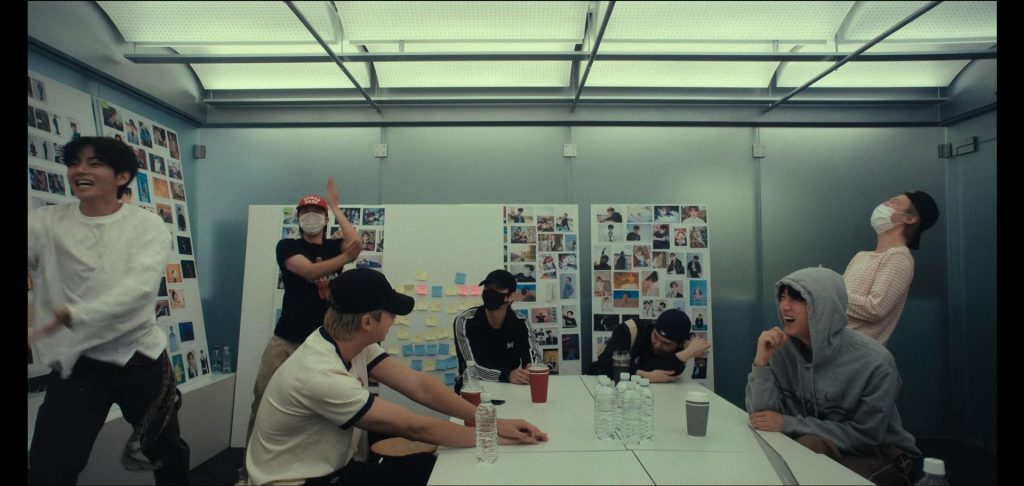
As V and J-Hope dance to the “Arirang” portion of “Body to Body,” Jin points at them and asks, “Isn’t this from the National Exercise?”
screenshot from Netflix
10. When V and J-Hope start dancing to the “Arirang” portion of BTS’s song “Body to Body,” Jin points at them and asks, “Isn’t this from the National Exercise”?
The “National Exercise” that Jin mentions here is referring to the “New Millennium Health Gymnastics” (새천년 건강체조), a group calisthenics routine created in 1999 by the Korea Sports Promotion Foundation and implemented across South Korean elementary schools during the 2000s. Unearlier national calisthenics programs, these exercises incorporated elements from taekwondo, traditional Korean dances and other sources, making the movements more fluid and dynamic but also more challenging. The New Millennium Health Gymnastics was also set to traditional Korean music, and the members of BTS would’ve learned it while in elementary school, so it makes sense that V and J-Hope would borrow moves from that routine!
Since most schools in South Korea no longer practice group calisthenics, many Korean students today aren’t familiar with these exercises.
‘BTS: The Return’ is currently streaming on Netflix.
ForbesBTS Comeback Concert Gets A New Edit On Netflix: Here Are The DetailsBy Regina Kim
Find Regina on Instagram, Threads and Bluesky.
Editorial StandardsReprints & Permissions
LOADING VIDEO PLAYER…FORBES’ FEATURED Video
Sumber Artikel:
Forbes.com