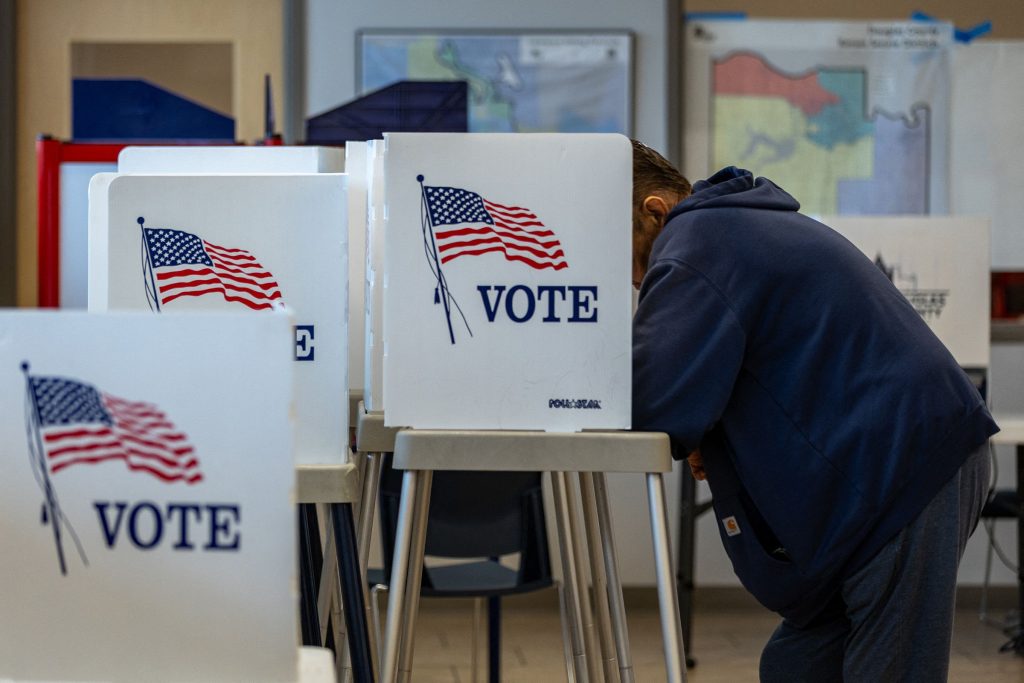
Civil society groups have feared that the mass anti-immigration surges across the US this year would have a chilling effect on voter turnout in Latino communities.
In reality, they have had the opposite result.
”We have not seen here at the local level people worried to show up to vote because they think ICE is going to be there,” Michael Mireles, a canvassing organizer with LUPE Votes, a get-out-the-vote group in southern Texas, tells WIRED. “People are driven right now by their anti-ICE sentiment, and it’s not stopping them from going to the polls.”
Mireles is one of a dozen activists, volunteers, and organizers WIRED spoke to in recent weeks about the impact Trump’s hard-line immigration policies were having on communities that turned out in surprising numbers for the president in 2024. Trump’s immigration policies have disproportionately targeted Latino neighborhoods, and many law-abiding US citizens have been caught up in the ICE dragnet. For weeks now, the Department of Homeland Security and the Trump administration have claimed that they have no plans to deploy ICE agents to polling locations on election day, but President Donald Trump and administration officials DHS secretary Markwayne Mullin and attorney general Todd Blanche have repeatedly hinted at some sort of deployment.
While there is certainly still fear about what may happen on Election Day, the overwhelming message coming from the Latino community is that rather than being cowed, they are defying the administration to turn up in record numbers.
These experiences are backed up by data. Early voting figures indicate people are casting their ballots at a much higher rate than in recent elections. By Monday afternoon, more than 57million people had voted early, 10 million more than the total early voting figure in the 2022 midterms. In many states, Latino communities are accounting for a larger than in previous years, according to data from the University of Florida’s Election Lab.
In Texas, there have already been over 400,000 people who didn’t vote in 2024 who have cast their ballot in 2026. Of that figure, 50 percent are Latino voters, Tom Bonier, a Democrat strategist and adviser to data company TargetSmart, revealed in an interview last week.
And what’s happening in Texas is being replicated across the country, according to data from TargetSmart. By October 27, 3.8 million Hispanic and Latino voters had cast a ballot nationwide, a massive increase from the 2.35 million Hispanic and Latino voters who had voted by the same date in 2022.
“Where large Hispanic communities exist in Texas, there is elevated turnout even above the blistering statewide pace,” Michael McDonald, who runs the University of Florida Election Lab, wrote in an analysis last week. “Texas Hispanics are voting at higher levels than in past elections, as we can see in Florida, Georgia, and North Carolina.”
This analysis was backed up by data d with WIRED by the League of United Latin American Citizens, the largest Latino civil rights group in the country.
The league’s data shows that in Texas’ 15th congressional district, which includes a part of the Rio Grande Valley, over 12,000 people who have voted early did not vote in the previous elections. Those votes could have a significant impact in a district where incumbent Republican congresswoman Monica De La Cruz won in 2022 by around 12,000 votes.
Dozens of organizations and individuals across the country have worked tirelessly for months to convince these communities that they need to stand up and have their voice heard, and the best way to do that is to vote.
“We didn’t try to pacify people or make it seem it wasn’t going to be that bad,” Liliana Rivera Baiman, an organizer with 614 ICE Watch and Ohio Good Neighbor Network tells WIRED. “We didn’t want to exaggerate either. We said this is the reality of what’s been happening. These are examples of what we’ve seen. You’ve told us that it’s really bad and that you don’t want this to continue, so you have a choice. You’re either going to show up and vote and make sure that your voice is counted, or you’re going to stay home and continue to deal with this for the next two or three years, possibly longer. I really think that motivated a lot of people.”
The experiences of citizens who have faced down ICE’s massive surges have played a huge factor.
“Folks in these places that have really come face-to-face with some of the worst of the ICE violence are feeling they understand that preparation is key,” Jill Garvey, executive director of States at the Core, a group that combats authoritarianism and political extremism, tells WIRED. “They understand how traumatizing this is, how chaotic it is. I think they want to be as prepared as possible for any scenario.”
But Garvey says that facing down ICE already means these communities are “frankly, a little less scared. They have faced this already, and it’s scary, but they also know that it’s possible, and that the escalation can happen very, very quickly.”
Living United for Change in Arizona is a group that targets working-class Latino voters with its get-out-the-vote efforts. In one recent week, volunteers knocked on thousands of doors, César Fierros, a spokesperson for the group tells WIRED. 1,000 people told the group they voted early or mailed their ballots back. “That’s a really good sign; that’s something that we have really never seen before,” Fierros says. “People are saying ‘Yes, there are threats out there, looming, but we’re still going to show up regardless.”
In DeKalb County in Georgia, volunteers from the America Movement, an anti-Trump group, heard similar messages from people streaming into early polling locations earlier this month.
“We’re hearing it everywhere our Vote Safe team members are,” Mary Corcoran, cofounder and executive director of the America Movement, tells WIRED. “Voters came through in a steady stream from the moment the polls opened until they closed. Person after person told our team that nothing was going to keep them from voting this year. People know what this administration is trying to do, and they are refusing to be scared out of their own democracy.”
In Nevada, secretary of state Cisco Aguilar, who is running for reelection against election denier Jim Marchant, believes that in order to convince reticent voters to show up, elected leaders need to “get real.”
“I did a Latino community event [and said] we have to actually fucking vote to tell these motherfuckers to fuck off,” Aguilar tells WIRED. “And when you get real with them about that, and they know that you’re willing to stand up and fight for them, then they are willing to consider showing up to vote.”
This is a sentiment echoed by Suzanne Almeida, vice president of states with voting rights group Common Cause, who says it’s important to “lean into that defiance” and tell voters “that the opposition wouldn’t be making it so difficult if there wasn’t power in voting.”
“The threats are real, but so is the joy, and there is a real joy that comes in participating in democracy,” Almeida says.
Sumber Artikel:
Wired.com