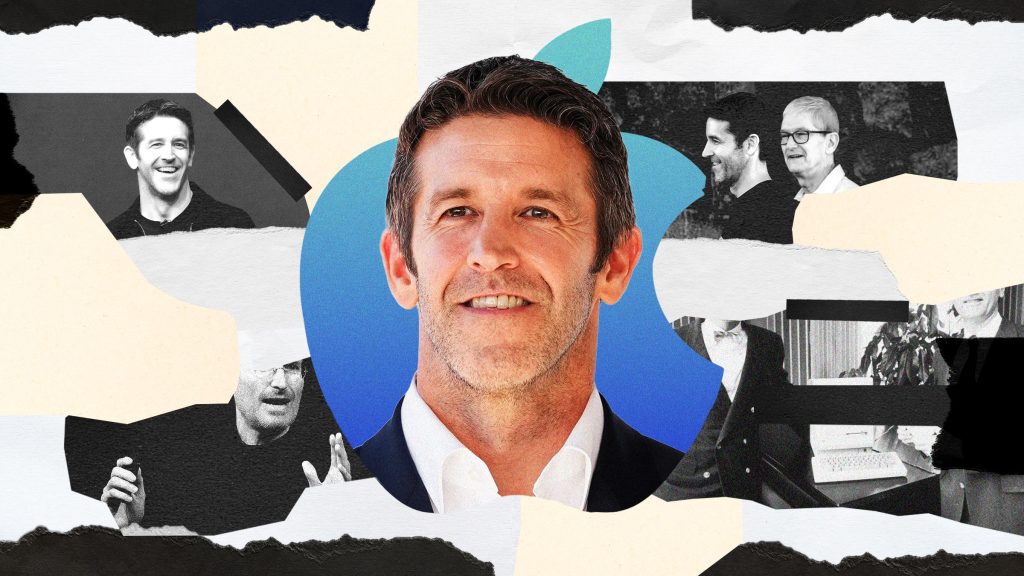
It’s a bright day in Cupertino. Apple’s new CEO strolls to an outdoor seating area within the company’s otherworldly ring-shaped headquarters and pulls up a chair. An employee notes the angle and asks if he minds the sun. John Ternus doesn’t mind at all.
Nearly two months into his tenure, he’s been busy. While the tech world buzzes about AI agents and the upcoming IPO of a company reporting spectacular losses, Ternus’ leadership of a ridiculously profitable firm has so far been defined by a sequence of significant launches—the long-awaited foldable iPhone, a household device that can control digital appliances, new Mac Minis, and AirPods. Intentionally or not, all that activity sends a message that, even as AI dominates the public imagination, hardware products still rule.

Photograph: Shot on iPhone 18 Pro Max by Peter Hapak/Courtesy of Apple
Ternus doesn’t endorse that take, but he doesn’t object when I suggest it. “We’ve been working on these products for quite some time,” he says. “It feels everyone here is just kind of riding high right now, enjoying it.”
I ask if Apple is about to break a long-imposed taboo and introduce a Macintosh with a touch screen.
Ternus beams. “Who knew?”
We are referring to the new MacBook Pro with PROLED XDR Display that Apple is releasing today at an event in Los Angeles. It’s got a mighty M5 Pro or M5 Max chip and a show-stopping tandem OLED screen. (A tandem screen has multiple light-emitting layers, producing more dramatic contrasts.) But its most conspicuous feature is one that’s been deeply woven into iPhones, iPads, and even Apple Watches for years but not Apple’s laptops: a touch display. After years of resistance, a Mac screen has finally gone digital. As in fingers.
This turnaround is a big deal to Apple fans. Ternus shrugs off the drama. “The Mac is first and foremost an indirect input device, built around the trackpad and keyboard. But I think there’s times when it’s comfortable and handy to have touch.”
Ternus and Apple want to make sure that the Mac faithful don’t panic that the 42-year-old franchise is losing its identity to Apple’s gangbusters mobile products. “We needed to get to a point where adding touch didn’t make the product lesser in any way. It didn’t make it heavier. It didn’t make it thicker. That came together with the OLED screen, the best display we’ve ever put into a Mac,” Ternus told me. “All of these things, and, oh yeah, it has touch as well.”
Apple has a long history of refusing to implement certain desirable features, only to pivot when it feels the time is right. Steve Jobs once proclaimed iPods would never do video, until they did. He also once said “no one’s going to buy” a jumbo-size phone—and then Apple released a supersized iPhone 6. Then there was that time Jobs declared styluses inappropriate for tablets. Now the Apple Pencil works with iPads and the brand-new Duo.
The 2026 MacBook Pro instantly qualifies as the canonical example of this switcheroo. Apple executives had been on record regarding touch on PCs as a misbegotten idea. Never mind that just about every PC maker not headquartered in Cupertino has implemented touch on their laptops. And customers of Microsoft, Dell, Acer, Lenovo, and HP have snapped them up. Clearly, people wanted touch on their laptop displays. Even toddlers knew it—put some rugrats in front of a computer and their little arms shoot straight to the screen in futile attempts to swipe and scroll as they do on their iPads. People were baffled why Apple—the pioneer in touch displays since the iPhone—was so steadfast in its rejection.
In 2015, while doing a story about a new iMac, I pressed Phil Schiller, then the senior vice president of worldwide product marketing, on this very question. Usually, top Apple executives field such queries with cryptic remarks. In this case, Schiller began a filibuster. “I’m going to get a little bit philosophical,” he said, and launched into what I later described as the Grand Unified Theory of Apple Hardware.
He explained that every Apple hardware product—the Watch, iPad, iMac, MacBook—is basically a computer and a piece of glass. Each one has a specific function. And each one has an interface appropriate to the hardware. Multitouch is fine for products the iPhone, he said—but not the Macintosh. He provided two reasons: ergonomics and the software interface.
“From the ergonomic standpoint, we have studied this pretty extensively, and we believe that on a desktop scenario, where you have a fixed keyboard, having to reach up to do touch interfaces is uncomfortable,” he told me.
As for the interface, Schiller argued that Apple’s two main operating systems were built on different design principles. The iPhone and iPad’s iOS was multitouch from the get-go, and didn’t use macOS conventions that require precision, such as cursors and tiny boxes to close windows. “These two worlds are different on purpose, and that’s a good thing—we can optimize around the best experience for each of those and not try to mesh them together into a least-common-denominator experience,” he told me.
A year later, when Apple introduced a MacBook Pro with the ill-fated “touch bar”—a dynamic strip of virtual function keys above the keyboard’s top row—Schiller doubled down on the view that touch should never find its way into a Mac display. He said that such a move would mean totally redesigning the menu bar for fingers, and that would clash with the experience of pointer devices a touchpad or mouse. “You can’t optimize for both,” he said.
To double-check this assumption, Apple conducted user tests with touchscreens on Mac. “What the heck, we could be wrong,” Schiller told me then. “We’ve absolutely come away with the belief that it isn’t the right thing to do. Our instincts were correct.”
When I met with Apple executives Johny Srouji and Greg Joswiak this week to discuss the touchscreen MacBook Pro, you bet I invoked Schiller’s list of concerns. (Apple’s reps chose not to make Schiller, who now holds the title of “Apple Fellow,” available for an interview. In fact, they laughed when I asked.) It wasn’t only Schiller drawing a red line. In 2021, Ternus told journalist Joanna Stern, “The Mac is totally optimized for indirect input. We haven’t really felt a reason to change that.”
“Ten years is a very, very long time,” says Srouji, Apple’s chief hardware officer. “Many things have changed, whether it’s the display technology, the custom silicon, et cetera.” Eventually, he told me, the confluence of chips, display tech, and software architecture “met our bar.” “I my engineers to be gated by physics, not imagination or timelines,” he says.
Joswiak, who holds Schiller’s old title of SVP of worldwide marketing, concedes that touch was overdue, at least for users with sophisticated needs. Its pro customers—engineers, scientists, software developers, and media creators—were impatient with Apple for its failure to let them interact directly with the screen. “Most pros own an iPad, and almost every pro owns an iPhone,” Joswiak says. “So this is something that they’re natural with. There’s a generation of young creators and young people using our MacBook Pros that expect to touch.”
Between the lines, Srouji and Joswiak seem to consider their competitors’ touchscreen implementations shabby and lazy. The Apple ethos, as every one of its executives will happily explain to anyone who asks, is an expectation of quality that’s sky-high. “If you’re working on something easy, you’re wasting your time,” says Srouji, who has been at Apple since 2008 and has pretty much driven its innovation by spearheading the company’s charge to custom-build silicon.
“The easy things, I want to outsource,” he continues. “So the custom silicon is hard. The touch is hard. The display is hard. Everything we build is hard.” This swaggering philosophy dates from the Steve Jobs days and, in 2026, stands in contrast to the endgame of the ascendant AI industry, which hopes to turn over the toughest parts of industrial production to superintelligent entities.
Srouji presents Mac touch as a suite of innovations, starting with that screen that Ternus described as the Mac’s best ever. It also involves custom silicon and a rearchitected thermal system to prevent the display from feeling hot when people pinch, stretch, and swipe on it. Srouji contends that current touchscreen laptops suffer from “wobble” when fingers make contact with the display; to minimize this effect, Apple has redesigned the hinge on the MacBook Pro screen to stabilize it.
When I get a demo of the 16-inch version (as with previous Pros, it’s also available in a 14-inch version), I see what they mean about the display. It’s noticeably dense and bright, and the obsidian blacks are the deepest I’ve seen on a computer screen. In part because the OLED screen doesn’t require backlighting, this MacBook weighs less than its predecessor.
As a pair of Apple managers take the MacBook through its paces, I see how Apple has addressed some of Schiller’s decade-old concerns, having to redesign the menu bar for fingers. While it looks the same, when you move a finger over a menu item, it expands to allow you to select your choice with precision. Some of the objects on the screen, the traffic-light buttons that close or hide windows, also get bigger when you touch them.
They show me how the touch tech can handle precision tasks, color grading in the video editing software DaVinci Resolve, or tweaking a soundtrack on Logic Pro, Apple’s high-end audio workstation. One innovation, not just for pros, is a new gesture to pull down the “Dynamic Island,” that black oval hosting ongoing tasks that has made its way to Mac from iPhone. An expanded version floats on the screen a widget, enabling easy access to Siri responses and Spotlight search.
But what about greasy fingers messing up the screen? I was told that the new display has an anti-reflective outer coating that will require no more cleaning than your normal non-interactive screen.
Apple clearly hopes that the MacBook Pro launch puts an exclamation point on the burst of product announcements that Apple customers are still absorbing. For the foldable Duo, some customers are impatiently waiting for delivery dates that stretch into January. (Lines were long at Apple stores last Friday, when the device went on sale, and Joswiak personally greeted those who queued up at Apple’s Fifth Avenue store in New York City.)
I ask Srouji whether Apple is making a statement with its armada of new products, maybe as a way to say that in a year dominated by AI obsession, Apple is still here. He responds much as his new boss did, contending that Apple is simply sticking to its game plan. “We’re here to build the most amazing products in the world, and we want to ship them when we believe it’s ready and complete,” says Srouji. “That’s the statement we’re making. I think everyone knows we’re here.”
While longtime users will be happy to hear that a Macintosh now has a touchscreen, those with limited budgets will be disappointed. Apple’s current stance—that touch-on-a-Mac display is most appropriate to the “pro” crowd—rationalizes an astronomical price tag: The new MacBook Pro starts at $2,899 for the 14-inch version and $3,399 for the 16-inch model. Financial analyst Neil Cybart, who got an early MacBook Pro briefing, thinks that serious professionals will pay up. “People are in search of value, and that means going for products that leverage technology to improve what they’re doing,” he says.
When I ask Ternus about the timeline, or even the possibility, of seeing touch displays on less exorbitantly priced MacBook Airs and iMacs, he shakes his head. “You’ve been doing this a long time,” he says. “You know I will never tell you anything about our future.”
I don’t know why I bothered to ask. If Ternus said that touch would never happen on a MacBook Air, who would believe him? I’d be back at The Ring a year later, hearing that Apple had finally figured out a way to do it right.
Let us know what you think about this article. Submit a letter to the editor at[email protected].
Sumber Artikel:
Wired.com