
Contributed by Prasanna Venkatesan | Chief Operating Officer, Landis+Gyr
Edited by Paul Gerke
For the last century, utilities relied on infrastructure investment to improve reliability and resilience, but the operating environment has changed. And the scale of investment ahead is significant. Deloitte estimates that the U.S. power sector could invest as much as $1.4 trillion between 2025 and 2030, roughly equivalent to what the industry spent over the previous 12 years combined, as utilities respond to growing electricity demand and modernize generation, transmission, and distribution systems.
There’s a healthy caution here that comes with such a big upside potential. We have to remember that today’s American electricity consumer now expects greater visibility into their energy use to control their bills and interconnected devices in their homes and businesses, all in service of efficiency and leveraging tech to make energy use smarter and more affordable. With higher consumer expectations, utilities are also under pressure to make energy more affordable, and infrastructure alone cannot overcome the challenge, but with more connected platforms and grid intelligence, it’s possible to do these two critical things at once: Satisfy the needs of the people paying for power, and grow your utility business at the same time.
As Exelon President and CEO Calvin Butler recently put it, “You don’t step into any of our states without the first thing that governors or commissions talk about is affordability.”
The next phase of grid modernization will center on analysis to intelligently manage existing infrastructure and defer unnecessary upgrades.
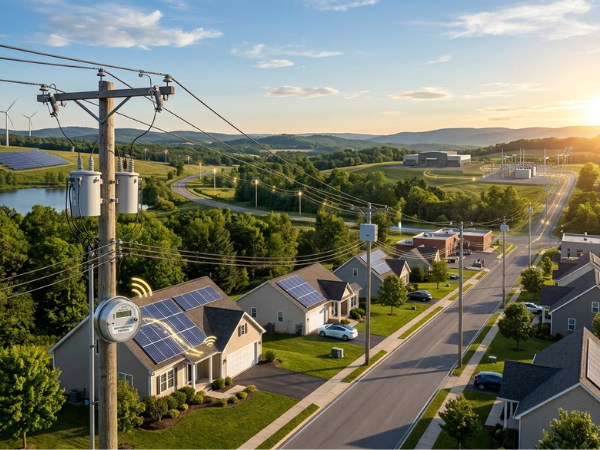
Advanced metering infrastructure (AMI) has progressed beyond data collection. AMI 2.0 closes the grid intelligence gap, helping utilities improve affordability.
Moving Beyond Advanced Metering 1.0
AMI 1.0 digitized the grid edge by connecting utilities to millions of service territory endpoints. The connection delivered unprecedented visibility into grid operations and customer energy use, but the supporting technology required to leverage that data was still developing.
Advanced distribution management systems, distributed energy resource management systems, cloud computing, communications networks, and analytics platforms have matured significantly over the past decade alongside AMI. Together, these technologies let utilities analyze and act on operational data in near real time.
AMI 2.0 and beyond is no longer limited to collecting historical usage data. It delivers real-time operational intelligence through capabilities such as waveform analytics, advanced power quality monitoring, distributed energy resource management, and enhanced outage and fault pinpointing.
Tokyo Electric Power Company (TEPCO) has successfully converted advanced metering into a grid intelligence platform. TEPCO manages one of the world’s largest utility IoT platforms, collecting billions of data records each day from more than 30 million connected endpoint devices. Data from meters and other connected devices is transformed into operational intelligence that supports forecasting, planning, asset management, and grid operations across the service territory.
How Grid Intelligence Improves Affordability
Real-time grid intelligence made possible by AMI 2.0 and beyond enables faster, more informed operational decisions that reduce operating and energy procurement costs.
Lower operating costs
Waveform analytics and advanced power quality monitoring help utilities identify voltage irregularities, equipment stress, and developing power quality issues before they become larger operational challenges. Processing operational data closer to the grid edge reduces the volume of raw data that must be transmitted and centrally analyzed, shortening the time required to diagnose changing system conditions and coordinate an appropriate response. Filtering and grading data at the grid edge reduces unnecessary communications traffic and ensures operators receive all relevant information when system conditions change.
Florida’s Clay Electric Cooperative uses real-time data to decrease outage response costs. The cooperative’s integrated AMI infrastructure and outage management capabilities increased visibility during the 2024 Florida hurricane season. The integrated data helped Clay Electric Cooperative quickly assess damage and deploy assistance as needed, reducing outage restoration costs during major storms.
Lower energy supply costs
Managing peak demand is another affordability lever. Coordinating flexible loads in real time enables utilities to reduce demand when wholesale energy costs are highest.
Central Georgia EMC used AMI to expand its demand flexibility strategy to include appliance-level load management across HVAC systems, water heaters, and electric vehicle chargers. Real-time system information enabled the cooperative to reduce peak demand and lower wholesale power procurement costs.
Lower infrastructure costs
Utilities can make more strategic infrastructure decisions using real-time grid intelligence. Analyzing system performance and asset utilization data identifies where new infrastructure investment is justified and how existing assets can continue delivering value.
The City of Neenah Water Utility, for example, leveraged existing infrastructure to support its AMI deployment. A d network model reduced utility deployment costs and enabled the city to modernize its operations without duplicate infrastructure investments.
National Grid’s deployment of nearly one million Revelo grid-sensing meters tells a similar story. Built on standards-based Wi-SUN communications, the network meets current operational requirements and provides flexibility to integrate additional distributed energy resources, electric vehicles, and other grid edge technologies without requiring a new communications network.
Lower customer energy costs
AMI 2.0 enables customers to better understand and manage their energy use through real-time load disaggregation, home energy management, and consumer energy insights. More detailed energy information allows customers to identify opportunities to shift or reduce consumption, helping lower their electric bills.
The Next Phase of Grid Modernization
Affordability also cannot be considered separately from the other challenges utilities are addressing. As Butler said at EEI 2026, “We used to talk reliability, affordability and resilience in separate conversations. They’re all linked now.”
Utilities that transform operational data into grid intelligence will have an affordability advantage during the next phase of grid modernization. Grid edge data informs how best to strengthen operational performance and maximize the value of existing infrastructure.
Early deployments demonstrate how grid intelligence stands to reshape utility operations now and into the future. AMI 2.0 will be a central technology that informs how utilities manage affordability and deliver value to their customers.
About the Author

Prasanna Venkatesan, chief operating officer at Landis+Gyr, has been with the company since 2006 and has held several leadership roles, including head of strategy (2022-2024), head of Americas (2014-2021), senior vice president and general manager of systems and services for Landis+Gyr North America (2009-2013), and vice president of research and development (2008-2009).
Before that, he held senior roles at Cellnet Technology, Inc., including vice president of supply chain and manufacturing engineering, where he also led the integration of Cellnet Technology into Landis+Gyr after its acquisition in 2007. Prasanna Venkatesan holds a Master of Science in Industrial Engineering from the University of Oklahoma, U.S.
Sumber Artikel:
Renewableenergyworld.com