

The big shift coming in AI data center spending
When you dig under the hood of hyperscalers’ massive capital expenditure budgets, there are two core components: the data center buildings and the servers and networking equipment inside them. As Jassy points out, “these have different capital cycles.” Data centers depreciate much more slowly than the server racks full of GPUs.
“For our data centers, which have 30-plus-year useful lives, we should get at least five to six generations of server economics,” Jassy told analysts during Amazon’s second-quarter earnings call. “This means in the short term, when demand is necessitating so many data centers being built simultaneously in advance of when we can start monetizing them, we’ll spend a lot of capex and encounter free cash flow headwinds until these data centers come online, can be monetized, and we get a few years into these servers being utilized.”
In other words, once a data center is built, Amazon doesn’t have to build the data center again. However, it does have to periodically refresh the chips inside of it. As a result, over time, more and more of its capital expenditures will go toward semiconductors. The same is true at all the other hyperscalers.
Expand

NASDAQ: AMZN
Amazon
Premium Feature
Moneyball Superscore
90/100
Today’s Change
(-0.60%) $-1.54
Current Price
$256.97
Key Data Points
Market Cap
$2.8TMarket cap calculated using publicly traded s outstanding only. Does not include unlisted, private, or dual-class non-traded s. Implied market cap may vary.
Day’s Range
$254.75 – $257.99
52wk Range
$196.00 – $287.20
Volume
576.1K
Avg Vol
47.8M
Gross Margin
50.77%
In fact, Microsoft (MSFT -1.15%) CFO Amy Hood said she’s already seeing the shift happen for the company’s competing Azure cloud computing business. “You’ve seen our capex really pivot toward what I would call and do call short-lived assets,” she said on Microsoft’s fourth-quarter earnings call. She noted roughly two-thirds of Microsoft’s capex currently goes toward GPUs, CPUs, and other equipment for data centers.
PwC’s estimates suggest a significant slowdown in spending at some point over the next decade. But if chips make up a significantly larger portion of the budget in the future, the growth in semiconductor spending can climb at a relatively high pace. That bodes well for one semiconductor stock in particular.
My favorite AI chipmaker right now
Nvidia’s leading GPU systems are very ly to retain a significant portion of AI spending well into the future. It’s establishing partnerships and even providing funding to ensure its chips continue to find their way into big data centers. That said, there’s a growing push toward custom silicon among the hyperscalers. Jassy noted that it’s bringing more of its own Trainium chips into its data centers than Nvidia chips this year during Amazon’s first-quarter earnings call.
Meanwhile, Broadcom is experiencing tremendous growth for its AI business, which includes its partnership co-developing and engineering Alphabet‘s (GOOG +0.02%) (GOOGL -0.03%) popular TPU chips. The company recently reported quarterly AI-related revenue growth of 221% with expectations for that number to accelerate next quarter.
But the semiconductor company best positioned to benefit over the long run is Taiwan Semiconductor Manufacturing (TSM +2.35%). The largest contract chip manufacturer in the world works with Nvidia, Broadcom, and almost every other fabless chip designer in the world. It benefits from both its scale and its leading technology, creating a virtuous cycle that’s only strengthening amid the AI build-out.
Expand

NYSE: TSM
Taiwan Semiconductor Manufacturing
Premium Feature
Moneyball Superscore
99/100
Today’s Change
(2.35%) $10.09
Current Price
$439.00
Key Data Points
Market Cap
$2.3TMarket cap calculated using publicly traded s outstanding only. Does not include unlisted, private, or dual-class non-traded s. Implied market cap may vary.
Day’s Range
$433.72 – $444.29
52wk Range
$257.75 – $479.00
Volume
118.9K
Avg Vol
13M
Gross Margin
63.08%
Dividend Yield
0.80%
Taiwan Semiconductor Manufacturing, or TSMC as it’s known, has grown its market of third-party chip manufacturing to 73%. That provides huge amounts of revenue ($143 billion over the past 12 months) with which it can reinvest in research and development and additional manufacturing capacity. That allows it to maintain its leading technological capabilities in designing the world’s most advanced chips for AI data centers while supplying the capacity hyperscalers demand. That, in turn, ensures it wins more contracts with Nvidia, Broadcom, and everyone else in the future.
No matter which chips hyperscalers decide to put in their data centers, it’s very ly they’ll be manufactured by TSMC. The stock trades for less than 25 times earnings, despite expectations for revenue growth of around 25% per year and potential for even better earnings growth. That makes it a great buying opportunity with a long runway for growth from here.
Read Next

•By Bram Berkowitz

Creating a Forever Portfolio: 5 Stocks to Buy and Never Sell

•By Lyle Daly
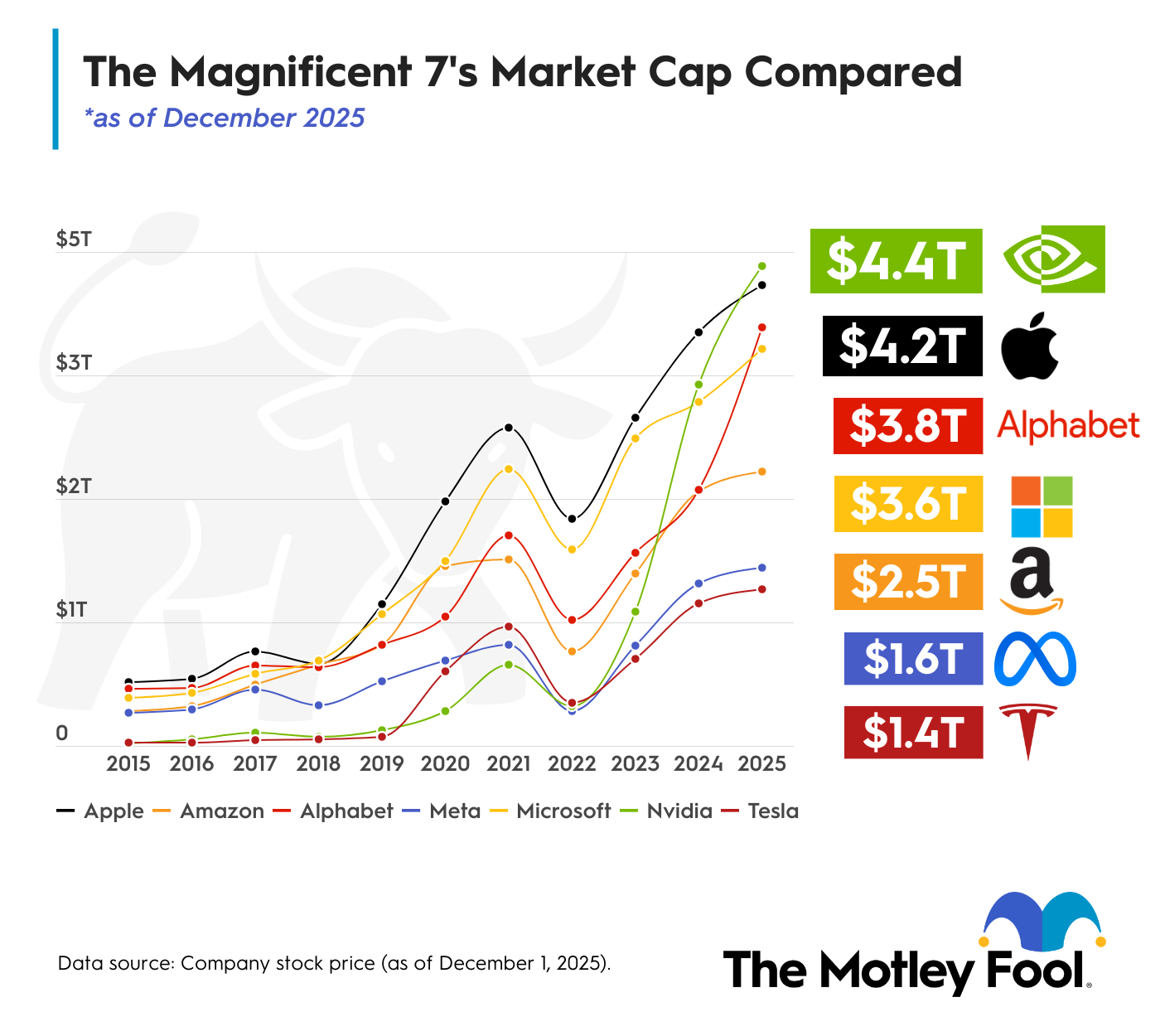
The Magnificent Seven Stocks: Market Cap, S&P 500 Weight, and Returns
•By Adam Levy
10 Best Growth Stocks for 2026

•By Keithen Drury
Amazon’s 39% AWS Operating Margin the Single Best Reason to Buy the Stock in September
About the Author

Adam Levy is a contributing Motley Fool stock market analyst covering technology, consumer, and financial stocks and how policy, economic, and consumer trends shape personal finance, Social Security and retirement savings. Before The Motley Fool, Adam was a financial advisor at Edward Jones. He studied finance and electrical engineering at Carnegie Mellon University.
Stocks Mentioned

Amazon
NASDAQ: AMZN
$256.97
(-0.60%)-$1.54

Motley Fool Stock Advisor’s Latest Pick
—% Avg Return

Broadcom
NASDAQ: AVGO
$368.56
(+2.98%)+$10.67

Microsoft
NASDAQ: MSFT
$493.95
(-1.15%)-$5.75

Alphabet
NASDAQ: GOOGL
$338.36
(-0.03%)-$0.10

Taiwan Semiconductor Manufacturing
NYSE: TSM
$439.00
(+2.35%)+$10.09

Nvidia
NASDAQ: NVDA
$225.73
(-2.01%)-$4.63

Alphabet
NASDAQ: GOOG
$335.38
(+0.02%)+$0.07
*Average returns of all recommendations since inception. Cost basis and return based on previous market day close.
Sumber Artikel:
Fool.com

