
You see words “innovation” and phrases “technology evolution” thrown around a lot in this sector. And hey, I’m guilty of it myself, because they can represent a single solution just as easily as they can something much larger. But I’ll also admit that using them in either context can be a bit of a cheat, because the specifics behind them can feel elusive and not connected to what it means for utilities to create value or make necessary changes to better meet ever-increasing energy demand.
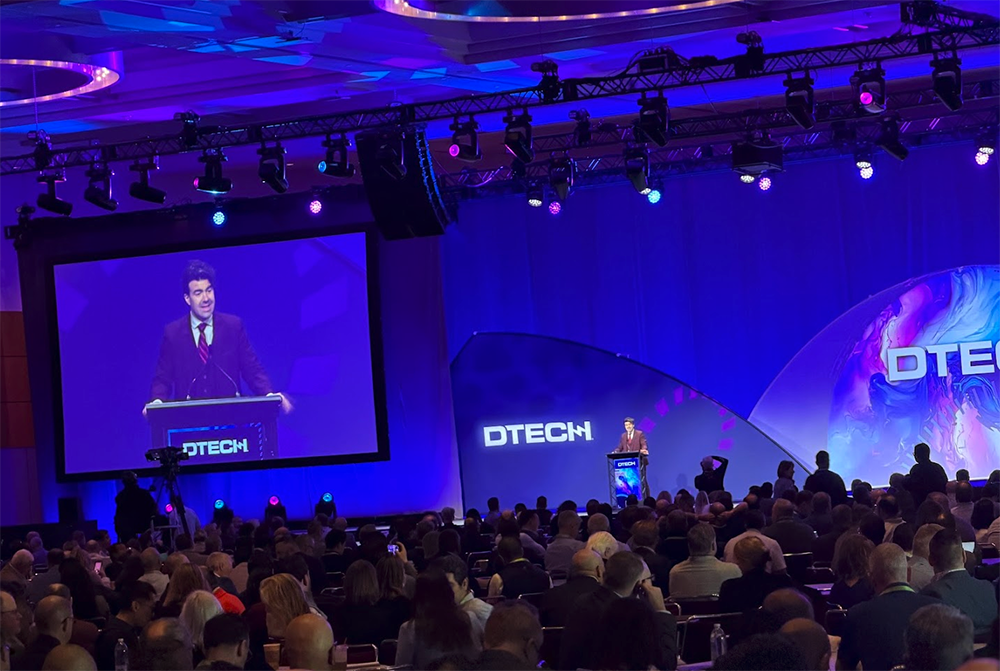
It’s also the reason that DTECH, which took place this year in San Diego from February 2-5, is such an important event. Because it’s a place where you can not only see innovations and technology evolutions in specific products and for the broader industry, but also understand how they’re creating value and enabling change for individual teams as well as the wider sector. It’s where those words and phrases literally come to life.
That said, such things happen in different ways at various events. So, what specifically has made DTECH the leading transmission and distribution gathering spot in the utility landscape? It comes down to the event being the only venue that provides you with a place to see the actual work, expand your thinking, and connect with the people that define the present and future of the entire sector.

Going hands-on with utility innovation
We spend a lot of time analyzing specs and hearing about how new products will transform utilities, but much of that distinction exists only on paper or in the abstract. On the DTECH show floor, those diagrams become three-dimensional products and provide attendees with a place to put those claims to the test.
At DTECH 2026, the Hubbell booth featured a demo of their LineDefender™ recloser, illustrating how utility personnel can perform their jobs more easily and safely. Over at the Itron booth, attendees were able to participate in a demo that showed what the real-time visibility of grid operations actually looks . Schneider Electric both announced and showed off enhancements to its EcoStruxure ArcFM Web, a web-based geographic information system (GIS) application that gives planning, operations and emergency response teams a d view of the grid.
Going way beyond the simple display you might see at other events, the solutions on the show floor at DTECH invite active participation. For utility leaders, seeing data move across a screen or holding a tool in their hands provides a level of insight that is unparalleled. Whether you’re talking about switches or software, trading abstract specs for a hands-on experience turns a theoretical discussion into a practical one. These insights can speed up the path to implementation, ensuring a given solution can be tailored to a utility’s unique requirements.

Understanding the Big Ideas
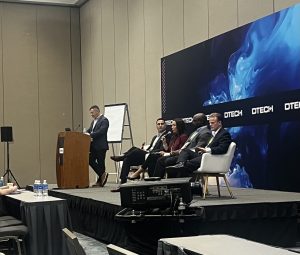
The DTECH opening keynote featured leaders from San Diego Gas & Electric, Pacific Gas & Electric, and Duke Energy talking about how leadership at some of the biggest organizations in the space are thinking about everything from decarbonization to affordability. However, their most revealing insights weren’t really about policy or trends, but about the reality of execution. They highlighted the need for utility processes and approaches to change, but also underscored how these updates need to be made in the context of the existing infrastructure and teams. Rather than starting from scratch, true progress is about leveraging current data to solve problems in the context of how things currently exist, both internally and externally.
Other keynotes similarly explored large-scale developments, from GE Vernova’s reveal of GridBeats and Grid OS to Dex Torricke exploring macro societal trends to how AWS is approaching responsible energy sourcing and the integration of renewables. They’re insights that aren’t just about what’s happening next in the utility sector, but about connections and opportunities that have a much wider reach.
All of which highlight the synergy between global macro-trends and the practical realities of the utility world that is specific to DTECH. It’s the kind of big-picture thinking that shapes conversations and -up long after the event ends.

A different way of thinking
DTECH 2026 featured over 275 curated technical sessions and over 800 speakers, all of whom are subject matter experts. But volume isn’t value, and neither is raw information. Instead, it’s about how and where this expertise is being applied and can be understood.
Because the conference program is built by a committee of industry practitioners, these sessions aren’t merely case studies or showcases of success. Instead, they reveal how utility professionals think about solving problems in the short and long term. They explore applications and solutions in ways that take teams and leadership beyond “the way we’ve always done it” mentalities.
It underscores the reality that grid modernization isn’t really a technical challenge, but is instead a cultural one. You can use a search engine or LLM to find technical specs, but how are teams comparing those options against one another? How do you quantify the success of a given initiative? Those search engines and LLMs don’t have that info, because it doesn’t reside anywhere but with the people who are thinking and working through these issues and challenges. And they’re the ones on the stages at DTECH.

Connect or reconnect with your team
With the increasingly remote world that we live in, connecting with colleagues has never been more difficult. Whether you’re part of a 20,000-person organization or a utility of a few hundred, the challenge really is the same. It’s wild to think you have to leave the office to actually meet your colleagues, but it’s the reality of our modern world, and one that can be directly facilitated at DTECH.
I made it a point to prioritize those connections this year. The ideas sparked by simple conversations with my colleagues have us thinking about the expansion of our Future Energy Leaders program. It’s a testament to what can happen when people who don’t frequently connect in person come together and discuss the topics and challenges they’re individually thinking about on a daily basis.
Beyond internal networking, DTECH is the ideal place to meet peers you would never encounter in any other context. Because the utility sector is uniquely non-competitive, these connections are more open and honest than in almost any other industry. This concentration of -minded professionals fosters candid exchanges that only happen when you get enough of the right people in the same room.

Where the present meets the future
Typically, the most popular sessions at an event are focused on exploring what’s next. “What are we going to be talking about next year?” DTECH is one of the few events where answers to those types of questions are less important than the perspectives of the people asking.
I can already tell you what we’ll be discussing in Atlanta in 2027. Sessions and conversations will be defined by the results of strategies to meet increasing energy demand while maintaining affordability. We’ll see the details of efforts to squeeze more capacity out of existing transmission networks rather than waiting on the years-long process of building new lines. And data centers. We’ll definitely still be talking about data centers.
Of course, those results and strategies aren’t going to be directly applicable to everyone. A muni’s AMI 2.0 rollout in the Northeast will look very different from an IOU’s strategy in the Southeast. Data center integration in Virginia will be different from the approach in Texas. But the approach to those rollouts, as well as what it meant to work through the challenges associated with those integrations, will be relevant to everyone. And they’re specifics that will only be revealed in those rooms.
All of which underscores why answers to questions about what’s next aren’t really about the “what” but are instead about “how”. This shift has sparked an energy unique to the event that Richard Donaldson of Duke Energy put best during the opening keynote when he joked that utility professionals “are the cool kids now.”
That enthusiasm and energy can be seen across the sector, but DTECH is the only place where you can experience it in the work, the thinking and the people building this future.
Sumber Artikel:
Renewableenergyworld.com