
But our utilities’ business model wasn’t built to move that fast
Contributed by Skip Newberry | President & CEO of the Technology Association of Oregon and Robert W. Cross | Principal, Outfit
Edited by Paul Gerke
Building a data center takes 18 to 24 months. Connecting it to electricity takes nearly five years on average, according to Lawrence Berkeley National Laboratory. That’s more than twice as long as in 2008.
The gap surfaced in July 2026 when the PJM Interconnection, the nation’s largest power grid, proposed new rules letting it temporarily cut power to data centers during electricity shortages, rather than build enough supply for every possible spike. Meanwhile, Google agreed in June 2026 to fund a 100-megawatt “virtual power plant” — software that bundles small batteries, smart thermostats and other flexible devices and sells their combined output to the grid one large power plant.
Both moves point to the same underlying problem: Utility incentives and power markets still lag behind the enormous changes underway in data and electricity.
Expanding DER Adoption
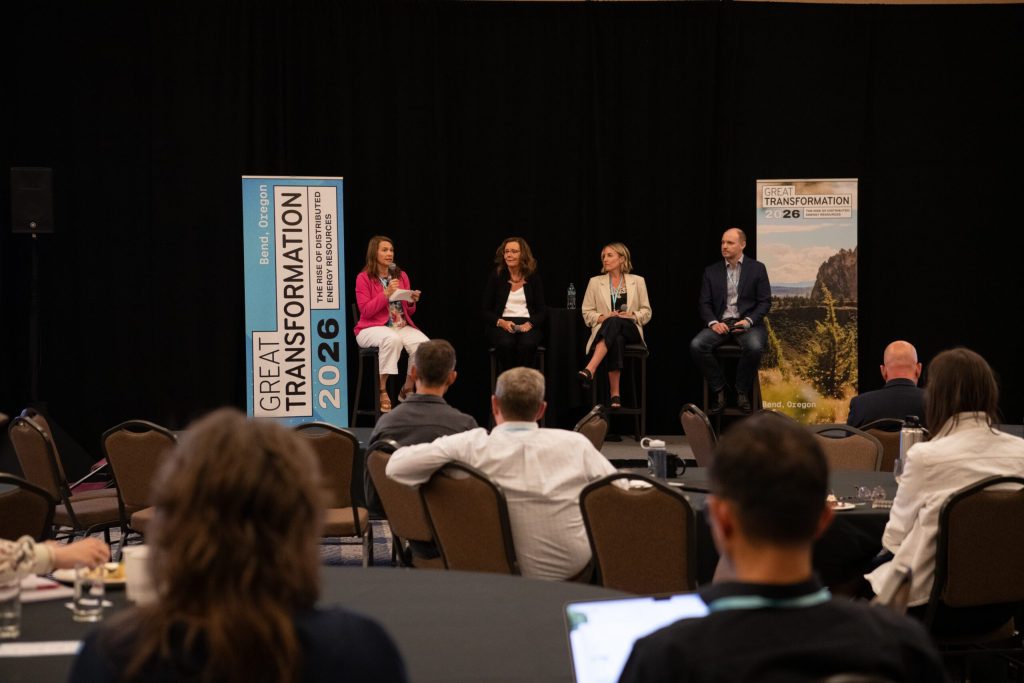
We recently spent three days at the Great Transformation summit in Bend, Oregon, with utility executives, grid operators, and technology leaders. We found broad agreement on the need to expand distributed energy resources — behind-the-meter batteries, rooftop solar, and other generation where electricity is actually used, rather than produced centrally and transmitted over long lines. In wildfire-prone areas, these systems double as insurance. When utilities cut power preemptively to prevent a fire, a facility with its own energy storage can keep running.
The Federal Energy Regulatory Commission (FERC) is pushing grid operators to get ready for the future. But distributed energy still moves faster than engineering, funding, and building new power lines. The best solution to a constrained grid is to avoid using it entirely.
None of this makes utilities the villain. Many, including Puget Sound Energy in Washington state and Portland General Electric in Oregon, are working hard to integrate distributed resources — but the deeper issue is structural, rooted in how they get paid.
Such investor-owned utilities earn most of their profit through their “rate base”: the value of physical assets that regulators let them own. They get to collect a target rate of return, typically around 10%. Every dollar spent building and owning new infrastructure grows that base — and the return with it — for decades.
Operating costs work differently: A utility that runs leaner than its regulator-forecast budget simply keeps the difference until the next rate case. But paying a third party for capacity — buying from a distributed energy asset that someone else owns — adds nothing to the rate base. That money covers a cost; it buys no lasting return.
More on Distributed Energy Resources

Look what DERs can do: 580 MW sent to the grid in largest-ever VPP dispatch
During a heat wave on the evening of September 9, 2026, Sunrun and Tesla dispatched more than 580 megawatts to the California grid in the largest VPP demonstration to date.
4 min read
BatteryEnergy StorageNewsSmart Grids#Reliability and Resilience#Renewables#VPP

Scaling DERs for reliability and resilience | Factor This Policycast
This episode of the Factor This Policycast explores how customer-sited technologies, including batteries, smart thermostats, backup generators, microgrids, rooftop solar, and flexible load, can be aggregated and operated as dependable grid assets.
6 min read
#DTECHBusinessDistributionGrid ModernizationNewsPodcastsPolicy & RegulationPower Grid#DTECH Midwest#Factor This Policycast#Reliability and Resilience#Renewables

The rate-base business model works, and that’s the problem
As long as utilities are rewarded for what they build rather than what they solve, the build-first cycle will continue, writes contributor James Richmond, CEO and founder of e2Companies.
4 min read
BusinessNewsPower Grid#affordability#Reliability and Resilience
Rethinking the Rate Base Model
That’s the real incentive problem, and it calls for a policy fix rather than a lecture. Because a utility earns more, for longer, by building large, centrally owned generation — even if it takes years longer to connect — it lacks that financial incentive to buy ready capacity from independent distributed energy resources today.
That’s one reason distributed energy has long been treated as backup power, idle until something went wrong, rather than a resource utilities had little reason to buy.
The Federal Energy Regulatory Commission changed that in 2020 by opening wholesale power markets to aggregated distributed energy for the first time. Google’s virtual power plant is an early example: Distributed energy will be paid for its output rather than kept on standby.
A battery sitting idle earns nothing; one enrolled in a virtual power plant earns money for every hour it’s available. This technology already works — what’s missing are clear price signals aligning revenue with the value it provides. And that reform moves slowly, especially when the public doesn’t understand what’s at stake.
Closing the gap doesn’t require turning every ratepayer into a grid engineer. The instinct to distrust big institutions has already made people want more control over their own energy reliability. Plug-in balcony solar, legalized in Utah in 2025 and since adopted by nine more states, shows people are willing to pay for that control themselves.
The lesson we heard in Bend wasn’t that distributed energy is a silver bullet. It’s that business leaders and regulators willing to rethink how utilities get paid—and customers willing to take more responsibility for their own power supply—will come out ahead as the energy transition continues.
About The Authors

Skip Newberry is president & CEO of the Technology Association of Oregon, which works with hundreds of technology companies and tech departments, from startups to the world’s largest companies. He serves as vice chair of the Oregon Workforce & Talent Development Board, on the Oregon Cybersecurity Advisory Council, and on the board of directors for Technology Councils of North America.

Robert W. Cross is principal of Outfit, the design studio driving The Great Transformation—a strategic initiative redefining the intersection of physical infrastructure, energy design, and economic development.
Sumber Artikel:
Renewableenergyworld.com