
Contributed by Brett Willitt, Senior Vice President of Product for ikeGPS.
Global investments in power grids ly topped $470 billion for the first time in 2025, according to BloombergNEF. Yet with this ongoing investment cycle, many distribution utilities—responsible for the last mile connecting substations to customers—face a problem. They can’t reliably answer a fundamental question: Which assets require investment and which do not?
Distribution utilities often have good data on system performance, outage patterns and asset age. But most lack verified data about the physical state of overhead assets, particularly the structural loading of their poles. With 70-80% of assets overhead, this blind spot affects most distribution infrastructure and puts millions of dollars in spending at risk.
Utilities need structural intelligence about these assets to avoid replacing poles that could safely remain in service or, worse yet, leaving undersized or overloaded poles that fail prematurely. Plus, regulatory bodies are beginning to ask harder questions about how utilities justify capital projects. In an era of infrastructure-related litigation, utilities must increasingly demonstrate that investment decisions are based on actual analysis—and not outdated assumptions.
The Growing Risk of Failure
Today’s distribution infrastructure management was shaped by an earlier era. Poles erected during the mid-20th-century electrification efforts were designed with straightforward assumptions: apply deterministic wind and ice loads, expect a 30-50 year service life, and plan for telephone company attachments in predictable locations. A utility’s published design standards reflected the engineering practices and historical climate patterns of that era. While joint use was common, the players were few and coordination was simpler.
Today’s reality is dramatically different. The number of joint-use attachments has exploded; DER interconnections and EV charging loads are straining existing networks in ways that weren’t originally anticipated; and climate change is causing more frequent extreme weather that pushes aging infrastructure to its limits.
Yet many utilities still rely on asset management practices developed for that earlier era: ground-line inspections that check for decay but not structural loading, distribution standards created decades ago, and old-school, run-to-fail mentalities. The consequences of this gap between practice and need can be catastrophic.
After a termite-infested utility pole snapped in high winds on August 8, 2023, sparking the fire that destroyed Lahaina, Maui, and killed 102 people, investigators found that Hawaiian Electric’s poles were built to “an obsolete 1960s standard” and were “nowhere close to meeting a 2002 national standard” for withstanding 105-mph winds. The utility agreed to pay nearly $2 billion as part of a $4 billion settlement and faced the prospect of bankruptcy.
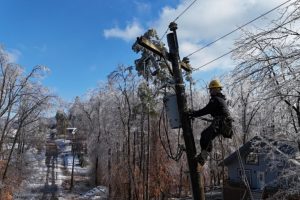
That disaster, many others, reveals what utilities across the country confront: extreme weather testing infrastructure that may have been in service for decades without comprehensive structural assessment. When a pole fails catastrophically, the question isn’t just about restoration speed. It’s whether utilities knew which structures were at risk—and whether they can demonstrate to regulators, customers, and potentially courts that they were managing risk appropriately.
The Structural Analysis Imperative
When it comes to managing distribution assets, there’s no replacement for pole loading analysis (PLA). What was once viewed as optional engineering due diligence is becoming standard practice across the industry. Adoption of PLA is being driven by converging forces: a fundamental shift in risk aversion accelerated by catastrophes Maui; regulatory pressure in states California, which has suffered its own catastrophes; and the rapid increase of joint-use attachments as broadband providers expand fiber networks onto utility infrastructure.
Improvements in technology are also driving adoption. Field data collection, which used to require slow, two-person inspections, can now be completed by a single person with a point-and-shoot device. Similarly, PLA software now performs the calculations engineers used to labor over, making it possible for utilities to rapidly and reliably assess poles. At the same time, PLA solutions are also becoming an integrated component of other upstream and downstream processes involving distribution-asset data.
Implementing pole loading analysis effectively requires more than buying software. Utilities making initial investments sometimes approach it as just a compliance thing—running analyses only when required and missing the broader value for capital planning. Others isolate structural data in joint-use departments rather than sharing it across planning, engineering, and operations teams who could benefit from the data.
Forward-thinking utilities are taking a different approach. They’re establishing a foundation of structural intelligence through integrated workflows that connect field data directly to pole loading analysis and back to GIS and asset-management systems. Whether internal crews, contractors, or joint-use applicants are doing the work, utilities are standardizing around consistent tools and methods to build comparable, system-wide knowledge. They recognize that every field visit—for joint use, inspection, or emergency response—is an opportunity to gather structural intelligence that will serve multiple programs and complement the existing data on system performance.
Performance data answers many critical questions about operation and reliability. But it can’t identify which poles are overloaded and at risk of failure. It can’t determine where capacity exists for new loads or attachments, or how to prioritize replacements in a capital-constrained environment. That’s what structural intelligence is for, and distribution utilities need it now as they prepare to update for the grid demands of the next 50 years.
About the author

Brett Willitt is Senior Vice President of Product for ikeGPS. Brett has more than 25 years of grid asset management experience and is considered a leading structural-analysis and structure-management expert in the U.S. He holds a BS in Civil Engineering from Clarkson University.
Sumber Artikel:
Renewableenergyworld.com