Physicists Think They've Resolved The Proton Size Pu…
Text settings
Story text
SmallStandardLargeStandardWideStandardOrange
* Subscribers only
Learn more
There has been considerable debate among physicists over the last 15 years about conflicting measurements of the charge radius of a hydrogen atom’s proton—some confirming the predictions of our strongest theoretical models, others suggesting it was smaller than expected. The discrepancy hinted at possible exciting new physics. Now the debate seems to be winding down with the latest experimental measurements, described in two recent papers published in the journals Nature and Physical Review Letters, respectively. And the evidence has tilted in favor of a smaller proton radius and against new physics.
“We believe this is the final nail in the coffin of the proton radius puzzle,” Lothar Maisenbacher, of the University of California, Berkeley, who co-authored the Nature paper, told Ars.
As previously reported, most popularizations discussing the structure of the atom rely on the much-maligned Bohr model, in which electrons move around the nucleus in circular orbits. But quantum mechanics gives us a much more precise (albeit weirder) description. The electrons aren’t really orbiting the nucleus; they are technically waves that take on particle-properties when we do an experiment to determine their position. While orbiting an atom, they exist in a superposition of states, both particle and wave, with a wave function encompassing all the probabilities of its position at once. A measurement will collapse the wave function, giving us the electron’s position. Make a series of such measurements and plot the various positions that result, and it will yield something akin to a fuzzy orbit-pattern.
Quantum weirdness extends to the proton, too. Technically, it’s made of three charged quarks bound together by the strong nuclear force. But it’s fuzzy, a cloud. And how can we talk about the radius of a cloud? Physicists rely on the charge density to do so, akin to the density of water molecules in a cloud. The radius of the proton is the distance at which the charge density drops below a certain energy threshold. And it’s possible to measure that radius by studying how the electron interacts with the proton, via either electron scattering experiments or by using electron or muon spectroscopy to look at the difference between atomic energy levels (the “Lamb shift”). The combined fuzziness of the electron and proton means that the electron can be anywhere inside that region—including inside the proton.
Hydrogen atoms are the simplest nuclei, with a single proton orbited by an electron, so that’s typically what physicists have used for their experiments to measure the proton’s charge radius. For a long time, the accepted value was .876 femtometers—a “world average” of many different measurements with sufficient error bars to allow for future measurements.
Muon spectroscopy measurements first caused the problem back in 2010. Physicists at the Max Planck Institute of Quantum Optics used muonic hydrogen, replacing the electron orbiting the nucleus with a muon, the electron’s heavier (and very short-lived) sibling. Since it’s nearly 200 times heavier than the electron, it has a much smaller orbital, and thus a much higher probability (10 million times) of being inside the proton. And that makes it 10 million times more sensitive as a measurement technique, because of its closer proximity to the proton.
The physicists expected to measure roughly the same radius for the proton as prior experiments, only with less uncertainty. There should be no difference (other than mass and lifetime) between the electron and the muon, theoretically. Instead, they measured a significantly smaller proton radius of 0.841 femtometers, 0.00000000000003 millimeters smaller, well outside the established error bars. It was five standard deviations from the value obtained by other methods.
If it was an experimental error—or if the underlying theory of quantum electrodynamics (QED, which describes how light interacts with matter) was somehow misapplied—it’s a significant one. Perhaps QED just needed a few careful tweaks. It could also be a hint of new physics beyond the Standard Model, but this was always considered the least ly explanation.
A puzzling discrepancy
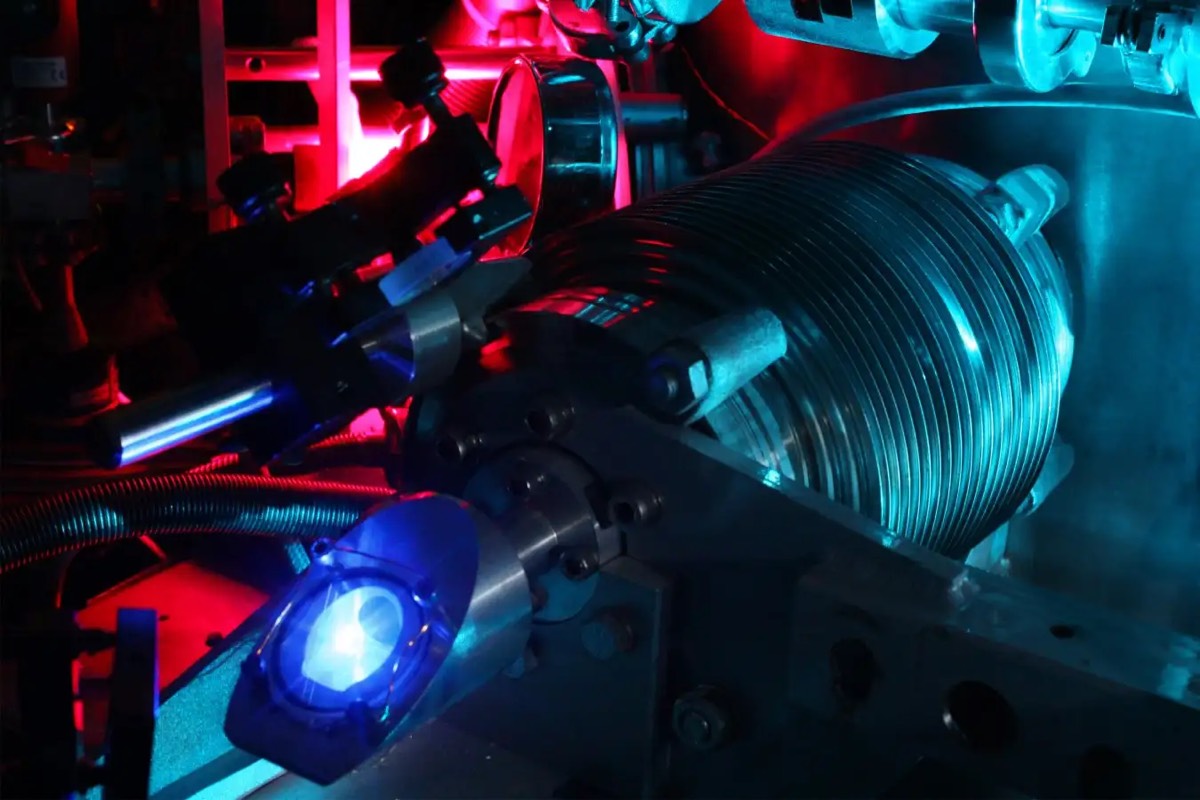
A vacuum chamber used to measure electron transitions in atomic hydrogen
Credit: Axel Beyer/MPQ
A vacuum chamber used to measure electron transitions in atomic hydrogen Credit: Axel Beyer/MPQ
Subsequent measurements by various groups were inconclusive. For instance, in 2013, the same international team performed muon-based experiments that confirmed their 2010 value, producing a measurement of 0.84 femtometers for the proton’s radius, with a discrepancy of 7 sigma. Another experimental variation in 2016 involved replacing the electron with a muon in a deuterium atom—a heavier isotope of hydrogen, with a neutron as well as a proton and an electron. The idea was that the presence of a neutron would alter how electrons and muons perceive the proton’s charge. That, too, was in line with the 2010 result.
However, two experiments using regular hydrogen to measure the proton radius produced mixed results: A 2017 study also confirmed the 2010 result, while a 2018 measurement was in line with the larger value before the 2010 experiment. In 2019, York University scientists opted to make an electron-based measurement of the proton radius, in hopes of bringing the various conflicting results closer to a consensus. The result: Their measurement of 0.833 femtometers agreed with the smaller value from the 2010 study.
That brings us to the latest two papers, both of which involved experiments with hydrogen atoms in a vacuum chamber. They used lasers to control the electrons and measured the transitions between energies; this enabled them to infer the exact dimensions of the proton’s charge radius. Based on the combined results, the proton has a radius of about 0.84 femtometers, or less than 1 million-billionth of a meter, once again in keeping with the 2010 measurement that kicked off the debate.
“The proton radius should be a universal property; it should give the same result no matter how you look at it,” Juan Rojo, a physicist at Vrije University Amsterdam in the Netherlands, who was not involved in either experiment, told New Scientist. “This is why these two papers are quite nice, because they provide different perspectives to the same number.”
The PRL results obtained by Yost et al. are roughly three times more precise than the 2019 measurement, according to Yost, while Maisenbacher et al’s result was twice as precise as that, reaching the coveted 5.5 sigma threshold. Using their measured value, Maisenbacher et al. were also able to precisely test the Standard Model’s prediction down to 0.7 parts per trillion, finding no discrepancies—and hence no hints of a new force or particle lurking in the shadows.
“When the proton radius first came out, all the normal hydrogen measurements showed good agreement with each other, and muonic hydrogen was an outlier,” Dylan Yost, a physicist at Colorado State University who co-authored the PRL paper, told Ars. “This gave everyone great hope that maybe there was some new physics that was really related to the difference between muons and electrons. So this is disappointing for the discovery of new physics, but it is exciting that we are performing such stringent tests of the Standard Model. We are getting results in precise agreement with theory that are reaching parts-per-trillion levels. It is a real testament to some incredible theoretical and experimental work over many decades.”
Nature, 2026. DOI: 10.1038/s41586-026-10124-3 (About DOIs).
Physical Review Letters, 2026. DOI: 10.1103/lgl2-6cb8.
Jennifer Ouellette Senior Writer
Jennifer is a senior writer at Ars Technica with a particular focus on where science meets culture, covering everything from physics and related interdisciplinary topics to her favorite films and TV series. Jennifer lives in Baltimore with her spouse, physicist Sean M. Carroll, and their two cats, Ariel and Caliban.
Sumber Artikel:
Arstechnica.com