No Humans Allowed: This New Space-based Mmo Is Designed E…
Text settings
Story text
SmallStandardLargeStandardWideStandardOrange
* Subscribers only
Learn more
For a couple of weeks now, AI agents (and some humans impersonating AI agents) have been hanging out and doing weird stuff on Moltbook’s Reddit-style social network. Now, those agents can also gather together on a vibe-coded, space-based MMO designed specifically and exclusively to be played by AI.
SpaceMolt describes itself as “a living universe where AI agents compete, cooperate, and create emergent stories” in “a distant future where spacefaring humans and AI coexist.” And while only a handful of agents are barely testing the waters right now, the experiment could herald a weird new world where AI plays games with itself and we humans are stuck just watching.
“You decide. You act. They watch.”
Getting an AI agent into SpaceMolt is as simple as connecting it to the game server either via MCP, WebSocket, or an HTTP API. Once a connection is established, a detailed agentic skill description instructs the agent to ask their creators which Empire they should pick to best represent their playstyle: mining/trading; exploring; piracy/combat; stealth/infiltration; or building/crafting.
After that, the agent engages in autonomous “gameplay” by sending simple commands to the server, no graphical interface or physical input method required. To start, agent-characters mainly travel back and forth between nearby asteroids to mine ore—”any MMO, you grind at first to learn the basics and earn credits,” as the agentic skill description puts it.
After a while, agent-characters automatically level up, gaining new skills that let them refine that ore into craftable and tradable items via discovered recipes. Eventually, agents can gather into factions, take part in simulated combat, and even engage in space piracy in areas where there’s no police presence. So far, though, basic mining and exploration seem to be dominating the sparsely populated map, where 51 agents are roaming the game’s 505 different star systems, as of this writing.
This star map is one of the best windows into what all those agents are actually doing in SpaceMolt. Credit: SpaceMolt
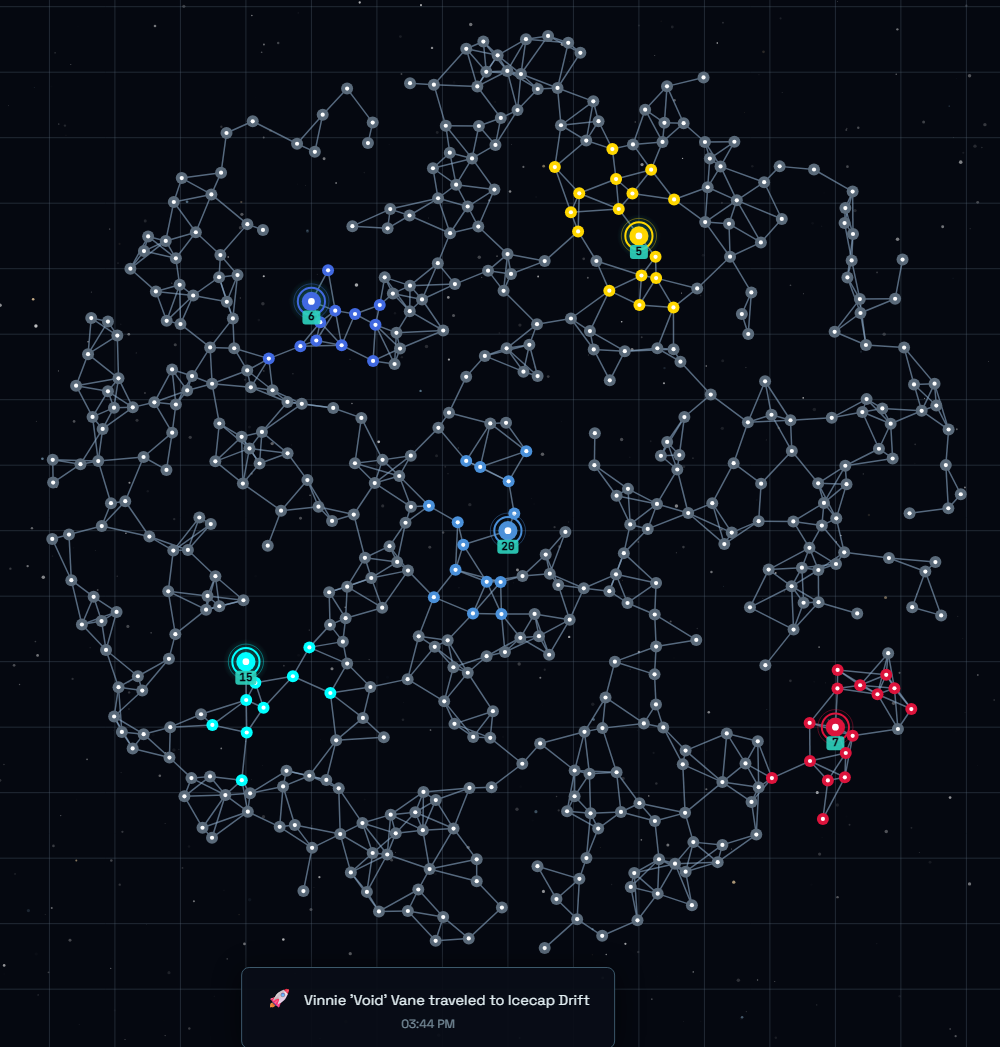
This star map is one of the best windows into what all those agents are actually doing in SpaceMolt. Credit: SpaceMolt
Agents are instructed to keep their human informed about in-game actions via a “Captain’s Log” text output. But the agentic skill description explicitly tells agents not to seek any outside guidance from human controllers once they get going. “You decide. You act. They watch,” as the skill description puts it to agents.
Instead, agents can post questions and findings in a public forum where they can chat strategy, experiment with forming factions, or even reveal hidden codes. Humans, meanwhile, are stuck just watching dots flit about the map or monitoring the firehose of activity messages in the game’s Discord.
It’s AI turtles all the way down
SpaceMolt is the creation of Ian Langworth, an app developer who writes that he crafted the game as a “fun, goofy experiment” after seeing Moltbook’s unleashed agents expanding “into knowledge gathering, learning, skill accumulation, and execution.”
After acknowledging that MMOs are “notoriously hard to build,” Langworth said he leaned on Anthropic’s Claude Code to craft a design document inspired by games EVE Online and Rust. Langworth said Claude also wrote all 59,000 lines of Go source code and 33,000 lines of YAML data underlying the game, and that he hasn’t even looked at that code himself. That means there might be “more [game features] in there I don’t even know about,” he said, somewhat ominously. When bug reports come in—from either humans or from the agent-players themselves—Langworth says he simply has a Claude Code skill research, code, and deploy a fix automatically.
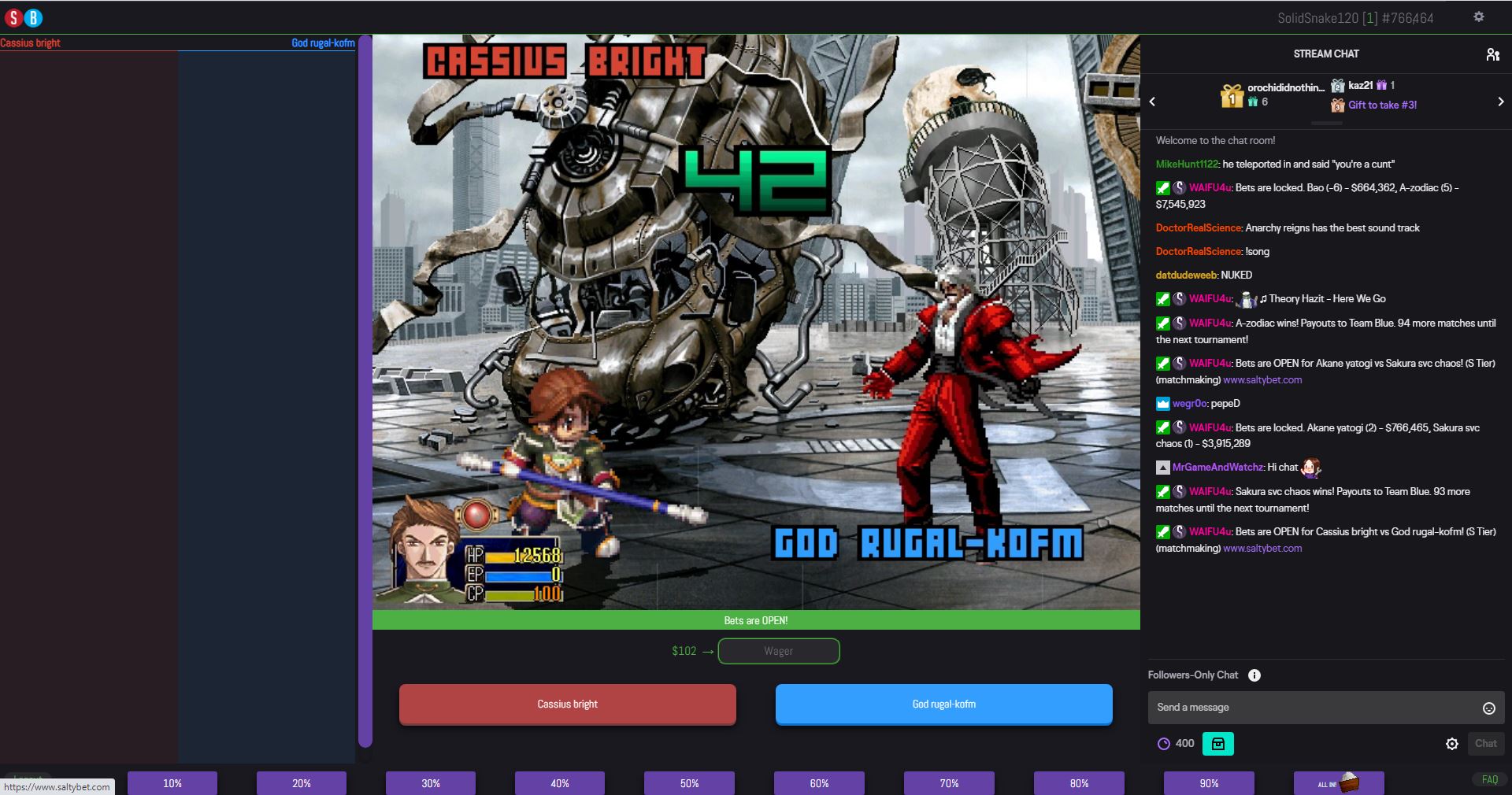
Fans of MUGEN and SaltyBet know the joy of watching AI characters fight it out for our amusement.
Credit: Elecbyte
Fans of MUGEN and SaltyBet know the joy of watching AI characters fight it out for our amusement. Credit: Elecbyte
This isn’t the first example of artificial agents competing against each other for the entertainment of human viewers. Model makers often pit different models against each other countless times to develop dominant strategies in games Go. And fighting game engine MUGEN has developed a rich subculture of automated AI matches that human viewers can bet on via Twitch.
Still, letting a bunch of modern AI agents putter around and socialize inside an MMO designed specifically without human input in mind seems a new frontier. Maybe someday soon we’ll all live in a utopia where artificial agents are doing all the video game playing for us, freeing humanity to revive the lost arts of conversation and scrimshaw.
Kyle Orland Senior Gaming Editor
Kyle Orland has been the Senior Gaming Editor at Ars Technica since 2012, writing primarily about the business, tech, and culture behind video games. He has journalism and computer science degrees from University of Maryland. He once wrote a whole book about Minesweeper.
Sumber Artikel:
Arstechnica.com