New 3d Map Of Universe Could Solve Dark Energy Mystery
Text settings
Story text
SmallStandardLargeStandardWideStandardOrange
* Subscribers only
Learn more
Visualization shows how DESI built its 3D map of the Universe. Earth is at the center of the wedges, and every point is a galaxy. Credit: DESI/KPNO/NOIRLab/NSF/AURA/R. Proctor
In a significant milestone, the Dark Energy Spectroscopic Instrument (DESI) has completed its 3D map of the Universe—the highest resolution of any such map yet achieved—on schedule and with more data than expected, the collaboration announced today. Analyses of DESI data from earlier runs have already produced exciting hints of new physics—namely that the Universe’s dark energy, rather than being constant, might vary over time. The latest data must still be analyzed but could help definitively confirm or disprove those hints within the next couple of years.
“DESI’s five-year survey has been spectacularly successful,” DESI director Michael Levi of Berkeley Lab said. “The instrument performed better than anticipated. The results have been incredibly exciting. And the size and scope of the map and how quickly we’ve been able to execute is phenomenal. We’re going to celebrate completion of the original survey and then get started on the work of churning through the data, because we’re all curious about what new surprises are waiting for us.”
As previously reported, Albert Einstein’s cosmological constant (lambda) implied the existence of a repulsive form of gravity. (For a more in-depth discussion of the history of the cosmological constant and its significance for dark energy, see our 2024 story.) Quantum physics holds that even the emptiest vacuum is teeming with energy in the form of “virtual” particles that wink in and out of existence, flying apart and coming together in an intricate quantum dance. This roiling sea of virtual particles could give rise to dark energy, giving the Universe a little extra push so that it can continue accelerating. The problem is that the quantum vacuum contains too much energy: roughly 10120 times too much.
So the Universe should be accelerating much faster than it is if the dark energy is, essentially, the cosmological constant. Still, all the observations to date indicate that it’s constant. The best theoretical fit thus far is known as the Lambda CDM model, which incorporates both a weakly interacting cold dark matter and dark energy. One alternative theory proposes that the Universe may be filled with a fluctuating form of dark energy dubbed “quintessence.” There are also several other alternative models that assume the density of dark energy has varied over the history of the Universe.
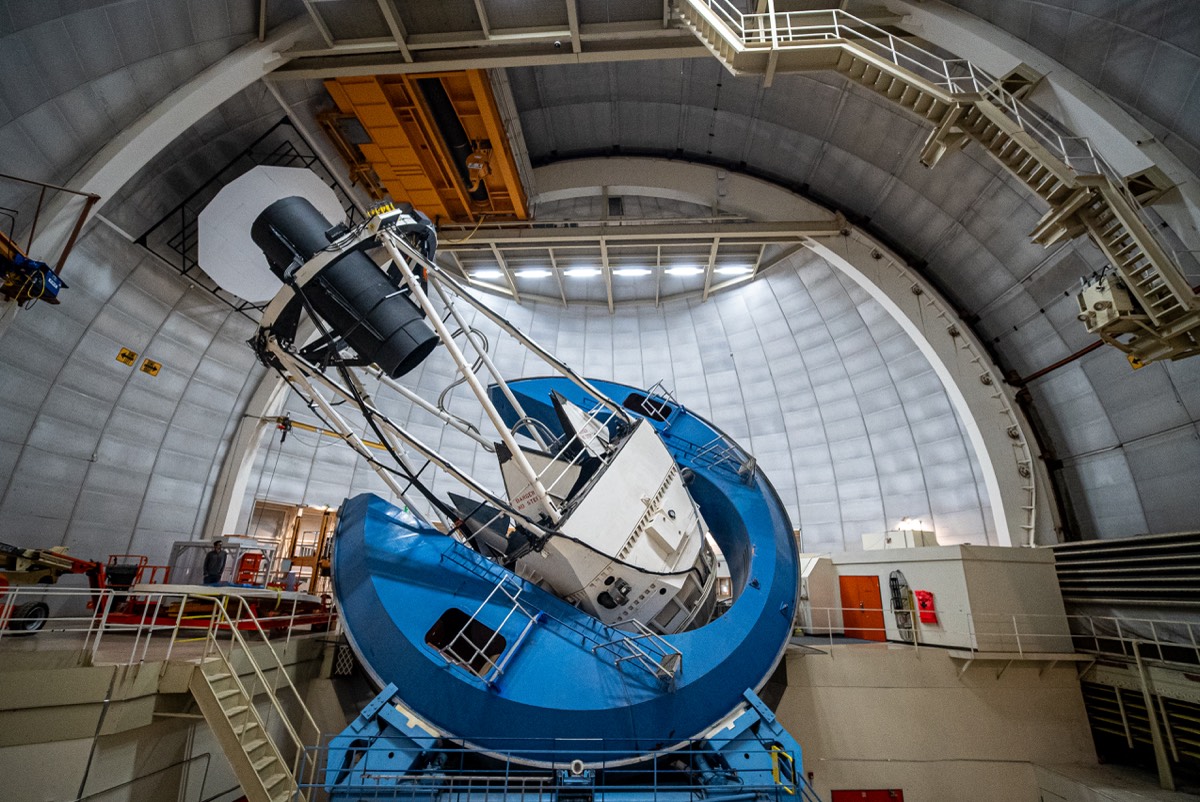
DESI is a state-of-the-art instrument and can capture light from up to 5,000 celestial objects simultaneously.
DESI is a state-of-the-art instrument and can capture light from up to 5,000 celestial objects simultaneously.
In its earliest days, the Universe was a hot, dense soup of subatomic particles, including hydrogen and helium nuclei, aka baryons. Tiny fluctuations created a rippling pattern through that early ionized plasma, which froze into a three-dimensional place as the Universe expanded and cooled. Those ripples, or bubbles, are known as baryon acoustic oscillations (BAO). It’s possible to use BAOs as a kind of cosmic ruler to investigate the effects of dark energy over the history of the Universe.
That’s what DESI was designed to do: take precise measurements of the apparent size of these bubbles (both near and far) by determining the distances to galaxies and quasars over 11 billion years. Robotic positioners precisely line up optical fibers, and 10 spectrographs collect light and split it into separate colors to determine the position, velocity, and chemical composition of each object.
Each so-called “tile” is one telescope pointing to a specific spot to record spectra for several thousand objects at once. Roughly 80 gigabytes of data is collected each night and streamed to supercomputers at Berkeley Lab’s National Energy Research Scientific Computing Center. That data is then sliced into chunks to determine how fast the Universe was expanding at each point of time in the past to better model how dark energy was affecting that expansion.
The first hints that dark energy might vary over time appeared in the first full year of data. While there was basic agreement with the Lambda CDM model, when those results were combined with data from other studies—involving the cosmic microwave background radiation and Type Ia supernovae—subtle differences cropped up that suggested the dark energy might be weakening. It amounted to between 3.5 and 3.9 sigmas in terms of confidence. But the subsequent 2025 results covered the first three years of data with confidence levels between 2.8 and 4.2 sigma—just shy of the five-sigma threshold that is the gold standard for discovery.
Analysis on this latest round of data won’t be completed until 2027 or 2028 if all goes smoothly. But finishing the original planned survey, on time, with significantly more data than expected, is a major achievement in itself. Over its five years of operation, DESI has mapped over 47 million galaxies, with more to come.
“Some people have been working on this for decades, so it’s just amazing to see it come to completion,” DESI co-spokesperson Alexie Leauthaud of the University of California, Santa Cruz, told Ars. “Anyone who does science knows that you rarely achieve more than you proposed you would. And you never achieve more on time. DESI is maybe the only team I’ve ever worked with—that has actually done more than it was going to do—on time.”
A bumpy road
The DESI scientists achieved this while overcoming some pretty daunting challenges, including figuring out how to maintain operation during the 2020 COVID-19 pandemic. Two years later, in June 2022, the Contreras wildfire spread rapidly toward Kitt Peak National Observatory, where DESI is mounted, thanks to winds and very dry conditions. DESI scientist Klaus Honscheid of Ohio State University credits “heroic” firefighters for protecting the telescopes. “We were all watching the web cameras and seeing the fire and the glow, and then suddenly it all went dark,” Honscheid told Ars. The communications and power lines had gone down. “We were sitting there for 12 hours not knowing if we still had an experiment left,” he said.
A thin slice of the map produced by the DESI five-year survey shows galaxies and quasars above and below the plane of the Milky Way. Credit: Claire Lamman/DESI collaboration
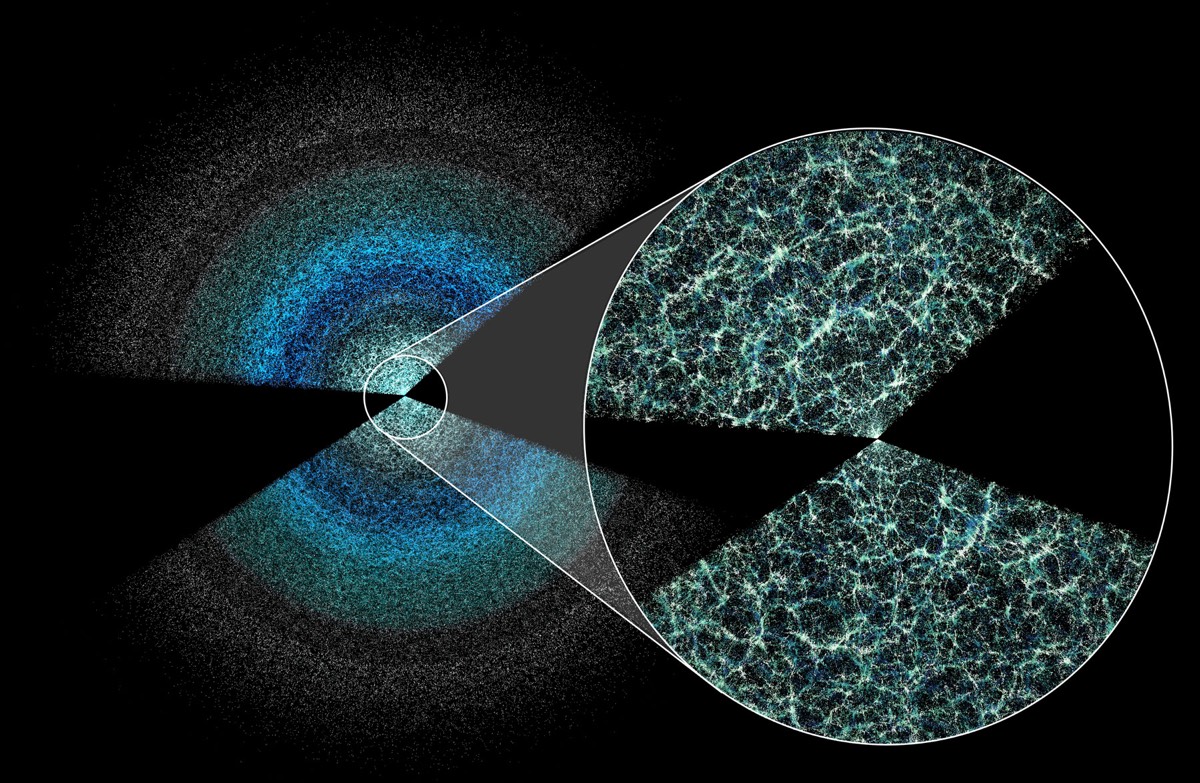
A thin slice of the map produced by the DESI five-year survey shows galaxies and quasars above and below the plane of the Milky Way. Credit: Claire Lamman/DESI collaboration
Fortunately, the DESI team was able to resume operations fairly quickly, despite subsequent heavy rains and mudslides. Just before the fire, they had implemented an emergency communication system with a Starlink satellite. “Starlink is not viewed favorably in the astronomical community because these satellites really affect nighttime observing,” Honscheid admitted. “But in our case, they actually d us.” And when they had to reduce the readout channels from four to two, due to a few defective CCD cameras, the team’s earlier efforts to cut reconfiguration times between exposures helped ensure the project stayed on schedule—and also preserved the quality of the data.
The team also developed a backup protocol they dubbed “Sneakernet,” driving down the mountain to NOIRLab in Tucson every morning with a hard drive of the prior night’s data for processing. That protocol proved critical just one year later when several NOIRLab observatories were hit with a cyberattack. “Again, we were very fortunate and reacted quickly,” said Honscheid. “We basically pulled the Internet plug to the instrument, and therefore we were isolated from the attacks.” They were able to keep observing thanks to the Starlink connection and Sneakernet. The cybersecurity architecture has since been completely overhauled to stave off future cyberattacks.
Getting that final tile to complete the map was delayed slightly due to certain adverse conditions: clouds, wind, atmospheric turbulence, and the location of the Moon, according to co-manager of DESI’s survey operations, Adam Myers of the University of Wyoming. DESI took all those factors into account from the start. “Bright-Time” surveys were done when reflected light from the Moon hindered observations of the faintest and most distant objects, while “Dark Time” surveys, which required good conditions across the board, constituted a kind of back-up program.
“When the original DESI survey began, we had ‘dark’ tiles over many different parts of the sky, so we weren’t as limited by conditions,” Myers told Ars. “But for the final dark tile, we had to thread the needle more, which made it seem ‘weather’ was more of a problem. A lot of the time we were waiting to complete the final dark tile from the original program; we’d been observing plenty of ‘bright’ and ‘backup’ tiles, as well as even some tiles from newer dark programs, which span more of the sky.”
Gearing up for DESI-II
DESI’s operation has been extended until 2028 to get a deeper look at more distant and faint “luminous red” galaxies, as well as nearby dwarf galaxies and stellar streams. Plans are already underway for DESI-II, which will require a small instrument upgrade. As for further tests of the Lambda CDM model, future analysis will be able to incorporate observational data from the Vera Rubin Telescope’s sky survey as well as the Euclid Space Telescope. “We’re going to need a lot of datasets and mix them in different ways to try to figure out what the Universe is trying to tell us,” said Leauthaud.
The big question mark is whether there will be future funding for DESI and DESI-II, given the precarious state of science funding in the US. Honscheid acknowledged the uncertainty but is cautiously optimistic, in part because of the project’s success to date, and because DESI-II’s upgrade is a relatively small-ticket item.
“I’m optimistic for DESI-II, but I’m also gravely concerned more broadly by the funding landscape and the attack on science,” said Leauthaud. “Even though we may be lucky, I’m still extremely concerned for my colleagues in astronomy who have lost funding, students whose careers have been jeopardized, postdocs who have had to leave. More broadly, beyond astronomy and astrophysics, I’ve been extremely concerned about the impact on climate science and NOAA. We rely on weather services to help with our observations.”
Jennifer Ouellette Senior Writer
Jennifer is a senior writer at Ars Technica with a particular focus on where science meets culture, covering everything from physics and related interdisciplinary topics to her favorite films and TV series. Jennifer lives in Baltimore with her spouse, physicist Sean M. Carroll, and their two cats, Ariel and Caliban.
Sumber Artikel:
Arstechnica.com