
Grid modernization is a messy business. It helps to have a place to tinker without jeopardizing electrical service, especially when you work for a utility racing to implement the latest hardware and software, which is precisely what makes the DERConnect Testing Facility at the University of California, San Diego so special.
There are few sandboxes with cooler toys than what UCSD has to offer. Its advanced, fully integrated, and programmable grid environment has been designed to accelerate the development of a more decentralized, resilient, and sustainable energy system. The state-of-the-art facility on campus supplies a unique platform for experimentation and testing of distributed energy resources (DERs) and features a “living laboratory” of more than 2,000 devices across the UCSD campus, representing a diverse set of controllable assets, including energy storage, electric vehicles (EVs), solar photovoltaics, and building loads. This provides the scale and complexity needed to test and validate solutions such as advanced control and management systems in real-world settings.
The testbed, which is grid-connected but can also operate as an island, is designed to be flexible and highly configurable, enabling it to accommodate a variety of DER technologies and use cases, making it an ideal platform for showcasing the latest advancements- hardware, software, and policy- and demonstrating their potential applications in real-world scenarios.
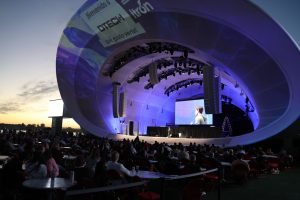
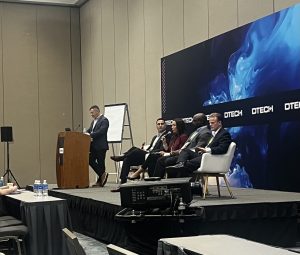
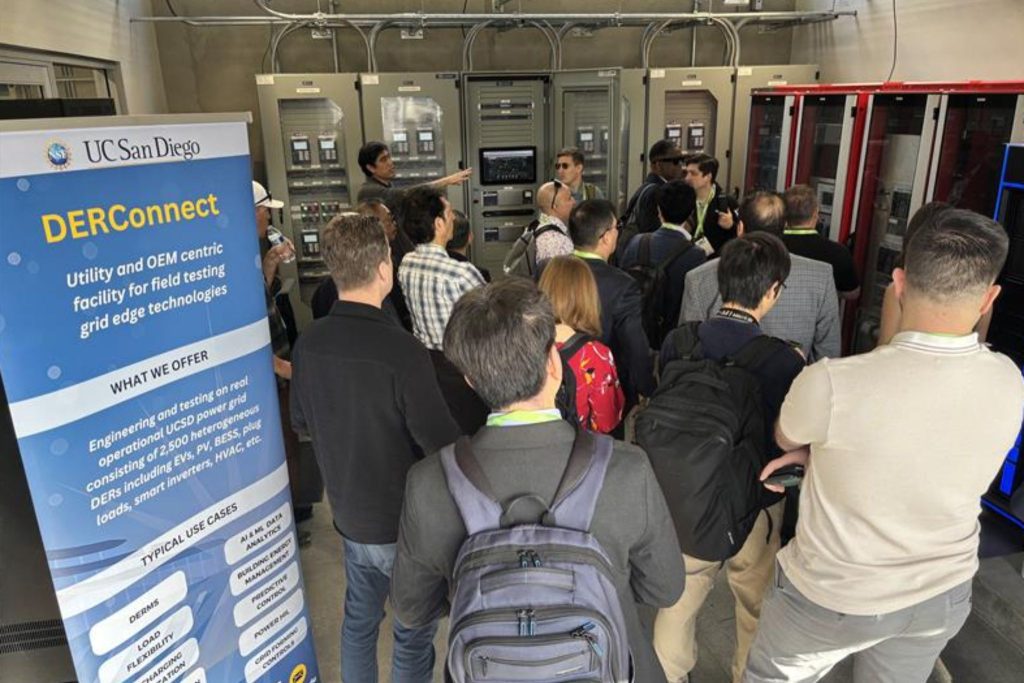
Earlier this month, dozens of DTECH attendees toured the DERConnect site and saw firsthand how integrated hardware and software solutions are driving grid modernization.


“Our DERMS software is here,” d Alonso Castillo, vice president of global sales at Atlanta-based Minsait ACS. He made the trip to California to see his company’s implementation firsthand. “This is a testbed… And I’m looking forward to seeing how customers are using it in real-case scenarios.”
Adil Khurram, a project scientist in the UCSD Department of Mechanical and Aerospace Engineering, led one of several demonstrations showing off DERConnect’s capabilities. Starting with a set load, Khurram put the batteries in grid-ing mode, then opened a breaker to push them into grid-forming mode, monitoring various data throughout the process. The demo was hardly a sampling of the site’s capabilities.
The Research
DERConnect, founded in 2025, is supported through a grant from the National Science Foundation. By inviting collaboration with academia and industry, the project’s research is informing best practices, shaping energy policy, and contributing to the creation of a more reliable, adaptable, and renewable energy grid, ultimately benefiting communities and the environment.
Right now, it’s ground zero for the development of cutting-edge technologies, including inverter-based microgrids and AI-powered power systems. As select DTECH attendees learned, there are several ongoing research projects at DERConnect, and UCSD is sharing findings as they become publishable.
The first published paper to leverage DERConnect’s capabilities studies real-time hybrid co-simulation of voltage regulation. A hardware inverter controller was integrated with two subsystems simultaneously simulated on RTDS and Typhoon HIL platforms within a single framework. Using real-time load-metering data, the authors emulated realistic conditions on the UCSD microgrid. To enhance voltage regulation, they employed centralized and distributed algorithms based on a second-order conic relaxation of the nonlinear voltage regulation formulation. These algorithms were then tested in a hybrid physical and simulation environment using the physical assets of the DERConnect testbed under various real-time loading scenarios.
Another, more recent study examined the potential benefits and impact of integrating plug load control with a building automation system. Plug load controllers are also a component of the DERConnect testbed, enabling continued research into grid-interactive efficient buildings. Keaton Chia, research and development engineer and project manager at UCSD’s DERConnect, was the lead author. He also led DTECH’s tour of the campus’s electrical engineering ‘playground.’
“The power system landscape is really evolving and changing. It’s such an exciting time,” Chia told Factor This. “How do we make our power grids more resilient? How do we reduce costs for consumers and make it more robust to environmental challenges? All of that can really be tested here… Having this type of facility to test software, technology, products, and policies is really valuable and will make an impact on your everyday user of electricity.”
DERConnect s one side of the testbed with its sister lab, UCSD’s energy storage group. Among their recent and ongoing research: a startup’s carbon-capture project, an experiment repurposing two old Tesla batteries for EV charging, and another test case for using such batteries in green construction.
“They’re doing some construction projects on campus and seeing how to use electric construction vehicles,” Chia told the group. “How can we optimize the charging and movement of charging stations for that?”
Challenges and Opportunities
It probably goes without saying, but getting DERConnect off the ground, much less keeping it running, is a lot of work, and there’s not exactly an instruction manual for assembling such a testbed. UCSD’s Chia credits the National Labs with helping get things going and tips his hat to the university, acknowledging how tricky it was to integrate the facility with UCSD’s microgrid.
“We all learned from those who came before us,” he chuckled. “Challenges including lead times and system integration- knowing how the landscape is changing and what needs to be tested- that was a huge challenge for us.”
“Data centers and artificial intelligence (AI) are now hot topics, so how do you manage large loads and make them flexible and grid-interactive and not pass down costs to consumers? Those are now questions that need to be answered.”
Chia is particularly curious to learn more about how inverter-based resources intersect with human behaviours and habits. He recognizes that distributed energy resources (and leveraging them properly) will be critical to the grid of the future.
“For utilities, back in the day, you were just a load. But now we’re talking about things behind the meter and the social, human behaviors… It brings so many different domains together, and that’s been really exciting.”
Sumber Artikel:
Renewableenergyworld.com