

OnPoint Subscriber Exclusive
Longer Reads provide in-depth analysis of the ideas and forces shaping politics, economics, international affairs, and more.
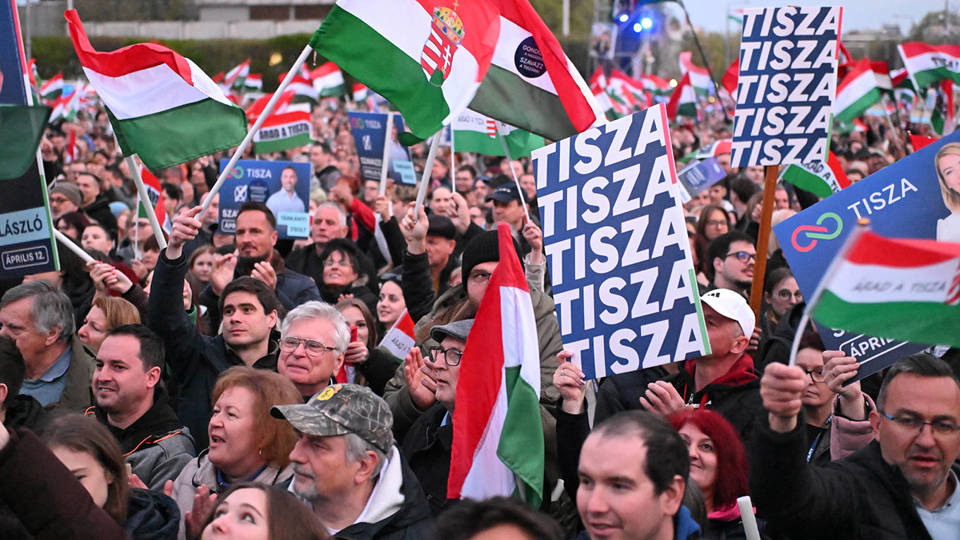
 Balint Szentgallay/NurPhoto via Getty Images
 Ordinary Hungarians have paid a steep price for Viktor Orbán’s smash-and-grab mafia state, where family and friends enriched themselves while living standards stagnated. Voters have turned the page on Orbán, and now the question is whether Hungary can turn the corner after 16 years of his “illiberal democracy.”
In April 2023, to commemorate Pope Francis’s visit to Hungary, then-President Katalin Novák pardoned Kónya. The pardon was not officially reported, and the story broke accidentally in February 2024. The previous summer, a few months after pardoning Kónya, Novák published photographs of her week-long family vacation at Mikes’s castle. The head bishop of the Reformed Church in Hungary, Zoltán Balog, who had a close personal relationship with Novák, publicly admitted that he lobbied for the pardon. As Orbán’s trusted spiritual adviser, Balog was allowed to keep his bishopric but was forced to resign from leadership of the RCH. Not long after, rumors began circulating that Lévai had personally intervened on behalf of Kónya.
The news caused an uproar. Novák was previously Orbán’s minister of family affairs in a government that banished gender studies from university curricula, passed a “pedophile law” to stigmatize homosexuality, banned the Budapest Pride parade, and ordered bookstores to wrap books containing even the mildest reference to sexuality, to protect “the safety and well-being of innocent children.” According to the 2021 “Child Protection Law,” sex education is the responsibility of parents, and schools are prohibited from teaching any content that diverges from “the tradition of the heterosexual family model.”
The conservative British philosopher Roger Scruton, a pole star of Central European anti-liberalism, had pointed the way to such culture-war regulations, once arguing that, “Liberal jurisdictions on the whole tolerate the harm inflicted on children by this kind of sexual freedom.” By contrast, “[t]he old morality was based on the assumption that children are both necessary and vulnerable, and that they can be harmed in many ways, not least … [by a] culture of libidinousness, into which children are initiated through the official lessons in sex education…” (There is no official sex education in Hungarian schools, but there is a taxpayer-subsidized chain of Scruton-themed cafés in Hungary, where Orbán’s supporters can meet and imbibe the late philosopher’s watered-down ideas.)
A Hypocrisy so Immense
In the months leading up to the pardon, Novák was Hungary’s most popular politician, but she took her largely ceremonial role too seriously for Orbán’s liking. She traveled the world, negotiated with foreign leaders, and used a somewhat softer, milder tone when talking about Ukraine. UnOrbán, she did not even exclude the possibility that Russia had started the war.
Orbán found the pardon scandal an ideal opportunity to rid himself of a potential rival and forced Novák to resign, turning a moral outrage into a political crisis. Political intuition and luck had, it seemed, at last deserted him.
The legal process for presidential pardons required the justice minister to advise the president and to countersign the decision. At the time of the pardon, the justice minister was Varga, Magyar’s then-wife, who reportedly advised Novák not to pardon Kónya, but countersigned after Novák decided to do so anyway. In the meantime, Varga had already stepped down from the ministry in July 2023 to lead Orbán’s Fidesz party in the European Parliament, and resigned from the National Assembly when the scandal broke.
At the time of the pardon, Varga was also in an ugly, highly public divorce from Magyar. The evening after her resignation in 2024, Magyar gave an interview to the internet-based television portal Partizán. (He had no other outlet, because all television stations, except RTL, owned by Germany’s Bertelsmann group, are either government-run or controlled by Orbán’s allies.) More than 2.5 million people, one-third of Hungary’s electorate, tuned in.
The interview caused a sensation. Magyar, previously a relatively marginal figure in Orbán’s circle, defended his ex-wife and expounded on the magnitude of the government’s lawlessness and corruption, the greed of Orbán’s cronies (particularly his son-in-law, now one of Hungary’s richest men), and the country’s crumbling public services and rising poverty. This was the first time that someone who obviously had sensitive first-hand information had spoken out publicly against the regime.
To be sure, nothing that Magyar said was news to Hungarians. But coming from an insider in a regime that takes its vows of omertà seriously, it signaled a political rupture. Magyar became an instant celebrity—and for some, a potential national savior, a tormented figure who decided to leave his privileged life for the sake of the country.
Orbán’s government tried desperately to discredit Magyar. The secret services recruited his new girlfriend to tape their conversations. Rumors started circulating about his private life and sexual behavior. Nefarious business transactions, money laundering, and even secret Ukrainian connections were alleged. But Magyar seemed to be made of Teflon. Each newly concocted scandal only proved his invincibility.
The Most Hungarian Candidate
Magyar soon decided to enter politics and take revenge on Orbán. He proved to be an astonishingly capable, brave, and tireless operator, quickly mobilizing a dormant political party and traveling the country virtually nonstop. In two years, he visited almost every settlement, whether large or small.
The party he chose, Tisza, aptly conveys his political stance. The Tisza is the country’s second-largest river, and is known as the “most Hungarian river,” because it flows entirely within the former Kingdom of Hungary, as opposed to the “cosmopolitan” Danube. Magyar wanted to attract not only Orbán’s diehard opponents but also his disaffected supporters. Accordingly, while Magyar seems to be a pro-Europe center-right conservative liberal, he cannily remained silent about the hot-button issues that have polarized the electorate: immigration, LGBTQ rights, and Ukraine’s possible EU membership.

Secure your copy of PS Quarterly: Winners & Losers – and $20
In the new issue of our magazine, leading thinkers examine how recent developments, from the AI revolution to intensifying geopolitical volatility, are reshuffling the economic and financial deck and generating new winners and losers across the global economy.
Subscribe to PS Premium now, with a $20 discount, to read the issue, featuring Claudia Goldin, Mark Blyth, Dambisa Moyo and others.
Subscribe Now
Opposition to Orbán has always been strong in the capital, Budapest, where some 20% of Hungary’s population lives. For 27 of the 36 years since the fall of communism, Budapest has had a liberal mayor. Since the beginning of the 20th century, Hungary’s political right has referred to Budapest as “sinner city”; cosmopolitan, liberal, and, until 1944, with a large Jewish population that played an important role in cultural and artistic life.
As in many recent European elections, the smaller the town or village, and the less educated the population, the more ly people were to support anti-liberal parties. Orbán proudly stated that Fidesz’s base is not urban egghead intellectuals, but true Hungarians, embodying supposedly traditional virtues.
It’s a familiar story. The late political scientist Richard Hofstadter recalled that in 1926, Hiram W. Evans, the Imperial Wizard of the Ku Klux Klan, “wrote a moving essay on the Klan’s purposes, in which he portrayed the major issue of the time as a struggle between ‘the great mass of Americans of the old pioneer stock’ and the ‘intellectually mongrelized Liberals.’” All the moral and religious values of the “Nordic Americans,” Evans lamented, were being undermined by invading ethnic groups and mocked by liberal intellectuals. Still, Evans expected to “return power into the hands of the everyday, not highly cultured, not overly intellectualized, but entirely unspoiled and not de-Americanized, average citizen of the old stock,” because “[a]ll action comes from emotion, rather than from ratiocination.” And it is these “emotions and the instincts on which they are based” that “are the foundations of our American civilization, even more than our great historic documents.”
wise, knowing that he could not count on the support of the intellectuals he despised, Orbán waged a long-running war against Hungary’s cultural and academic institutions. As one of his advisers and lobbyists in Brussels, Frank Füredi, a former member of the British Revolutionary Communist Party reborn as a libertarian nationalist sociologist, put it: “The most important theater of the cultural war is the war on the past.”
A key component of the heroic nationalist narrative that Orbán promoted is the idea that the West has repeatedly betrayed Hungary. The 1920 Treaty of Trianon had cost Hungary two-thirds of its territory and population. During World War II, Winston Churchill and Franklin Roosevelt allied themselves with Stalin, leaving Hungary no other choice in its defense of the West from Bolshevism but to ally itself with Nazi Germany. In 1944, even the Nazis occupied the country.
The Nazi occupation occurred with the acceptance of Admiral Miklós Horthy’s collaborationist government. But according to Orbán’s version of the past, it was the Germans who deported more than 430,000 Jews, most of whom were murdered in Auschwitz. Hungarians were completely innocent, even though only a few dozen Nazi extermination experts came to Hungary with Adolf Eichmann. In Orbán’s narrative, Hungary—where 52,000 civil servants organized the murder of nearly a half-million of their fellow citizens in a mere 57 days—was WWII’s sole moral victor, fighting against the Soviets, Americans, Britons, and finally, even Hitler’s Germany.
This story is the inverse of what Communist history books taught after 1948. In that rendering, although Hungary had been a fascist country during the interwar years and Hitler’s last ally, the postwar Communist takeover turned Hungary into a member of the anti-fascist coalition, and in this way, retroactively, into an ally of the Soviet Union, one of the victors of WWII. The point for Orbán, no less than for the Communists, was to turn defeat into victory in a country that last won a war , when King Matthias occupied Vienna. It also fit seamlessly with the selfless heroic tradition that Orbán claimed Hungary was continuing: defending Christian values against the decadent, secular, morally relativist West, with the help of those Russian President Vladimir Putin, who still take Christianity seriously.
The Roots of Anti-Reactionary Reaction
Liberal democracy, with its inbuilt political contestation and elections whose results cannot be known in advance, can seem a luxury: arriving at political decisions—except when national security is at stake—is usually a slow process of deliberation, disagreement, debate, and compromise. All of this deprives citizens of the stability, spiritual and political authority, and security that an autocratic leader can promise. And because enemies of liberal democracy have the right to campaign and get elected, the constitutional order enables them to win, grab power, and undo democracy.
That is what happened in Hungary. When Orbán, who had served as prime minister between 1998 and 2002, returned to power in 2010, he launched a counterrevolution against the liberal-democratic political system Hungary had established after 1989. His government began by dismantling institutional checks and balances, media pluralism, judicial independence, local self-governance, academic freedom, and separation of church and state, to consolidate a reactionary regime the one Evans favored, based on nationalist, racist, xenophobic, and homophobic policies and propaganda.
The election on April 12 was a revolt against the counterrevolution. There was no new ideological rhetoric, no slogans and demands by the young crowds other than that Orbán and his regime should go: Go to hell, disappear forever, Russians go home. It was a counter-counterrevolution.
Many observers have all but buried liberal democracy, regarding it as a relic of the past century and greeting—or mourning—the dawn of post-liberal autocracy. But the record of post-liberal autocracies, such as the United States (where consumer satisfaction is at an all-time low), and especially Hungary, can hardly be said to herald a new political era. What happened in Hungary suggests that large groups of people still think that there is no proven alternative to autocracy other than the liberal democracy Orbán had supposedly buried.
So, the right question to ask is not why autocracies emerge, but the opposite: why do people, time and again, despite all obstacles, setbacks, and failures, try to build, , and rebuild liberal democracies? The Hungarian example seems to show, once again, that, over time, large groups of people find authoritarian rule suffocating. They find it unbearable to be treated not as individuals, but as members of hostile rival groups. They find it unbearable to live in a state of permanent political warfare, as the regime constantly conjures enemies against whom to defend the nation, the fatherland, faith, ethnic purity, traditions, order, and stability. And they find it unbearable that autocracy is making them poorer.
A De-Developing Country
Average life expectancy for men in Hungary is 73.7 years—six years below the EU average and among the shortest in the bloc. Hungary has the world’s highest mortality rates for several types of cancer, and by the end of 2025, one out of every ten patients in post-operative care suffered a hospital-acquired infection—among the highest rates in Europe. In the homeland of Ignác Semmelweis, the “savior of mothers” who discovered the link between maternal mortality and lack of handwashing, hand sanitizer consumption per day of care in hospitals is among the lowest in Europe.
Demographic trends also point to Hungary’s stagnation. Despite the efforts of Orbán’s self-proclaimed “child-friendly government,” the fertility rate has been declining, reaching 1.31 children per woman in 2025, the lowest level in 14 years. With the death rate higher than the birth rate, population decline is accelerating, exacerbated by official opposition to immigration.
Other development indicators tell a similar story. Over the past 16 years, the Czech Republic, Poland, and Slovakia have done a better job of reducing poverty. Hungary ranks with Bulgaria at the bottom of the European Union in terms of purchasing power and living standards. In 2020, the Hungarian Central Statistical Office claimed that 9.5% of Hungarian children were living below the poverty line. After Eurostat, the European Commission’s statistical agency, published its own findings, the Hungarian authority had to revise the figure sharply to 20.9%.
Hungary is distinguished not only by extreme income inequality but also by rapidly growing wealth inequality. Ten percent of the population owns 72% of the country’s assets, while the bottom 50% own only 5%. (In Germany, where the wealthy had a much longer time to accumulate their wealth, the upper 10% owns 60% of the country’s material assets, while the percentage in China is roughly 68%.) The top 1% of the population holds approximately 33.7% of household wealth, similar to the 34.8% held by the top 1% in the US. In 2025, the richest 100 Hungarians accounted for 14% of total wealth, up from 2.5% back in 2005.
Eight of the ten richest Hungarians are directly connected to Orbán, including family members and childhood schoolmates. According to Transparency International, Hungary has the highest corruption rate in the EU. The country received close to €60 billion ($71 billion) from the EU during Orbán’s 16-year reign, equivalent to roughly 3% of GDP over this period and about half—in 2023 US dollars—of the total the US provided to Europe under the post-WWII Marshall Plan. At least one-third of these funds ended up in the pockets of 13 oligarchs around Orbán.
Ordinary Hungarians have paid a steep price for Orbán’s smash-and-grab mafia state. Hungary experienced one of the world’s highest per capita mortality rates during the COVID-19 pandemic. Only three countries fared worse. Due to political considerations, the government decided to import Russian and Chinese vaccines at a significantly inflated price, using intermediary companies owned by politically connected individuals to manage the transactions. The government imported several thousand overpriced respirators as well, again using startup trading firms that raked in astronomical profits. Most of these respirators were not used during the pandemic. For Orbán and his cronies, preventing their compatriots’ deaths was not the highest priority.
Europe’s Second Chance
Despite the warnings coming from the Hungarian democratic opposition and foreign observers, the EU long seemed unable or unwilling to reckon with the autocratic threat posed by Orbán. Using Hungarian and European taxpayers’ money, Orbán shamelessly bought Germany’s favor. Offering enormous tax breaks and overpriced infrastructure investments (in roads, airfields, sewer construction, and electric capacity) financed with EU funds, Hungary was transformed into the most significant foreign assembly hub for German car companies outside Germany and China.
Besides the automotive industry, other big German companies, such as Bosch and Siemens, also availed themselves of the Hungarian government’s largess. In a sense, Orbán took Germany hostage, which guaranteed then-Chancellor Angela Merkel’s inaction. Orbán was just too important to the German economy to be allowed to fail.
When Orbán, with the backing of Russia and China, felt secure enough in his control, he started to bring Chinese car and battery companies into Hungary. The country was to be China’s car manufacturing hub within the EU, perhaps terminally undermining the stability of German automakers. The Hungarian state, with the help of Orbán’s cronies, bought up the Budapest airport and turned it into China’s EU cargo hub, undermining not only the EU’s economic interests, but its security as well. At this point, the EU started to take notice.
Then came Russia’s full-scale invasion of Ukraine in 2022, when Hungary became Russia’s Trojan horse within the EU, repeatedly vetoing support for Ukraine. With the help of Patriots for Europe, a radical right-wing European parliamentary grouping established on his initiative, Orbán promoted a vision of Europe as a conglomerate of ethno-nationalist, “sovereigntist” states, effectively ending the postwar European project. Magyar’s victory gives Europe a second chance.
Throughout his career, Orbán has insisted: “I am not the person who is right, but the one who will be right,” implying that he not only can foresee what is coming, but make sure things turn out as he predicted. With political skill, good timing, and self-assurance, Orbán long succeeded at exuding an air of infallibility. But ever since the pardon scandal broke, enabling the emergence of a new opposition, Orbán and his government have made one serious mistake after another. Autocrats who become convinced of their infallibility, who isolate themselves, and who listen only to bootlickers become unable to recognize reality, fortune abandons them. The flaws show. The pedestal trembles.
Over the past two years, and especially in the last months of the election campaign, Orbán went from a larger-than-life figure to a hapless caricature, a shameless liar desperately clinging to power as it slipped away, madly raving about a coming attack by Ukraine. After 16 years, the electorate realized that the king was standing naked—and had seen enough.
Featured
-
After Orbán, Hungary Faces an Even Harder Battle
Apr 13, 2026 Maciej Kisilowski
-
The Hormuz Crisis and the Fate of the Global South
Apr 14, 2026 Laura Carvalho
-
The Decline and Fall of the Dollar Empire
Apr 9, 2026 Barry Eichengreen
-
Trump’s Next Coup Attempt
Apr 9, 2026 Timothy Snyder
-
To Work for Us, AI Must Not Think for Us
Apr 13, 2026 Dani Rodrik
https://prosyn.org/lrfp4lA
It appears that you have not yet updated your first and last name. If you would to update your name, please do so here.
Please wait, fetching the form
Please wait, fetching the form
Please wait, fetching the form
Please wait, fetching the form
Please wait, fetching the form
Please wait, fetching the form
Please wait, fetching the form
Sumber Artikel:
Project-syndicate.org

