
The United States is not building transmission fast enough to satisfy growing demand. Full stop.
An alarming report issued by Grid Strategies and Americans for a Clean Energy Grid last summer pointed out that only 322 miles of 345 kV+ transmission lines were completed in 2024. The previous few years have been just as slow, if not slower.

2025 totals are still being calculated, but it looks extremely unly that the U.S. returned to, say, 2013 levels, when 4,000 new miles were constructed. And we need to hurry the hell up.
According to the U.S. Department of Energy (DOE) in its 2024 National Transmission Planning Study, the lowest-cost portfolios that meet future demand growth and reliability needs require expanding the transmission system of the contiguous United States by 2.1 to 2.6 times its 2020 size by 2050. DOE found that under high-demand growth scenarios (i.e., 2.7% of growth or more per year), we must increase the 2020 system by 2.5 to 3.3 times. The U.S. Energy Information Administration (EIA) expects domestic electricity use to grow by 1% this year and 3% in 2027. Uh oh.
The math works out to about 5,000 new miles of transmission to be constructed each year, starting… last year. Forget supply chain and interconnection slowdowns- transmission is the bottleneck preventing grid modernization.
But short of grabbing a shovel and starting to dig, what can be done?
Well, the DOE is throwing money at the problem. The Office of Electricity just announced a $1.9 billion funding opportunity to accelerate what it deems “urgently needed” upgrades to the U.S. power grid. They’re targeting reconductoring and advanced transmission technologies (ATTs) to make the system more resilient, focusing on smart grid projects such as grid-enhancing technologies (GETs), and exploring how to work large loads (data centers) into regional transmission planning.
“We encourage the Department of Energy to move swiftly to get those funds out the door,” recommended Dylan Reed, managing director at clean energy advocacy group Advanced Energy United and a former DOE Senior Advisor. “Industry leaders are ready to respond.”
Speaking of industry leaders, settle in for another jam-packed edition of our weekly energy finance and development roundup, featuring some eye-popping sums and milestone projects. If you want to see something included in the next iteration, drop me a line. And when you get to the weekend, may it scoop you up, throw you on its shoulders, and take you on a giggle-inducing piggyback ride that lasts until Monday.
ArcLight Acquires 50% Stake in 5.4 Gigawatt Power Portfolio
Electrification infrastructure investor ArcLight Capital Partners has signed an agreement to acquire a 50% stake in Invenergy AMPCI Thermal Power (IATP), a jointly-owned power portfolio in which Invenergy will retain its existing ownership interest and operational role.
IATP is a large-scale, diversified portfolio of 11 power infrastructure assets located in seven North American markets, including several highly efficient combined cycle gas generation facilities: Grays Harbor Energy Center in Washington, Nelson Energy Center in Illinois, Lackawanna Energy Center in Pennsylvania, and St. Clair Energy Centre in Ontario. The assets are owned in partnership with Invenergy, North America’s largest privately-held developer, owner, and operator of independent power infrastructure.
“We believe that strategic power portfolios IATP, which provide significant capacity, reliability, and grid infrastructure across North America, will play an increasingly critical role in helping to meet the power demand needs driven by AI and electrification,” assessed Angelo Acconcia, president of ArcLight.

Financial terms of the private transaction were not disclosed. The deal, expected to close in the second half of this year, is subject to customary regulatory approvals and other closing conditions. BofA Securities is acting as financial advisor to InfraBridge, the middle-market infrastructure manager that facilitated the deal. Morgan Stanley & Co. LLC is acting as financial advisor to ArcLight.
Arevon Secures $920M for Massive California Storage Project
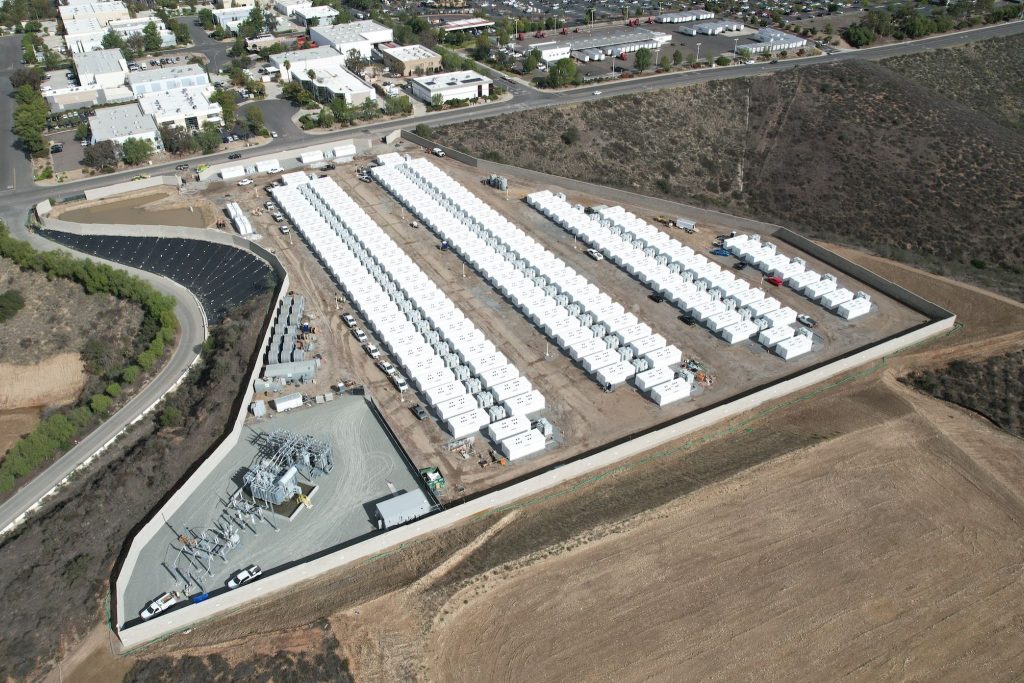
Developer, owner, and operator Arevon Energy is kicking back on 92,000 stacks, or $920 million dollars, which the company has secured for its 300 megawatt (MW)/1,200 megawatt-hour (MWh) Nighthawk Energy Storage Project, currently under construction in Poway, California (pictured above).
Arevon will own and operate Nighthawk Energy Storage, which utilizes lithium iron phosphate battery technology designed to provide safe, efficient, and flexible storage capabilities. It will strengthen grid reliability in the San Diego region and will provide resource adequacy capacity to Pacific Gas and Electric Company (PG&E) under a long-term agreement that supports California’s reliability and clean energy goals. Over the project’s lifespan, it is expected to deliver more than $30 million in property tax payments, supporting schools, infrastructure improvements, and public services.
“Strategically aligning debt, preferred equity, and transferability structures is essential to financing energy storage projects at this scale and profile,” said Denise Tait, chief investment officer at Arevon. “This transaction demonstrates how innovative capital solutions can unlock long-term investment in critical grid infrastructure, even amid evolving market and policy conditions.”
The financing package includes a $482 million debt facility arranged by CIBC as Left Lead Arranger, alongside ING Capital LLC, NORD/LB, Santander, and Zions Bancorporation; a $169 million preferred equity investment structured to simplify the monetization of tax credits with Goldman Sachs Alternatives; and a $268 million tax credit transfer commitment with a corporate purchaser. Arevon was represented by Latham & Watkins and Sheppard. Norton Rose Fulbright and Allen Matkins served as Counsel to the lenders. Milbank LLP and Allen Matkins acted as Counsel to Goldman Sachs, and CG/CRC-IB served as Arevon’s tax equity advisor.
“The Nighthawk project exemplifies the type of large-scale, high-impact investment opportunity that our strategy was designed to support,” assessed Vikas Agrawal of Goldman Sachs Alternatives. “This preferred equity investment reflects our commitment to providing flexible, tailored financing solutions that help accelerate the deployment of critical infrastructure.”
Arevon, which recently named Justin Johnson its interim CEO after Kevin Smith’s departure to Cypress Creek Renewables, now boasts more than 3.7 gigawatts (GW) of operating capacity, representing more than $5 billion in capital investments.
The impacts of shifting tariff policy on solar generation and manufacturing
AyPa Power and Six Nations Close on Financing for Ontario Battery Projects
Blackstone portfolio company and renewable energy do-it-all Aypa Power, together with Six Nations of the Grand River Development Corporation, have closed on approximately CA$700 million ($512 million) in aggregate financing for the Elora and Hedley Battery Energy Storage System (BESS) projects in Ontario, Canada. The financing package comprises construction-to-term loan facilities, investment tax credit bridge loans, and letters of credit facilities.
The Elora and Hedley projects, located in Centre Wellington Township and Haldimand County, respectively, are scheduled to commence commercial operations in mid-2027. They were awarded contracts last year under the Independent Electricity System Operator’s Long-Term 1 (LT1) competitive procurement, a province-wide initiative to secure new capacity resources in support of Ontario’s long-term electricity reliability and resource adequacy needs. With a combined installed capacity of 422 MW/1,688 MWh, the projects represent one of the largest battery storage commitments under the LT1 program and will play an important role in strengthening the reliability and flexibility of Ontario’s power system.
“This financing reflects the strength of Aypa’s platform and our disciplined approach to developing and executing complex energy infrastructure projects,” said Moe Hajabed, CEO of Aypa Power. “Ontario has long been a core market for Aypa.”
The financing was provided by an eight-bank syndicate of leading international and domestic lenders, led by Canadian Imperial Bank of Commerce (CIBC) as Left Lead Arranger and Sumitomo Mitsui Banking Corporation, Canada Branch as Right Lead Arranger. Coordinating Lead Arrangers also included Desjardins Group; National Bank of Canada; Royal Bank of Canada (also Administrative Agent); and Société Générale, together with Industrial and Commercial Bank of China (Canada) and Siemens Financial Services as Joint Lead Arrangers.
“This transaction highlights the continued maturation of energy storage as a core infrastructure asset class and reflects our continued commitment to delivering tailored capital solutions that strengthen grid reliability and support flexible capacity resources across Canada,” added Nirushan Thambirajah of CIBC Capital Markets.
Octopus Australia Puts Shovels Down Under on Solar+Storage Site
Octopus Australia has broken ground on the $900 million Blind Creek Solar Farm and Battery project, a 300 MW solar farm with a 243 MW/486 MWh battery located in Bungendore, New South Wales (NSW). The site will connect via a new substation into the transmission backbone between Sydney and Canberra.

Construction is being led by engineering, procurement, and construction (EPC) contractor GRS, with Wärtsilä Energy Storage supplying the BESS. Blind Creek is due to be fully operational in 2028. The project will support up to 300 full-time equivalent jobs at peak construction, with approximately half expected to be sourced from the local Bungendore and Monaro regions.
“This is the kind of project New South Wales needs as we replace ageing energy infrastructure. We need to keep the lights on, keep costs as low as possible, and to keep regional communities with us along the way,” said NSW Premier Chris Minns at a groundbreaking event (or as the Aussies apparently call it, a ‘sod-turning!’). “The Blind Creek project is creating local jobs, and it will help deliver the replacement energy that households and businesses rely on.”
Blind Creek was initiated in partnership with local sheep farmers seeking to integrate agriculture with energy production to future-proof their properties and support the local community. The solar farm has been specifically designed to allow animal production to continue on the land, as it has for 155 years, benefiting from protection from wind, partial shading, condensation, and organic soil improvements resulting from the project. Capital supporting Blind Creek includes money from Australian superannuation funds Hostplus and Rest, the Commonwealth’s Clean Energy Finance Corporation, Westpac Private Bank, and Dutch pension giant APG.
“This project shows what happens when global capital, Australian super, and regional farming families align under stable government policy. You get real infrastructure, real clean electricity, and real jobs,” quipped Octopus Australia CEO Sam Reynolds.
Sol Systems Advances Pair of Solar Projects
Developer and independent power producer (IPP) Sol Systems is celebrating the advancement of two projects in its utility-scale solar portfolio, closing on financing for the 144 MWac Blossom Solar Project in Morrow County, Ohio, and its 180 MWac Nightfall Solar Project in Uvalde County, Texas.
Financing for both Blossom and Nightfall was arranged for Sol Systems as a construction warehouse facility last year with a lending group consisting of BBVA, ING Capital LLC, Intesa Sanpaolo SpA, NAB, Natixis CIB, and NatWest. Tax equity for the transactions was facilitated by Raymond James Renewable Energy Investments and its investors. The Blossom and Nightfall projects are the first two to draw on those funds, at a total transaction size of $634 million.

As a part of the $334 million transaction closing on Nightfall Solar in Texas, Sol Systems has selected SOLV Energy as the EPC provider for the project, marking their second collaboration (Eldorado Solar in Illinois). Nightfall is expected to power about 57,935 homes annually in ERCOT and will create around 300 construction jobs before reaching full operations later this year.
The $300 million deal advancing the Blossom Solar Project in Ohio marks Sol System’s first utility-scale foray into the PJM market. Blossom is expected to produce approximately 279,600 MWh of clean electricity in its first year, enough to power more than 29,000 homes annually. The project will be built across 1,700 acres of leased and owned land.
“Together, Blossom and Nightfall strengthen Sol Systems’ national development pipeline across two of the country’s most important power markets – PJM and ERCOT,” said Richard Romero, chief financial officer of Sol Systems. “These projects underscore our commitment to building resilient energy infrastructure that supports corporate decarbonization goals, strengthens local economies, and delivers lasting value for communities.”
Sumber Artikel:
Renewableenergyworld.com