
Individual results may vary, but this week, I noticed the water in the lobster pot getting uncomfortably hot for the camp concerned with artificial intelligence (AI)-related job losses.
Jack Dorsey, founder of the now-bot engagement farm hellsite formerly known as Twitter, made waves Thursday when he announced massive layoffs at his fintech company, Block, which he attributed directly to AI implementation. 4,000 of the firm’s 10,000 employees are now looking for work.
“The core thesis is simple. Intelligence tools have changed what it means to build and run a company,” the CEO wrote in a letter distributed to holders in Block, the parent company of online payment platforms Square and Cash App. “A significantly smaller team, using the tools we’re building, can do more and do it better.”
The real canary in the coal mine? s in Block shot up more than 20% overnight on the news. A company with $24 billion in revenue, which just reported its Q4 2025 gross profit had jumped 24% quarter-over-quarter, is culling 40% of its staff – and the market applauded resoundingly.
Rather than lay off employees in waves over the course of the next few years (indefinitely?), Dorsey conducted an analysis on what he really needed to grow a company with proper AI tools, and then swung his scythe precisely as deep as he thought he could. To his credit, the announced severance package looks better than most – and at least he’s owning the decision.
“Other large employers have announced tens of thousands of cuts in recent months. Some have downplayed the AI link. Block did not,” Dorsey said.
There is a time to reap. But there is also a time to sow. Right now, we’re in both, depending on your positioning relative to the blade.
The growth of artificial intelligence is fueling data center construction and accompanying power generation and transmission infrastructure coast to coast. You probably won’t be able to stop a hyperscaler from setting up shop in a pristine woodland near you, as residents of Pine Island, Minnesota, can attest, but if you play your cards right, at least you’ll be able to get something out of the deal. Tax revenue, upgraded utility assets, gigawatts of clean energy, support of pioneering technologies – it’s all on the table, so long as you allow a handful of companies to build what they need to keep your reels reelin’ and your Tik Toks tockin’. You can either let the government use your algorithms for autonomous weapons and civil surveillance, or the next guy will.
The machines haven’t been able to till me under yet, although, dear reader, one day they’ll come for me, too. Saying ‘please’ to ChatGPT will only keep them back for so long. Until then, let’s talk about some of the power projects and financing that’s driving all this electric load growth, shall we? As always, feel free to drop me a line if you see something that fits in our weekly roundup. And whenever you lay your weary head upon the soft pillow of the weekend, may both sides be cool.
Ameresco and Luminance Beautify Landfill with Solar Project
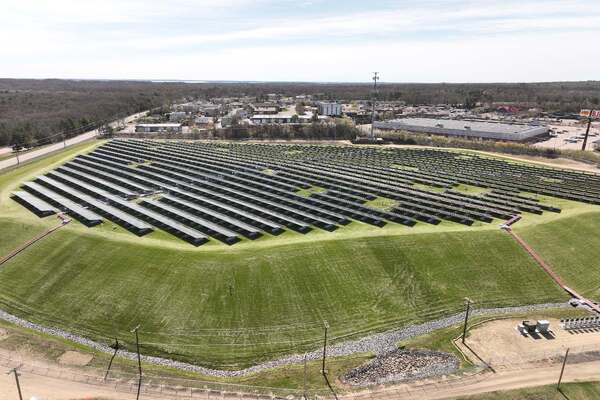
Renewable energy do-it-all Ameresco and decarbonization-as-a-service provider Luminance are celebrating the completion of the Coventry Landfill Solar project. Located in Coventry, Rhode Island, the capped landfill site now features a 5.74-megawatt (MW) solar array, enough to power more than 1,100 homes and eliminate 3,760 tons of carbon dioxide each year.
Designated under the Comprehensive Environmental Response, Compensation, and Liability Act (CERCLA), the Coventry solar project demonstrates how underutilized land can be transformed into productive clean‑energy infrastructure while providing significant economic benefits. Over the initial lease period, the town will bring in approximately $4.4 million.
“The Coventry Landfill Solar project is a testament to our commitment to innovative renewable energy solutions,” ventured Jonathan Mancini, senior vice president of solar and BESS project development at Ameresco. “Developing the Coventry Landfill Solar project showcases the potential of repurposing land for renewable energy and transforming landfills into sustainable, productive sites that enhance energy security and resiliency for communities across the country.”
Luminance, which owns the project, now serves more than 10,000 customers in the educational, commercial, industrial, utility, and municipal sectors and has over 1,600 MW of operating distributed energy resources spanning 30 states, Washington, D.C., and Canada.
Atlas Shrugged? Atlas Refinances $3 Billion Portfolio
International clean energy infrastructure provider Atlas Renewable Energy announced Monday that it has secured the largest corporate refinancing for non-conventional renewable energy in Latin America to date.
Totaling approximately $3 billion, the transaction was executed by Atlas with support from its sponsor Global Infrastructure Partners (GIP) and participation from BNP Paribas, Crédit Agricole, Goldman Sachs, Morgan Stanley, MUFG Bank, Ltd., Natixis CIB, and Santander CIB. The transaction involved 26 law firms across 11 jurisdictions, reflecting its scale and structural complexity. And, you know, the staggering dollar figure.
Atlas says the refinancing will allow it to optimize its capital structure, unlock competitive financing costs across its regional portfolio, and provide a long-term runway for continued growth in clean energy infrastructure. The transaction covers a portfolio of high-performing solar and storage assets located primarily in Chile and supports projects in Brazil and Mexico.
“Securing a refinancing of this magnitude is a strong vote of confidence from global financial institutions for our brand and forward strategy in the region”, observed Carlos Barrera, CEO of Atlas Renewable Energy. “This refinancing is also a sign of the company’s financial maturity and will support its next phase of growth.”
Factor This finance and development roundup: AES, Alliant, CleanChoice, CMBlu, Encore
Nextpower Sending Gigawatts of Steel Frames to Jinko Solar
Rapidly expanding clean energy solutions provider Nextpower (formerly Nextracker) has announced its second major commercial order for U.S.-manufactured steel module frames. Nextpower plans to supply more than one gigawatt (GW) of steel frames, scalable to up to 3 GW over a three-year period, to Jinko Solar U.S., one of the longest-operating solar module manufacturers in the United States. Production from Jinko’s Jacksonville, Florida, facility is expected by mid-year.
U.S.-made steel frames add 6% to a tracker project’s domestic content calculation, according to U.S. Treasury Department guidance. That matters quite a bit, which is why Nextpower pounced on the opportunity to acquire steel frame maker Origami Solar last fall.
“This agreement with Jinko Solar represents clear market validation of steel frames as a reliable and cost-effective solution that supports both module durability and U.S. manufacturing priorities,” said Dan Shugar, founder and CEO of Nextpower. “It also reinforces how the U.S. solar industry is industrializing, aligning domestic manufacturing, policy incentives, and proven technology at gigawatt scale.”
To simplify project logistics and reinforce the domestic supply chain, Nextpower plans to further expand its steel frame manufacturing presence in the Southeastern United States to enable direct supply to Jinko Solar U.S. This strategy s Nextpower’s recent expansion of its steel component manufacturing capacity in Memphis, one of more than two dozen U.S. factories Nextpower has opened or expanded since 2021.
“Improving module durability and strengthening domestic supply chains are closely linked priorities,” surveyed Nigel Cockroft, general manager at Jinko Solar U.S. “Partnering with Nextpower to integrate domestically produced steel frames into our U.S. modules is a natural extension of that leadership, aligning with U.S. manufacturing priorities, while delivering greater durability at scale for customers and the broader solar industry.”
Financing Secured for Big Solar Site Near Houston
OCI Energy, Arava Power, and ING Capital announced Monday that they’d closed on approximately $394 million in construction financing for Project SunRoper, a 347 MWdc solar project in Wharton County, Texas. OCI Energy and ING previously worked together on financing for the Alamo City Battery Energy Storage System project, which we featured in a roundup last September.
Located about 60 miles southwest of downtown Houston, SunRoper will deliver clean energy capacity to one of the highest electricity-demand regions in Texas and the United States. The project is slated to begin commercial operation in Q3 2027; it’s being developed through a joint venture between San Antonio-based OCI Energy and Israel’s Arava Power. WHC will serve as Sunroper’s EPC contractor, while Black & Veatch is acting as the technical advisor.

ING Capital underwrote the financing package, which includes a construction-to-term loan, a tax equity bridge loan, and various letters of credit. ING Capital serves as sole coordinating lead arranger, sole bookrunner, and sole green loan coordinator, and will also act as administrative agent. The construction financing is supported by a 20-year power purchase agreement (PPA) with a Fortune 100 company.
“Arava Power is entering a pivotal phase of growth, and the U.S. market is a central pillar of our long‑term strategy,” said Ilan Zidkony, CEO of Arava Power. “Project SunRoper highlights the strength of our collaboration with OCI Energy. Our teams have operated with exceptional alignment and a d commitment to excellence – securing the strongest commercial package, finalizing financing, and completing a long‑term busbar PPA with a major U.S. energy company to advance the project toward construction. SunRoper is a strategic milestone that supports our vision of building more than 1 GW of solar capacity in the United States within the next two years.”
Revolve Spins $10 Million in Strategic Financing
North American owner, operator and developer of renewable energy projects Revolve has completed the initial advance of a $10 million convertible credit agreement with Callaway Capital Management that provides for up to $40 million of financing.
The strategic financing partnership with Callaway is expected to provide Revolve with long-term capital security and flexibility to advance its portfolio of utility-scale and distributed renewable energy projects.
“By removing capital constraints and strengthening the Revolve’s balance sheet, the transaction positions Revolve to accelerate development timelines, pursue selective acquisitions, and unlock value across its portfolio,” analyzed CEO Myke Clark.
Revolve, headquartered in Vancouver, Canada, wants to develop 5,000 MW of utility-scale projects across North America. The independent power producer recently achieved a key interconnection milestone and received the generation permit for its 130 MW EL 24 wind project in Mexico.
Sumber Artikel:
Renewableenergyworld.com