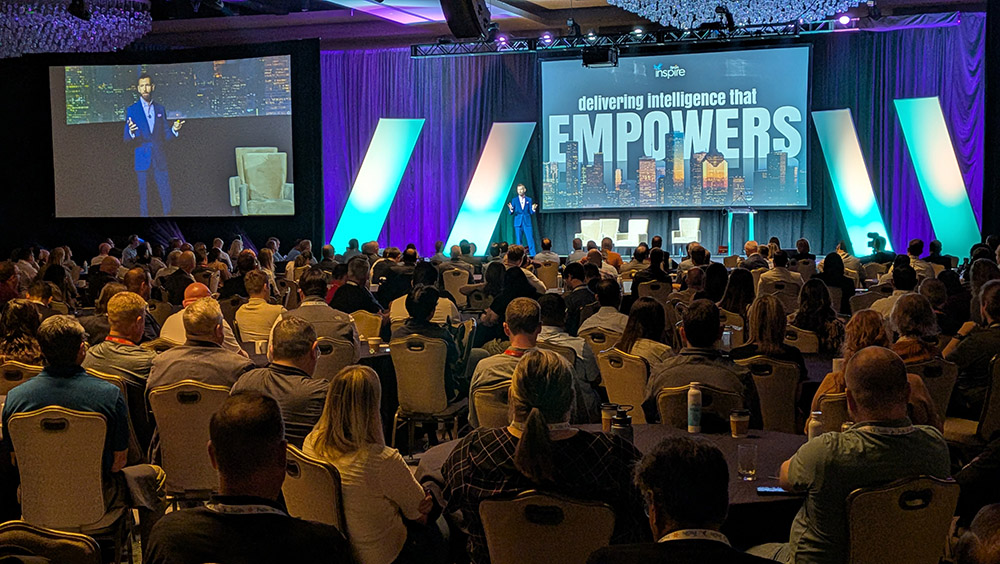

Itron Inspire 2026 brought together leaders from across the energy sector from October 16–21. Taking place in Houston, Texas, with CenterPoint Energy serving as host utility, the event showcased how edge intelligence and grid innovations are transforming utility efforts to simultaneously impact reliability, resilience, and affordability, breaking the zero-sum mindset that often defines grid modernization efforts.
While past editions of Itron Inspire explored what edge intelligence means and how to power utility innovation, the 2026 event showcased a decisive convergence around practical AI applications and a shift in thinking around how single strategic investments can make an impact on multiple measurable levels. With sessions covering everything from cellular Quality of Service (QoS) and traffic orchestration for AMI 2.0 to connected safety and grid edge value, the insights were as varied as they were deep, providing attendees with specific, actionable strategies.
Several notable takeaways highlight what’s happening now and what’s next across the energy sector.

Tapping Into What the Grid Already Knows
To kick off Itron Inspire 2026, Itron CEO Tom Deitrich told a story about a pole-mounted transformer installed in 1994 that finally gave out. Dispatchers immediately saw the failure, a crew was sent out, and the lights were back on in 45 minutes, highlighting the efficiency of the teams and process. But his story illustrated that today’s challenge isn’t handling these failures, or even predicting them. Instead, the challenge is when and how you become aware of them.
“The grid knew what was about to happen with that transformer failure before it happened,” Deitrich told the crowd. “For the previous three weeks before that event, the voltage sagged a little bit more. The endpoints saw that. The grid knew, but nothing was listening. That’s not because there was a failure in the control room, but because the data is going unused.” He asked the audience to think about how we can reframe this discussion. “How can we turn what the grid knows into what we do? How do we minimize that gap between knowing and doing?”
For utility leaders, closing this gap means moving past processes designed to capture data that ultimately sits in silos, rather than integrating it into existing systems or using it as a frontline defense. By leveraging AMI 2.0 and modern connectivity to more fully harness the information the grid has been capturing all along, the gap between what the grid knows and what teams can do about it can be narrowed.
Enabling and highlighting this type of awareness is about more than tools or technology, though. It requires an operational shift that goes beyond standard processes to transform the entire approach to traditional utility priorities.
A Balancing Act That Shouldn’t Be One
As part of his keynote address, Deitrich detailed how utilities are constantly asked to balance challenges related to reliability, sustainability, capacity, and affordability. But rather than treating these elements as trade-offs requiring expensive new infrastructure or massive capital investments to address them individually, utilities can leverage edge intelligence and software to support all of these efforts simultaneously.
“We need to stop looking at the world as a trade-off,” Deitrich added in an exclusive post-keynote interview with Factor This. “If I build more capacity, that doesn’t take away from the reliability impact. In fact, that additional capacity can augment reliability. When you do it right, when you put the data and intelligence to work, you really can move all of these dials at the same time.”
When leaders put data and intelligence to work, solving a single operational challenge related to reliability can positively impact larger affordability or capacity challenges. Doing so means widening the perspective around where such efforts can make a difference, and how they can be quantified. Long framed as a zero-sum game of competing choices, new initiatives and technology upgrades shouldn’t be constrained by the “or” of competing trade-offs, but instead driven by the “and” that needs to be inherent in modern grid strategy.

Bespoke Utility Solutions That Aren’t Bespoke
The Knowledge Center, Itron Inspire’s exhibition floor, featured a wide variety of solutions designed to enable operational efficiencies, but the approaches utilities take to implement them are as varied as they are distinct. While that might make every deployment feel bespoke, the underlying core technology remains the same across customers in ways that should be both inspirational and aspirational to potential users.
“The core technology that we’re deploying is the same to all of our customers,” said John Marcolini, senior vice president of networked solutions at Itron. “Every use case and utility has their own distinct value proposition, but we see and know how they’re able to quantify a clear, positive business case to make incremental investments. The real bespoke part is the journey and how they get there.”
Itron’s platform lays a foundation for a range of use cases, allowing utilities to focus on the capabilities that best address their specific needs and operational priorities. Rather than requiring a bespoke technology solution for every challenge, the platform supports different starting points and incremental investments as each utility’s needs evolve.
Marcolini pointed to real-world parallels, such as 100-amp service limitations faced by West Coast utilities and Canadian providers a, where a large percentage of homes still feature 100-amp panels. While the push on the West Coast is heavily driven by homeowners adopting Level 2 EV chargers that require immediate capacity mitigation to avoid multi-million-dollar neighborhood service upgrades, the Canadian application is part of a broader baseline infrastructure update. To address these distinct regional hurdles, Itron’s Networked Solutions business unit has focused on communication flexibility, uniting public LTE, private LTE, and traditional mesh technology into a single platform.
It’s an example that shows how the use cases can vary in region and application, but the technology deployed to solve them uses the exact same modular foundation in ways that can scale across teams and organizations.
The convergence of IT and OT
We’ve been hearing about the benefits of combining utility IT and OT for over a decade, but true integration is a bit of a moving target. Process maturity and best practices to design, secure, and manage such large, complex systems are often outside the traditional experience of OT departments, while utility IT organizations have the process maturity and governance that grid operations are literally built upon. Pulling them closer together requires the individuals, teams, and entire department involved to recognize that technology alone can’t bridge this gap.
“There are multiple masters with these systems and processes, but they need to truly be considered as a d asset,” said Ty Roberts, vice president of product marketing at Itron. “There are technical challenges, but there are also operational challenges and silo challenges within utilities that we have to solve, and we’re finally getting there.”
True operational transformation requires aligning internal teams around the reality that something meter data isn’t just a concern for billing, but can also serve as a baseline for distribution engineering and outage response. It’s a realization that’s easy to call out but tough to operationalize, even as the talent and technology needed to make it happen are already available.

What Does It Mean to Put Utility Data to Work?
Realizing the full promise of data requires translating these high-level concepts into actionable field deployments across multiple operational fronts. It’s something that was showcased in multiple ways at Itron Inspire.
For utilities sorting out what it means to best leverage AI, questions are pervasive as ever, but as Emily Fisher, director of sales and marketing for North America at NET2GRID, explained, successfully integrating AI into utility operations is about moving past generic industry buzzwords to impact specific or established workflows. By establishing a centralized single source of truth that breaks down traditional departmental data silos, utilities can effectively pair AI analytics with edge intelligence to support real-time operational decisions and behind-the-meter asset management.
At the same time, external environmental pressures are compelling teams to reconsider everything about how they’ve traditionally quantified risk and established priorities related to reliability and affordability. Sunny Wescott, Federal Emergency Response Chief Meteorologist and Executive Director for the Geospatial Intelligence Information Sharing and Analysis Center, explained why utilities can no longer rely on historical precedent to best assess weather risk that is about so much more, highlighting the need for proactive grid planning that can safeguard long-term grid reliability while simultaneously making a positive impact on affordability and future capacity needs.
This type of proactive philosophy is already taking root in the field. Ed De Varona, senior vice president of CenterPoint Energy’s electric business, detailed the utility’s Greater Houston Resiliency Initiative, which is a massive infrastructure hardening campaign launched in response to intense coastal weather events that includes deploying over 75,000 stronger utility poles, 750 automated switching devices, and 850 miles of underground power lines. By coupling these physical investments with edge computing and advanced metering infrastructure, CenterPoint is providing real-time grid feedback that significantly accelerates restoration times and serves as a replicable resilience blueprint for coastal utilities nationwide.
All of these examples showcase what it means to put data to work in ways that scale and prove that utilities don’t face a zero-sum balancing act. By driving multiple benefits from single efforts, they highlight how the talent, technology, and frameworks needed to achieve simultaneous reliability, resilience, and affordability benefits can define the modern utility journey, no matter the size or ambition.
Sumber Artikel:
Renewableenergyworld.com