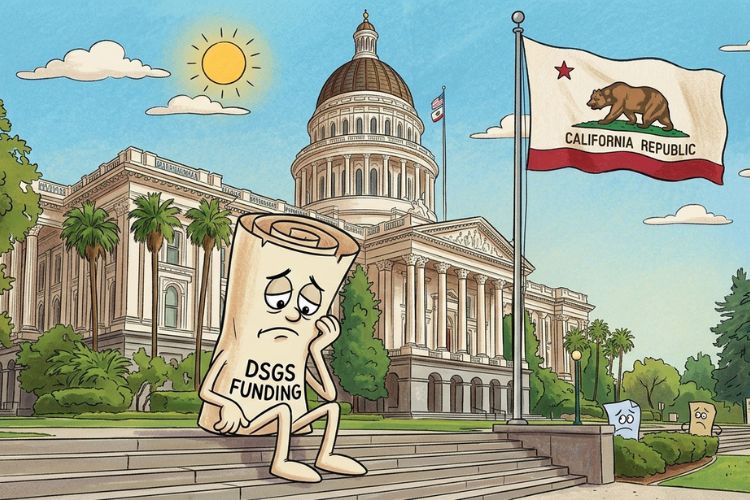
The most robust virtual power plant (VPP) program in the United States is running out of funding at a time when the grid needs it more than ever.
Launched in 2022, California’s Demand Side Grid Support (DSGS) program coordinates more than 1 gigawatt (GW) of dispatchable capacity from more than 200,000 unique customer sites enrolled across every single legislative district in the state. The program leverages customer-sited resources home batteries, solar systems, and smart thermostats, bringing clean, flexible, and responsible energy resources online during grid emergencies. Since the DSGS program began, the California Independent System Operator (CAISO) has avoided blackouts and hasn’t issued a single Flex Alert, its call for voluntary energy conservation, in more than four years.
Despite its impact, the DSGS program was never intended to be permanent, and California’s last legislative session ended without dedicating new funding. While still operational through the end of the year, its fate in 2027 and beyond is uncertain at a critical moment: the nexus of rising electricity demand, more frequent extreme weather, and mounting affordability challenges.
This edition of DTECH‘s Factor This Policycast, presented in partnership with national business association Advanced Energy United, explores the future of the DSGS program. Hosted by Factor This content director Paul Gerke, the episode features special guests Brandon García, Advanced Energy United’s California director, and Lauren Nevitt, senior director of California policy and energy markets at Sunrun.
They react to a new report evaluating how VPPs can lower utility costs and details of recent record-breaking VPP dispatches. This episode of the Factor This Policycast also addresses critical questions including: Can California’s policymakers establish a durable, long-term market pathway to support the nation’s leading VPP? What role do distributed energy resources (DERs) play in the state’s energy future? And what can California’s next Governor do to buoy DSGS before it can’t pay its participants?
Listen to the audio version of the podcast:
In This Episode
Major grid milestones
On September 9, 2026, Californians used more electricity at once than on any day in the last four years, but the state’s power grid didn’t have to resort to emergency measures. Governor Gavin Newsom credits more than 39,000 megawatts (MW) of new clean energy since 2019, including more than 23,000 MW of battery storage.
On October 5 and 6, 2026, Sunrun and Tesla delivered back-to-back record-breaking distributed energy dispatches to support California’s grid during a prolonged heat wave. Those days marked merit events for the DSGS program, which has an affordability trigger of $200 per megawatt-hour.
“DSGS becomes a true affordability mechanism for the state, and that’s what happened,” explained Sunrun’s Nevitt on the podcast.
In coordination with the Emergency Load Reduction Program (ELRP) run by the California Public Utilities Commission (CPUC), the Sunrun and Tesla fleet dispatched 669 MW on October 5 and 745 MW on October 6, driving prices back down.
“Around 500 megawatts is what it takes to run the entire city of San Francisco,” d Advanced Energy United’s García. “600 to 800 megawatts means that you’re running massive California cities on just residential batteries on their own, or you have the ability to do that.”
“And people in these programs were able to do it on demand, on call, when needed to do so. And that piece, I think, is something we don’t talk about enough,” he added.
The fate of the DSGS program
In June 2026, the California legislature allocated $27 million in funding to DSGS to keep it running through the end of the year. But the recent West Coast heatwave may have depleted the program’s coffers.
“It’s unclear how much money would be left, if any, given how much it’s being used,” García pointed out. “And a lack of funding in 2027 means, one, that the program has been not only successful, but instrumental in addressing grid costs and grid needs. If there was no need for the program, then we would have the full $27 million. But it got used; people needed it.”
A new report from The Brattle Group finds that rapidly scaling residential virtual power plants (VPPs) DSGS could cut expected household electricity bill increases by more than half over the next five years while providing utilities with hundreds of megawatts of dependable capacity.
“The total value created by a VPP is over seven times the cost of enabling it, and the majority of that value goes back to consumers as performance payments,” cited Nevitt on the Factor This Policycast, referencing findings in the report. “We’re thinking about using consumers as real drivers of innovation, and putting the power to the people to our grid.”
“What DSGS was set out to do was to really prove that these resources could be reliable and scale, and it’s done just that,” Nevitt tacked on. “There is no other way to frame DSGS as anything other than a resounding success.”
García believes the next governor should prioritize finding funding for DSGS.
“If I had my magic wand, early budget action is what we would use in California as a way to fund this program, and that’s not unprecedented,” he offered.
And if DSGS is allowed to die? That might not be the worst thing, theorized Nevitt, so long as it led to establishing a more permanent market for VPPs.
“I’m not convinced that we’re going to do the right thing and find some kind of patchwork funding for the program,” she admitted. “We really want to move beyond these kinds of one-off programs, and so as important as DSGS has been, if it’s not funded, it just points to the need to find another vehicle right for these resources.”
California’s clean energy conversation
While SB 913 was one of the bigger policy accomplishments in California this year, it wasn’t the only one. Advanced Energy United’s García utilized the Factor This Policycast to shout out SB 868, SB 905, and other pieces of legislation redefining the state’s clean energy future.
“Whoever the next governor is, they’re going to take a very proactive approach to address these things, and it won’t be by a lack of work,” he said. “There’s certainly a lot of stuff on the table, and I’m excited to just see how that pans out.”
This is an opportunity to go big without regrets, García suggested.
“The situation we’re in right now is so untenable that people want change, and this is more than just California… Maybe it’s just my old optimism, but we can make the world better, and I don’t know why we’re scared to do so.”
Sumber Artikel:
Renewableenergyworld.com