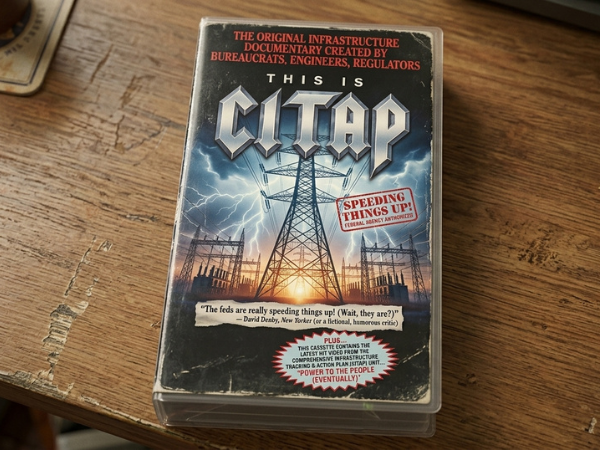
In April 2024, the U.S. Department of Energy (DOE) announced a final permitting reform rule to streamline the authorization process for large electric transmission projects without sacrificing environmental reviews. The Coordinated Interagency Transmission Authorizations and Permits (CITAP) program uses the Federal Power Act to establish the DOE as a coordinating entity between federal agencies and the state and local stakeholders responsible for permitting decisions needed to site transmission lines. CITAP sets a binding two-year schedule for a process that has historically taken four years or longer. It also requires developers to submit a comprehensive public participation plan to ensure that communities and key stakeholders are included in the permitting process.

By acting as the lead agency, DOE aims to reduce duplication of effort that would otherwise be expended across several distinct agencies, processes, and procedures. Ultimately, by enabling faster buildout of new electric transmission infrastructure, CITAP promises to increase access to a diversity of energy sources, reduce transmission congestion and energy prices, and deliver reliable, affordable power to consumers when and where they need it.
More than two years have passed since the final rule was issued- so where is the first wave of streamlined transmission projects?
This episode of the Factor This Policycast, the latest in a series presented in partnership with national business association Advanced Energy United, explores that question. Hosted by Factor This content director Paul Gerke, the podcast features Advanced Energy United managing director Dylan Reed and Ashley Kang, senior director of external affairs and communications for transmission developer Grid United. They dive into the details of the CITAP program and why community engagement plays a critical role. The group discusses the value of grid-to-grid projects and gets into why they’re so tricky to build. They also highlight the early fruits of the feds’ efforts, including the North Plains Connector project, which just broke a record for the fastest turnaround on an environmental impact statement.
Listen to the audio-only version of the episode:
New episodes of the Factor This Policycast go live at 6 am ET every other Thursday.
In This Episode
What could have been
CITAP nearly had a much catchier moniker, according to Advanced Energy United’s Reed, who worked for the DOE when the transmission permitting reform program was in its genesis. He admired the acronym: Streamlining Work in Federal Transmission, or SWIFT, a nod to the pop star’s Eras Tour, which was in full swing at the time.
“Perhaps the federal government didn’t want to step out too far pop culturally, so it was shelved,” Reed explained. “But I will say that was the vote I had, and was trying to move that forward. So we could be walking about T. SWIFT program today.”
“To any DOE colleagues listening, I certainly don’t know if you have to issue a whole new federal regulation to change a name. But if power of the pen is out there, here’s my formal pitch,” laughed Reed.
The North Plains Connector
Utilizing the framework of the CITAP program, Grid United’s 420-mile-long North Plains Connector HVDC line received the fastest-ever Final Environmental Impact Statement (FEIS) for an infrastructure project of that magnitude. Community engagement has been critical to the project’s success, and a line that size brings together quite a community, indeed- nearly 1,000 separate landowners. Ten different utilities access to the line.
“It’s not just my colleagues going out into the field, but it’s all of the folks that could have an impact with the land,” Grid United’s Kang explained while detailing Grid United’s approach to development on the Factor This Policycast. “Your environmental scientists, your tribal cultural specialists, your tribal historic preservation officers, the biologists, the aviologists, the paleontologists, the archeologists… I call them the -ologists. They all go back, and there are hundreds of them that survey the land and literally walk the miles every year to see if the land is suitable for us to build on.”
“You collect data, and the data informs the project,” Kang continued. “We also have a community investment program [through which] we partner with the state community foundations to set up in each of the counties that our projects would go through, and each of those counties has its own advisory committee, and they’re made up of local community members who review applications and then determine what grants would improve their communities. So it’s not Ashley and friends here in Houston seeing what would work well for Rosebud County community members in Rosebud County, Montana. It is the people of Rosebud determining what is best for Rosebud, and so on and so forth across the project. That goes on from the moment that we enter a community before we have gotten a permit in hand, before we’ve gotten any landowners’ permission to even be in their backyards.”
Capacity accreditation for HVDC?
Grid United’s Kang explains capacity accreditation and makes the case for why HVDC lines the North Plains Connector should receive similar credit to generators. Regional transmission organizations (RTOs) MISO do not prioritize interregional HVDC capacity accreditation yet, creating regulatory uncertainty for developers.
“Accredited capacity is the credit that a resource receives for delivering power,” said Kang. “You might have a solar farm that can generate 100 megawatts at full capacity, but when you really need it, the power you can rely on is only 20 megawatts.”
Of course, a transmission line doesn’t plug into any one resource, but rather pools of them. Therefore, effective load-carrying capacity (ELCC) is more appropriate for HVDC. By nameplate capacity, the North Plains Connector can send 3000 MW East or 3000 MW West. But the solar project, you can’t summon that much reliably on demand.
“So the nameplate capacity, what the line can move when it’s fully moving power each way, is 3000 each direction,” Kang confirmed. “But we found that for moving West, it’s 2200 MW of accredited capacity, super dependable. It will show up when needed, and then in the East it would be 400 to 440 to MISO and up to 1800 to Southwest Power Pool.”
Sumber Artikel:
Renewableenergyworld.com