

Cybersecurity for the AI era
AI agents can be configured to autonomously complete tasks without the need for further prompts from their human supervisors. This is a game-changer for productivity within the enterprise, but it also creates substantial risks because agents are constantly roaming through networks, data, and applications to complete their assigned tasks, often with minimal oversight.
Moreover, businesses are building agents and other AI software by using a range of different open-source models, which they pair with their internal data to achieve the best results. Willingly plugging sensitive information into any third-party application immediately leaves the enterprise vulnerable to a breach.
Simply put, many of the potential risks posed by AI are entirely self-inflicted, so Palo Alto is working hard to make sure enterprises can protect themselves.
The company’s Prisma AIRS platform, for example, monitors every AI agent’s actions in real time, while continuously scanning third-party models for vulnerabilities. It basically serves as a gateway for all AI-related traffic, ensuring that malicious applications don’t infiltrate the enterprise. Prisma AIRS surpassed $100 million in annual recurring revenue during Palo Alto’s fiscal 2026 fourth quarter (ended July 31), a mere 12 months after it launched, making it the fastest-growing product in the company’s history.
But external threats still require significant attention. Earlier this year, Palo Alto’s Unit 42 division demonstrated how an AI-driven attack can breach a corporate network in under 30 minutes, which is where the company’s Cortex XSIAM product comes in. It’s an AI-powered security operations platform that automates threat detection and incident remediation processes. It reduces the average customer’s median time to respond to under 10 minutes, from days or even weeks previously.
Accelerating revenue growth
A unified approach to cybersecurity is essential in the AI era. Products have to work together seamlessly and in real time to minimize vulnerabilities. This is driving a shift toward “platformization,” which involves enterprises consolidating all of their cybersecurity spending with one vendor, and Palo Alto is quickly becoming one of the industry’s top choices.
Palo Alto generated $3.41 billion in total revenue during the fiscal 2026 fourth quarter, a 34% increase from the year-ago period. That growth rate marked an acceleration from 31% in the third quarter just three months earlier, and platformizations were a key source of the momentum.
Expand

NASDAQ: PANW
Palo Alto Networks
Premium Feature
Moneyball Superscore
92/100
Today’s Change
(1.05%) $3.46
Current Price
$331.94
Key Data Points
Market Cap
$271BMarket cap calculated using publicly traded s outstanding only. Does not include unlisted, private, or dual-class non-traded s. Implied market cap may vary.
Day’s Range
$321.42 – $333.31
52wk Range
$139.57 – $398.88
Volume
9.1K
Avg Vol
6.8M
Gross Margin
78.89%
At the end of the quarter, Palo Alto had 2,500 platformed customers, which was a whopping 78% jump from the year-ago period. Plus, those customers had a net revenue retention rate of over 120%, meaning they had increased their spending by 20% compared to the same quarter last year.
Platformized customers are also the biggest buyers of Palo Alto’s next-generation security (NGS) portfolio, which includes AI products Prisma AIRS and XSIAM. ARR from the NGS portfolio soared by 63% year over year to $9 billion during the fourth quarter, but Palo Alto believes it can grow that figure to $20 billion from 4,000 platformized customers by fiscal 2030.
Palo Alto’s valuation could limit further gains for holders
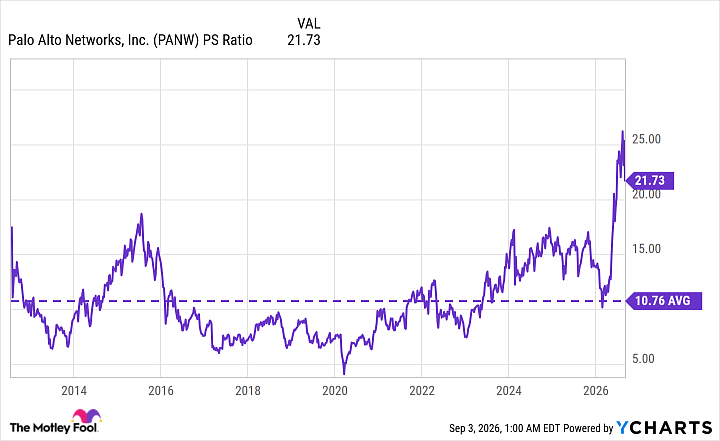
ing its blistering gains in 2026, Palo Alto stock now trades at a price-to-sales (P/S) ratio of 21.7, which is twice its average dating back to its initial public offering (IPO) in 2012.
PANW PS Ratio data by YCharts
Moreover, Palo Alto is now 3.5 times as expensive as the Nasdaq-100 index, which has a P/S ratio of 6.1. In other words, it looks significantly overvalued compared to a basket of America’s top technology companies.
Although Palo Alto has significant long-term growth potential based on management’s fiscal 2030 forecast for platformizations and NGS ARR, investors are pricing in a lot of that growth right now, leaving very little room for further upside in its stock over the next few years. As a result, investors might want to wait for a pullback before jumping in — if its P/S ratio falls back in line with its long-term average, that might be a good buying opportunity.
Read Next

•By Brett Schafer
Why Palo Alto Networks Stock Jumped 15% In August Before Falling This Week

•By Rich Smith
Why Palo Alto Networks Stock Crashed Today
•By Matt DiLallo
What Companies Does Amazon Own?

•By Matt DiLallo
Can You Invest in Wiz in 2026? Details & Alternatives to Consider

•By Rich Smith
Why Did Palo Alto Networks Drop Today?

•By Rich Smith
Why Palo Alto Networks Stock Just Popped
About the Author

Anthony Di Pizio is a contributing Motley Fool technology analyst covering artificial intelligence, cloud computing, autonomous vehicles, and enterprise software. Previously, Anthony was a licensed fund manager, stock broker, and corporate advisor. He holds a bachelor’s degree in commerce and economics from Macquarie University in Sydney, Australia, along with ASIC RG146 certifications in financial securities and derivatives.
Stocks Mentioned

Palo Alto Networks
NASDAQ: PANW
$331.94
(+1.05%)+$3.46

Motley Fool Stock Advisor’s Latest Pick
—% Avg Return

S&P 500 Index
SNPINDEX: ^GSPC
$7,747.71
(+1.06%)+$81.11
*Average returns of all recommendations since inception. Cost basis and return based on previous market day close.
Sumber Artikel:
Fool.com

