ByLela London,
Senior Contributor.
Forbes contributors publish independent expert analyses and insights.
Lela is a London-based writer and editor who covers food and drink.
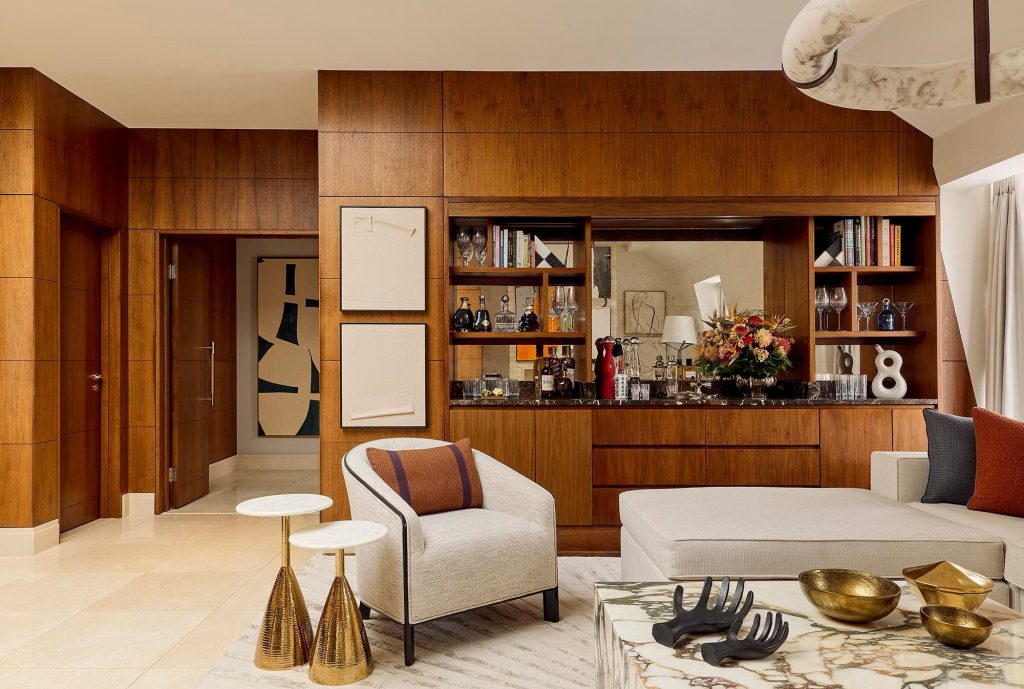
The living room, next to the dining room, in Conrad London St James’ new Conrad Suite, serving food from The Pem James McDonald
At the top end of London hospitality, the private dining rooms are moving upstairs.
For years, private dining in the capital has bounced between hidden rooms, typically tucked to the side of main restaurant floors, or kitchen-side chef’s tables. Both excellent, and still, a new category is beginning to emerge: dinner in a hotel suite, with restaurant-level food, and dedicated service. A new blend of room service, restaurant dining and the classic PDR.
“I think it sits somewhere between all three, but increasingly it feels its own category,” says Bernadette Gilligan, General Manager of Conrad London St. James. “It’s more elevated than traditional room service, yet more relaxed and personal than a private dining room or formal event space.”
Put simply, smart hoteliers are turning their suites into something more commercially and culturally sound. And Conrad London St. James’ newly-refurbished Conrad Suite is a brilliant example. “It was designed to feel much more a private residence than a traditional hotel suite, so creating a private in-room dining experience that reflects that felt a natural step,” says Gilligan.
The Pem’s Herdwick Lamb, served in the Conrad Suite
Jodi Hinds 2025
Crucially, the new suite experience is built around the kind of dining experience that would make sense downstairs. Exquisite, generous cookery from The Pem’s award-winning culinary team, served in a space that is, simply, ten times nicer for a group. There is a proper eight-seater dining room, separate from the kitchen and a gorgeous living space, meaning an evening can move the way a good evening should, without anyone hovering by the door or asking whether the table is needed back. Dedicated waiter, sommelier and bartender all included.
MORE FOR YOU
“A suite gives guests the feeling of hosting in their own home,” Gilligan says. “There’s a level of comfort, flexibility and privacy, where guests can choose the menu, the table setting and the level of detail that goes beyond what a private dining room can offer.”
The language here is important. Comfort. Hosting. Privacy. These are not the old cues of hotel room service, with its cloche-lifted practicality and midnight club sandwiches. This is luxury hospitality adapting to a guest who does not only want access to a good restaurant, but control over the conditions around it.
The Conrad Suite’s dining room
James McDonald
That line gets to the heart of why the format feels so current. Privacy has always been a luxury good, but the modern version is less about hiding and more about the details. The people in the room, how long the evening lasts, whether dinner becomes drinks, whether the music changes, whether children can go to bed nearby.
“Privacy is certainly part of the appeal, but what makes the suite unique is its ability to bring people together,” says Gilligan. “And because the suite connects to seven additional rooms on the same floor, it can effectively become a private floor within the hotel. For guests travelling as a family, it creates the opportunity to dine together in a beautiful private setting without ever needing to leave their own space.”
With that said, it’s also much harder to deliver than it looks. In a restaurant, the mechanics of service are built around the room. In a suite, the hotel is entering what the guest is meant to feel, temporarily, is their own space.
“The suite has a small galley kitchen which gives the team a useful space for finishing touches, but the bigger shift is really in the service choreography,” says Gilligan. “Everything has to be carefully considered, from timing and temperature to how the team moves through the space without disrupting the flow of the evening.”
The same idea is being explored elsewhere in London, though not always with the same hushed, Westminster polish. At art’otel London Hoxton, the Masterpiece Suite has become a high-rise answer to private entertaining. It can host around 12 guests for a seated dinner and around 30 for drinks, with food and drink coming from Solaya, the hotel’s truly fantastic Mediterranean restaurant.
“We’re seeing a clear shift in how guests want to use suites,” says Christian Masters, General Manager of art’otel London Hoxton. “They’re no longer just places to stay, but spaces to host, celebrate and create memorable experiences, and The Masterpiece Suite has been designed with that in mind. It gives guests complete privacy, incredible views across London, and the flexibility to personalise everything from dining to entertainment.”
The room leans into the theatre of it all, too: floor-to-ceiling windows, a backlit dining table, D*Face works across the space and, because subtlety clearly left the building, a statement motorbike installation. All of which could easily tip into gimmickry, but in the context of suite dining, it makes sense. If someone’s choosing a suite over a PDR, they’re also choosing a space that needs to have a restaurant-level aesthetic impact.
The dining area of art’otel London Hoxton’s Masterpiece Suite
art’otel London Hoxton
Aethos London, in Shoreditch, pushes the idea further into members’ club territory. Its Penthouse seats up to 22 for dinner, with the Aethos café menu as the standard catering option and Mitsu available on request. For smaller groups of up to eight, the hotel can arrange a chef-led dinner where guests watch the cooking in the kitchen area. “People still want great food and service, but increasingly they’re looking for something that feels more personal, more social and a lot more fun than a traditional private dining room,” says Jake Greenall, General Manager of Aethos London.
Yet another PDR is suite’s clothing, sure, but also a place for an evening to loosen its tie. Cocktails on the terrace, dinner at the table, drinks afterwards, then – should the host-cum-guest fancy it – a private DJ and a bit of a dance.
“We believe the best nights rarely stay in one room,” says Greenall. “That’s exactly why our Penthouse works so well. It allows guests to host and curate an entire evening the way they would at home.”
The dining area in Aethos London’s Penthouse Suite
Aethos London
Different as each hotel’s offering currently is, they’re united by a sophisticated understanding of private dining’s potential. Its authorship. Its softening of formality, without losing out on service or gastronomy. Its ability to make a guest feel the host, while the hotel takes care of everything that usually makes hosting exhausting.
“What we’re seeing is that guests tend to be more focused on the overall experience than on individual elements,” says Gilligan. “Rather than booking a table for dinner, they’re creating an occasion around the entire evening. The suite naturally encourages guests to linger, entertain and enjoy the space in a way that’s different from a traditional restaurant setting.”
It also gives hotels a more flexible way to monetise their most valuable spaces. A suite can be sold for tourism, as always, but also to locals, as a private dining room, a party venue, a chef’s table, et al. And In a market where luxury travellers are increasingly seeking experiences that feel personal rather than merely premium, that matters more than many realise.
Editorial StandardsReprints & Permissions
LOADING VIDEO PLAYER…FORBES’ FEATURED Video
Sumber Artikel:
Forbes.com