If you asked AI to create someone with the perfect résumé to help popularize the sport of soccer in the U.S., the result would be very close to Roger Bennett.
Born and raised in Liverpool, a lifelong Everton supporter who grew up in thrall of American pop culture.
Moved to the U
S. after college and made the country his home, eventually becoming a citizen and publishing a memoir called (Re)born in the USA.
Started the Men in Blazers podcast (that name a playful nod to the tradition of sportscasters and pundits wearing blazers) on ESPN in 2010 after realizing that almost no one in American journalism knew a damn thing about soccer, especially the elite leagues of Europe.
Grew that eccentric little pod into a full-blown independent media network, with a TV show on NBC, documentaries, live events, a steady stream of partnerships with major brands, 97 full-time employees, and 15 additional podcasts.
Raised outside money, a $15 million Series A in 2025, to expand coverage ahead of the 2026 FIFA World Cup, running in 16 cities across North America
Bennett and I sat down in Fast Company’s Manhattan offices in late March, three months ahead of the start of the World Cup, during the relative calm before that storm, the day before he flew to Atlanta for a Men in Blazers event with Big Boi, formerly of OutKast. We traced the growth of Men in Blazers (which, not coincidentally, tracks the growth of soccer in America), the unique way the network works with brands (Marriott, Michelob Ultra, Visa, Unilever, and others mentioned below), the significance of this moment for his business, the tensions inherent in the Americanization of the world’s most popular game, and more.
This interview has been edited and condensed. You can hear the full Office Hour audio version wherever you get your podcasts.
I feel soccer has been America’s sport of the future my entire life.
It has. It’s always been about to happen. This World Cup is the moment that’s going to turn it into the sport of the now.
How do you describe the Men in Blazers Media Network
We’ve been America’s leading soccer podcast, which has become YouTube, which has become a television show. We cover men’s soccer; we cover women’s soccer, which is the fastest-growing area of the sport in the U.S. We have a Hispanic platform, Vamos, which engages the second- and third-generation football fan in the U.S. And ultimately, wherever a ball is being kicked all over the planet, we become the biggest community engaging that football passion.
So how did you parlay your passion for soccer into a business?
There was an amazing moment that changed my life
In 2006, I was watching the World Cup on ESPN. It was the first time they’d really invested in it—a live broadcast of every game. And for the commentators—they just jerry rigged baseball commentators and flung them into action. And I thank Dave O’Brien, the esteemed baseball commentator, because when England came on the field that day, he said, “The world’s most famous soccer player, Charlie Beckham, takes the field.” And I screamed: “Oh, my God, if only they had people who knew what they were talking about covering the sport in this nation.” My wife, who was just humoring me, said, “Why don’t you do it, love?” So I did.
I wrote about how if ESPN had real coverage, the sport would fulfill its potential, and ultimately that got to [then-ESPN vice president] John Skipper, and he offered us a podcast on ESPN. We didn’t know what a podcast was. We had first-mover advantage because podcasts had just started. It felt we were just kids speaking into cans with string attached. But the podcast created a really intimate engagement with our fan base. We couldn’t believe how large the audience was that had been yearning to connect to football, to a regular conversation, to each other. The second guest we ever had, on our second day, was Liam Neeson. I was , “Oh, my God, what’s he doing on this janky little podcast?” People just wanted to connect to each other, to unleash their passion, to talk with real joy.
How much did you get paid for those early episodes?
Two hundred fifty dollars an episode
My beautiful wife, God bless her, she’d always say, “How much is it bringing in?” I’d be , “It’s a loss leader.”
What else were you doing for money at this time?
I was writing books about culture, writing books about anything I could think of. And the podcast business early on—I mean, it was hard for media companies to work out what the value was.
There really wasn’t any advertising to speak of yet
Early on, we began the show by pivoting from the [warm-up banter] to the football, and we’d mark that by opening a can of beer into the microphone. We picked a random beer that just made us laugh called Boddingtons, which is an English Mancunian beer. And after a couple of episodes, we got approached by Boddingtons. They said, “We sold out in three states—Arizona, Nevada,” and there was one other I can’t remember. “We couldn’t work out why there was a sudden rush on Boddingtons, and we’ve traced it back to you clowns.” And I thought, great. My Spidey business senses were , Okay, let’s negotiate, Boddingtons. We’re doing good business for you. Let’s talk about it. They said, “Oh, we have no money. Our brand was taken over in a rollup of the beer industry; no one in our ownership group cares about Boddingtons. It’s a zero-dollar marketing budget.” I’ve rarely gone from more excited to more deflated without watching football in my life.
Fifteen or so years later, your brand partnerships are extensive. Tell us what that means for the revenue picture for the Men in Blazers Media Network. How much do these partnerships drive what you’re doing?
The football audience is coveted
It’s young. It’s deeply connected. We’ve done brand-lift studies, and [the audience] feels a sense of gratitude to the brands that are investing in the sport.
We’ve spoken to a lot of brands in this run-up to the World Cup and encouraged them to get in as early as they can, in as thoughtful ways as they can. There’ll be a lot of brands charging into the field about a week before the World Cup Steve Buscemi with a skateboard over their shoulder: “Hello, fellow soccer fans!” The brands that have put in the time and effort, there’ll be a two-way relationship between them and the football fan base.
We work with Anheuser-Busch, Bank of America, Home Depot. We’ve worked with Verizon for a long time. These blue-chip brands are coming in to own the fan base, the men’s and the women’s. We become a real platform of joy because we have an ecosystem, ultimately, and then the brands can almost become characters—living, breathing characters—within that ecosystem. And that’s what’s allowed us to really drive the business.
Do you have to sell these brands hard, or are they just looking for a way to associate themselves with this growing sport in the U
S.?
By 2030, the football audience in the United States will be the perfect mirror to the diverse nation that we are. Football allows you to do anything, to touch any audience. Look at the example of a bank. A bank, by being part of football, can speak to high-net-worth individuals, with their elite card products, and also to a mass market at the same time, through the same sport. It allows you to have diverse aims.
Do we have to sell hard? No. But do we have to deliver? Yeah. I mean, that’s ultimately it. Our name is all that we have.
Let’s talk about your evolution as a creator of books and podcasts and now a sprawling media company
Football in America is a deeply passionate pursuit. Look, the secret of our success has been that we also know football is at its best when it transcends football. We’re always trying to bring a sense of joy, sense of upside, sense of value, sense of meaning in our world of challenge. The joy of football allows you to feel things, to feel alive, to feel emotions. I always joke that I’m dead inside, but when I watch football, I feel happiness, grief, victory, defeat that most people feel in real life, but I am immune to.
There was a football CEO who came on our show early on. A gentleman who runs a club that had been very, very lowly forever, and he brought them into the Premier League. And I stole so much of what I know about leadership from him. He said that on his first day, he got the staff there and just said to them, “We’re going on a journey. It’s not a journey for everybody. It’s not a journey that all of us are going to be on.” And that’s ultimately the way we’ve operated.
A lot of my role is culture building
One of the things that gives me the most joy is—we have someone who joined us as an audio editor who taught themselves how to be a video editor and now runs the whole content side, has 12 human beings reporting to them. We’ve got scriptwriters who taught themselves to be showrunners. We’ve got consultants that came in and now run our partnerships division.
Let’s talk about the Americanization of the world’s most popular sport—the pros and the cons.
That’s a whole conversation in its own right. What can I say? This story of America and football has been the major narrative of my lifetime.
I moved here right before the 1994 World Cup
When the United States was awarded [it, back in 1988]—which for any other nation in the world would be an honor and a joy—Jack Kemp, the former NFL quarterback and congressman, felt compelled to take to the floor of Congress and say he thought it was really important to remind America’s youth that football is where you rush with it, throw it, and catch it—not kick it. Basically: Our football is American capitalism, theirs is European socialism.
That’s yesterday’s news, and that journey has been remarkable to witness. Part of that journey has been the build of an audience [for Men in Blazers], the build of a business, which is beautiful. All I can say is it’s no longer a loss leader.
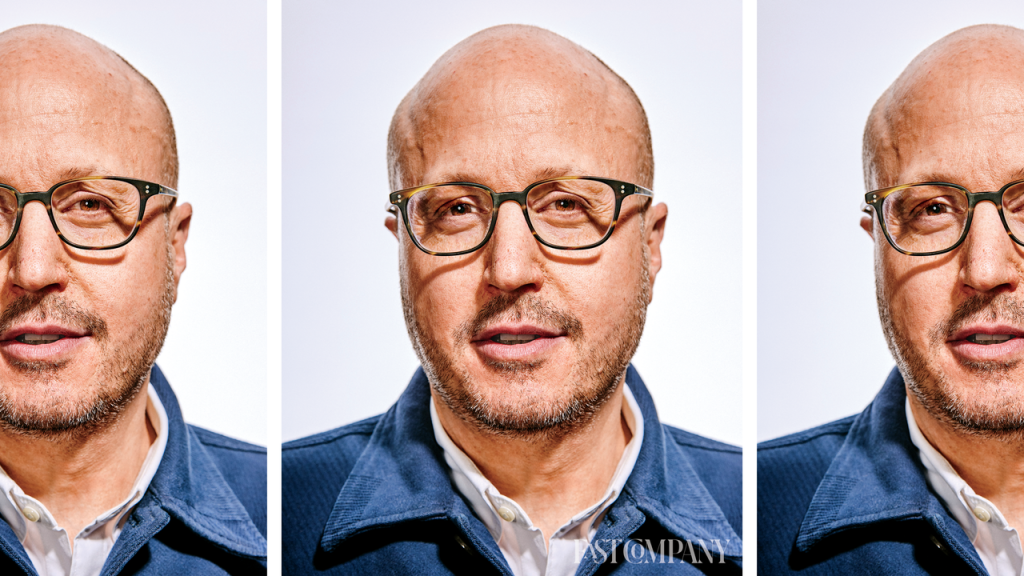
Name: Roger Bennett Title: Founder and CEO, Men in Blazers Media Network Education: Liverpool College; University of Leeds Soccer Books: The ESPN World Cup Companion: Everything You Need to Know About the Planet’s Biggest Sports Event; Men in Blazers Present: Encyclopedia Blazertannica: A Suboptimal Guide to Soccer, America’s “Sport of the Future” Since 1972; (Re)born in the USA: An Englishman’s Love Letter to His Chosen Home; Men in Blazers Present Gods of Soccer: The Pantheon of the 100 Greatest Soccer Players (According to Us); We Are the World (Cup): A Personal History of the World’s Greatest Sporting Event [Photo: Ben Berkes]
American investors have fallen in love with the sport
And on the other side of the World Cup, we are about to enter the American century in terms of football. The English Premier League, the best league in the world, is now majority-owned by American investors. Manchester United is owned by the Tampa Bay Buccaneers’ owners, the Glazers. Chelsea is owned by the Dodgers’ owner [Mark Walter], Clearlake Capital, and Todd Boehly. Liverpool is owned by the Boston Red Sox [Fenway Sports Group led by John Henry].
But they’re transforming it forever. And there is that tension—the most fascinating tectonic plate that will drive the future of football between this vast global audience that I am part of and [the game in America]. I’ll give you an example. The head of UEFA, the European organizing body, came on my show and said that having the Champions League final—which is the Super Bowl, the apogee of European football—could be possible in New York City.
The outcry was enormous, instant. European football fans said, “What are you doing? This is us. This is a manifestation of us. You can’t sell it to the American audience.” But will there be a date when the Champions League final will be in America? I would be shocked if that doesn’t occur.
And so the very thing that’s made it possible, this upsurge that’s driven our business, is also the thing that’s going to transform it forever
If I want to consume the World Cup entirely through the lens of the Men in Blazers Media Network, what will that look ? How are you planning to cover this event?
By sea, by land, by air. We have a bus, which we’re driving across the United States from sea to shining sea with Home Depot, which is a remarkable supporter of football in the United States. To be an English kid who saw John Madden drive that bus of his—to have our own bus with our logo on the side, it’s deeply meaningful.
We’re going from city to city doing live shows
Part of the driver of our growth is we’re really good storytellers. I am filled with self-loathing, and I don’t to praise ourselves, but we’re really good storytellers. Our most regular guests—John Oliver, Matthew McConaughey, Eva Longoria, Joel Embiid, and the —we know their time is short. When they come on, we want to make them sound poet laureates, or Pulitzer Prize winners for poetry. We’re going to let off all our fireworks at once as we move across the United States and end up here in New York City, where the World Cup final is going to be.
It’s a good thing you don’t have to pay for tickets.
I’ll hook you up, Brendan. (He lies, and you never hear from him again.) Ultimately, to be honest, the hard work begins once the World Cup’s over. There’ll be this massive audience—
But it always falls off
Well, it does and it doesn’t. Our story of growth has been one of every World Cup—a wave leaving flotsam and jetsam behind on the beach. Which is now a massive audience. Getting ahead of that and trying to work out what this audience will want on the other side of it is the intriguing part. In many ways, we’re only just getting started.
Sumber Artikel:
Fastcompany.com